



Legato

With
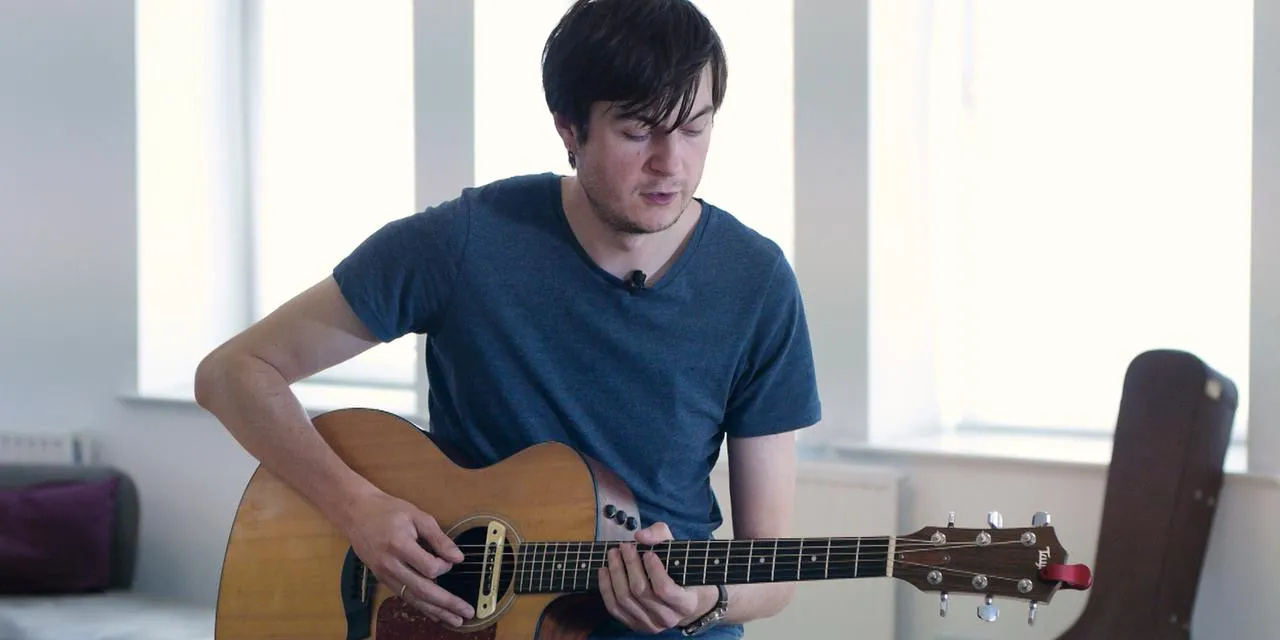
James BarrattJames Barratt teaches legato on guitar, using hammer-ons and pull-offs across open and fretted notes to play smoothly without picking every note.
What's in the course
14 lessons (2h 12m) · 1 free
01. Tuning
13:34
02. Getting started
Free lesson9:58
03. Basic technique
9:01
04. Open chords
6:24
05. Chord progressions
7:57
06. Rhythm & the right hand
11:56
07. REM - Everybody Hurts
9:01
08. Bryan Adams - Run To You
3:23
09. Palm muting
3:16
10. Legato
You are here8:47
11. Michael Jackson - Beat It
5:23
12. Bending
15:36

13. Barre chords
11:35
14. Summary - AC/DC Back In Black
16:56
Lesson transcript
Left Hand Technique: Legato
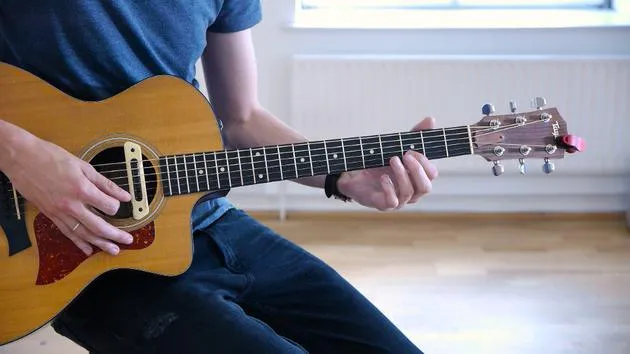
We're going to move on now to a left hand technique, specifically a style of playing called legato. In guitar, legato comprises two main techniques:
- Hammer-ons
- Pull-offs
Hammer-ons
A hammer-on occurs when we play a lower pitch note, pick it, and then transition to a higher pitched note.
- For example, if we're playing the third fret from open E:
- Normally, we pick the E note.
- In legato style, we pick the E and then use our left hand to hammer onto the fretboard without picking with our right hand.
This technique gives you a much smoother sound over the course of a lick, making it very different from picking every note.
Pull-offs
Conversely, a pull-off is the opposite of a hammer-on.
- In this case:
- We pick the higher pitch note (like the third fret) and then use our left hand to pull off, often to an open string.
- For example, we pick the third fret and pull off to an open E.
E Minor Pentatonic Scale
Next, we'll use the framework of the E minor pentatonic scale. This scale should be familiar to you.
- Instead of picking every single note:
- Hammer-on to the second note on the way up.
- Pull-off to the second note on the way down.
This will give you a different sound that's commonly used in guitar playing.
Notation for Hammer-ons and Pull-offs
In tablature, hammer-ons and pull-offs are shown by:
- A little bracket between the two notes.
- Alternatively, you might see a small H for hammer-on or P for pull-off.
Advanced Technique: Fretted Notes
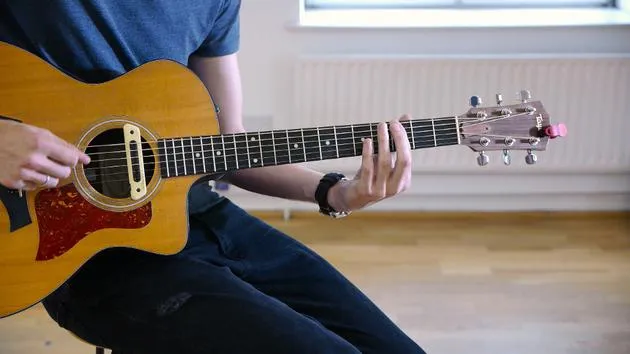
Now we're going to take this a step further and apply hammer-ons and pull-offs but with only fretted notes.
- Starting on the third fret of the B string, we will hammer on and pull off between two fretted notes.
- For example, we'll hammer on from the third fret on the B string with our third finger, then proceed to do the same on the next string.
Practice Routine
- We should duplicate that to get a full bar, counting 1 and 2 and 3 and 4.
- In the second bar, we'll practice going from hammer-ons to pull-offs.
- For this, we'll pick the last note (the A) and pull off to a fretted note.
Key Tips:
- For pull-offs, it's essential to have two fingers on the same string to prepare for the pull-off.
- Common Misconception: It's easy to assume that "pull off" means pulling upwards. Instead, you should pull off to the side to generate the necessary energy that your right hand would have provided with the pick.
Exercise Caution
- When practicing on middle strings, be careful to avoid accidentally fretting an open string while pulling off.
- A common mistake is catching your pull-off finger on the next string down.
Extra Exercise
Here's a great exercise to improve your accuracy with hammer-ons and pull-offs:
- Make sure your placements on the frets for the hammer-ons are crisp.
- For the pull-offs, think of it as flicking an elastic band onto the back finger.
- Remember to pull off to the side, not outwards!
Volume Consistency:
Aim to maintain an even volume across your notes. You don't want a loud pick note followed by a very quiet hammer-on or pull-off. Strive for an even dynamic throughout your playing.
Increasing Difficulty
Now, let's take it up a notch with a new exercise.
One String: Hammer-ons and Pull-offs
We'll perform the following exercise only on one string:
- Fingering: Line your fingers up on frets 5, 6, 7, and 8, with each finger on its respective fret.
- Picking: Only pick the very first note of this exercise. The volume for the rest of the lick must come from hammer-ons and pull-offs.
Performing the Exercise:
- Start by picking the note with your little finger at the eighth fret on the E string.
- Pull off to the first finger (third fret).
- Hammer on back up to seventh and then to eighth fret.
Reverse the Process:
- Pull off to the third finger and finally to the first finger again.
This lick is self-sustaining; once you've initiated it with your right hand, you can keep going using just hammer-ons and pull-offs.
Final Thoughts
Start this exercise slowly to ensure accuracy and gradually increase speed as you gain comfort. It's an excellent workout for finger strength and precision! Good luck, and have fun!
14 lessons
2h 12m of structured video lessons
Advanced video features
Slow down, loop a passage, follow along
Mobile, tablet & desktop
Practise wherever you are
100% satisfaction guarantee
30-day money-back guarantee
Meet your guru
Meet your guru
James has enjoyed a successful career as a full-time musician since graduating from the Academy of Contemporary Music in 2007. He has gone on to work with artists and producers from Stereophonics, Ronnie Dunn, Scissor Sisters and many more. He also composes music for television and film, such as Sony Walkman's 'Music Pieces' television commercial and the Albatross film trailer.
He refers to himself as something of a purist, a musicians' musician if you will, and this approach to his artistry has sparked attention from big corporations and TV producers. James can be heard during shows such as 'Geordie Shore' and even in adverts for the British Heart Foundation, thanks to his natural versatility as an artist. As he puts it: "The best, and most frequent, compliment I get when on sessions for clients is that I play what's 'right' for the music. Often it's all down to simplicity."
"James is the real deal. Great player, killer tone, and I wouldn't hesitate for a second recommending him for any project. Rock on James!" - Joey Sykes (Meredith Brooks / Will Champlin / The Babys)
In Foundations of Rock Guitar Technique, James passes on exactly that philosophy, showing you how to build solid, musical rock guitar technique and play what's 'right' for the song.







