



Michael Jackson - Beat It

With
James BarrattPut your legato to work on the main riff from Michael Jackson's 'Beat It', combining hammer-ons and pull-offs with your first slides.
What's in the course
14 lessons (2h 12m) · 1 free
01. Tuning
13:34
02. Getting started
Free lesson9:58
03. Basic technique
9:01
04. Open chords
6:24

05. Chord progressions
7:57
06. Rhythm & the right hand
11:56
07. REM - Everybody Hurts
9:01
08. Bryan Adams - Run To You
3:23
09. Palm muting
3:16

10. Legato
8:47
11. Michael Jackson - Beat It
You are here5:23
12. Bending
15:36

13. Barre chords
11:35
14. Summary - AC/DC Back In Black
16:56
Lesson transcript
Guitar Lesson: Incorporating Hammer-Ons, Pull-Offs, and Slides
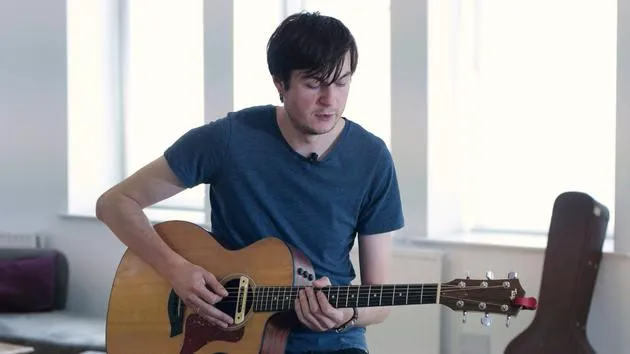
Okay, so we're going to take a little look at another part of a song now that is going to allow us to incorporate some hammer-ons and pull-offs into the real world and also some slides, which is another form of legato that we've not looked at today, but we're going to look at now.
The Riff: Michael Jackson's Beat It
I'm sure you've heard this song. I'm going to play it for you now. Here we go!
This is a great riff to encompass what we've covered in this lesson. It includes:
- Lots of hammer-ons
- Lots of pull-offs
- The odd slide as well
We're going to get a chance to look at slides.
Starting Off
- Begin on the bottom string with the open E.
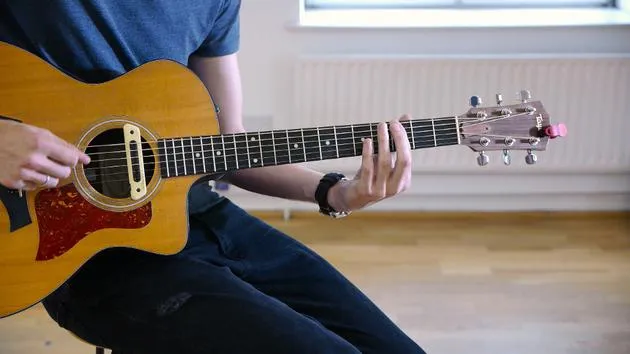
- Hammer on to the G note (third fret on the E string) using your second finger.
- Play the second fret on the A string with your first finger.
- Skip over with your right hand and play the open G string with an upstroke.
This gives us this movement.
- Fill in the skipped string with the second fret on the D string.
That is the first phrase of the riff!
Tips for Learning the Riff
I highly recommend breaking up the riff into smaller, bite-sized chunks. For me personally, it really helps to learn a new riff quicker by breaking it down into chunks of four or five notes.
If you can clearly define a phrase, use the individual phrases. This approach really helps, rather than just trying to learn the entire riff at once, which probably won't work as well.
Remember: Breaking it down into smaller chunks can be applied to absolutely anything you do on the guitar. You'll hopefully find that you pick things up a lot quicker by doing that.
Adding Slides
Now that we've looked at the first part of the riff, let's get into our first slide:
-
Pick the second fret again and, while keeping pressure on the D string, slide up two frets to the fourth fret.
- Important: Do not release the pressure off the D string; otherwise, the note won't sound when you get there.
-
Slide back to the original position.
- Again, do not pick it again. Use the same volume and energy from earlier when picking the second fret.
Practicing the Slide
It can take time to get used to stopping at the right place. Initially, you may go a bit short or a bit far. To practice this:
- Pick a string and a fret, then pick a target note.
- For example: Start with a target of five to eight and loop it around a few times.
- Try with different fingers and experiment with different distances (smaller and larger).
You'll soon get used to controlling that feeling. Also, remember to practice going the other way (from 8 to 5).
Continuing with the Riff
Once we've slid back down to the second fret, the next step is to:
- Pull off to the open D. This section is all legato:
- A slide up
- A slide down
- A pull-off to open D
After that, pick the open D again. This covers the first loop around the riff.
Repeating the Riff
When you repeat the riff a second time, the only difference is:
- Pick the D string once at the end instead of twice.
- The first time around, you pick it again; the second time, you only do the pull-off and do not pick it again.
Good luck with getting that together!
Final Thoughts
Incorporate all your hammer-ons, pull-offs, and slides as you practice. I'll see you in the next lesson. Good luck!
14 lessons
2h 12m of structured video lessons
Advanced video features
Slow down, loop a passage, follow along
Mobile, tablet & desktop
Practise wherever you are
100% satisfaction guarantee
30-day money-back guarantee
Meet your guru
Meet your guru
James has enjoyed a successful career as a full-time musician since graduating from the Academy of Contemporary Music in 2007. He has gone on to work with artists and producers from Stereophonics, Ronnie Dunn, Scissor Sisters and many more. He also composes music for television and film, such as Sony Walkman's 'Music Pieces' television commercial and the Albatross film trailer.
He refers to himself as something of a purist, a musicians' musician if you will, and this approach to his artistry has sparked attention from big corporations and TV producers. James can be heard during shows such as 'Geordie Shore' and even in adverts for the British Heart Foundation, thanks to his natural versatility as an artist. As he puts it: "The best, and most frequent, compliment I get when on sessions for clients is that I play what's 'right' for the music. Often it's all down to simplicity."
"James is the real deal. Great player, killer tone, and I wouldn't hesitate for a second recommending him for any project. Rock on James!" - Joey Sykes (Meredith Brooks / Will Champlin / The Babys)
In Foundations of Rock Guitar Technique, James passes on exactly that philosophy, showing you how to build solid, musical rock guitar technique and play what's 'right' for the song.







