



Open chords

With
James BarrattJames Barratt walks through nine of the most common open chord shapes on guitar - the foundation for playing hundreds of songs.
What's in the course
14 lessons (2h 12m) · 1 free
01. Tuning
13:34
02. Getting started
Free lesson9:58
03. Basic technique
9:01
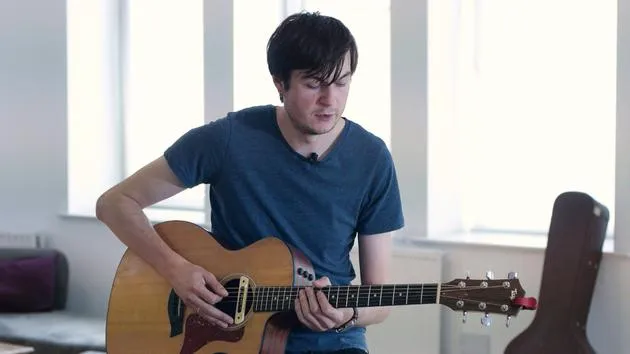
04. Open chords
You are here6:24
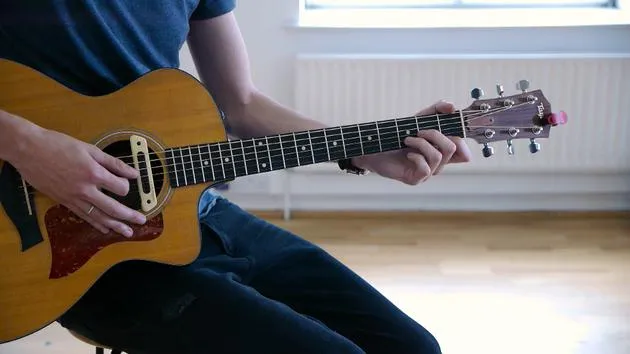
05. Chord progressions
7:57
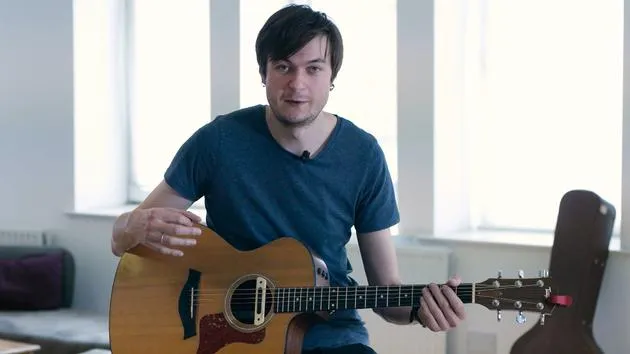
06. Rhythm & the right hand
11:56
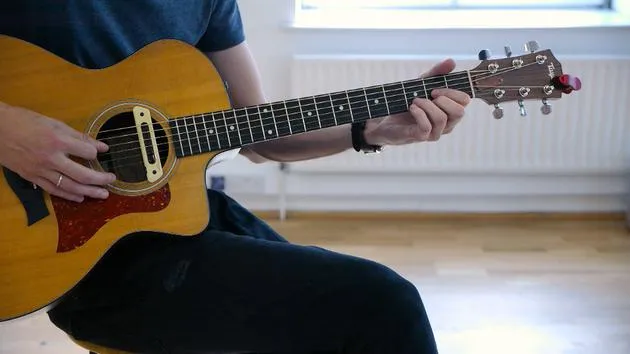
07. REM - Everybody Hurts
9:01
08. Bryan Adams - Run To You
3:23
09. Palm muting
3:16
10. Legato
8:47
11. Michael Jackson - Beat It
5:23
12. Bending
15:36
13. Barre chords
11:35
14. Summary - AC/DC Back In Black
16:56
Lesson transcript
Music Lesson: Open Chords
Hey, guys!
So in today's lesson, we're going to be talking all about open chords. We've got a lot to get through here, and I feel it's going to be a slightly longer one.
Overview of Open Chords
We've got nine shapes that I want to talk you through. These are really, really common, and if you can master these shapes and get comfortably between them, you can literally play hundreds of songs. I'm not joking. These are fundamental chords, and I hope you're going to enjoy them.
A Major Chord
Let's start now with an A major chord:
- Fret the second fret on the D string
- Fret the second fret on the G string
- Fret the second fret on the B string
Use your first, second, and third fingers.
Important: There are chord boxes for all of these chords in the downloadable PDF. For this chord, make sure that we don't strum the bottom E string. We want to avoid that one, so our right hand will strum from open A downwards.
When you're learning these new chords, or any new chords, I always find it helpful to pick down the strings individually. This way, you can immediately tell if one of your fingers isn't quite on its fingertips enough, or if you're not pushing down hard enough.
For example:
- If the B string isn't ringing as it should, ask yourself:
- Am I not pushing hard enough?
- Am I not on my fingertips?
- Is another finger blocking it?
You can usually figure it out this way. If you were to simply strum down, you might get away with a few strings not ringing out. If you're not used to how it's supposed to sound, you might think you've got it when, in fact, it needs a little more work.
I highly recommend practicing by playing the strings individually first, and then strumming once you're sure that you've got all the notes in there.
C Major Chord
Moving on, let's look at the C major chord. This one can be a bit of a stretch:
- First finger on the first fret of the B string
- Second finger on the second fret of the D string
- Third finger on the third fret of the A string
Just like with the A major, you can see in the chord box that there's an X above the E string, indicating we don't want to strum that string. We will strum from the A string downwards as well.
Make sure all your notes are nice and clean. Ensure your fingers are on their fingertips and you're not being flat. If your fingernails are even remotely long, you'll struggle to get on your fingertips, so unfortunately, they need to be nice and short.
D Major Chord
Next, we have a D major chord. This shape looks like a triangle:
- First finger on the second fret of the G string
- Second finger on the second fret of the E string
- Third finger on the third fret of the B string
For this chord, we want to avoid both of the bottom two strings, so avoid the E and A strings with our right hand. We want to hear the open D string, so strum from the D string downwards.
Remaining Chords
Now, I'm going to play through the remaining six chords:
- E major chord
- G major chord
- C add 9: This is slightly different, but I've included it for a reason that will hopefully become clear later. It's very simple, take your G shape and move your top two fingers down. It adds an extra note, making it a nice and common chord.
Minor Chords
Moving on to the minor chords:
-
A minor:
- It uses the same finger shape as the E major, but the fingers are moved down a set of strings.
- Fret the second fret on the D and G strings, and the first fret on the B string.
- Avoid the E string when strumming.
-
D minor:
- Fret the second fret on the G string, third fret on the B, and first fret on the E string.
- For this one, play only the top four strings.
-
E minor:
- This is a two-finger job:
- Fret the second fret on the A string and second fret on the D string with your first and second fingers.
- For this chord, you want to strum all six strings.
Practice and Application
Before moving on to the next part of the lesson, spend some time practicing these chords.
- Get the fingerings correct.
- Make sure you associate the right name with the right shape.
Not always will you see the chord box in the music. When learning a song, it might only specify a progression: C major, D major, G major, and that's all the information you're given. So, it's essential to know what these shapes are or how to play a version of them.
Next, we're going to look at joining these chords together, which is where they start becoming useful, allowing us to move towards playing some songs!
14 lessons
2h 12m of structured video lessons
Advanced video features
Slow down, loop a passage, follow along
Mobile, tablet & desktop
Practise wherever you are
100% satisfaction guarantee
30-day money-back guarantee
Meet your guru
Meet your guru
James has enjoyed a successful career as a full-time musician since graduating from the Academy of Contemporary Music in 2007. He has gone on to work with artists and producers from Stereophonics, Ronnie Dunn, Scissor Sisters and many more. He also composes music for television and film, such as Sony Walkman's 'Music Pieces' television commercial and the Albatross film trailer.
He refers to himself as something of a purist, a musicians' musician if you will, and this approach to his artistry has sparked attention from big corporations and TV producers. James can be heard during shows such as 'Geordie Shore' and even in adverts for the British Heart Foundation, thanks to his natural versatility as an artist. As he puts it: "The best, and most frequent, compliment I get when on sessions for clients is that I play what's 'right' for the music. Often it's all down to simplicity."
"James is the real deal. Great player, killer tone, and I wouldn't hesitate for a second recommending him for any project. Rock on James!" - Joey Sykes (Meredith Brooks / Will Champlin / The Babys)
In Foundations of Rock Guitar Technique, James passes on exactly that philosophy, showing you how to build solid, musical rock guitar technique and play what's 'right' for the song.







