



Adding Jazz Harmony to the Blues

With
Ollie WestonOllie Weston shows how bebop players reharmonised the 12-bar blues - adding ii-V-I movement and extra changes to turn it into a jazz blues.
What's in the course
47 lessons (1h 48m) · 1 free
01. The V-I 'Perfect' cadence
3:28
02. Dominant 7 - Cycle of 5ths exercise
1:24
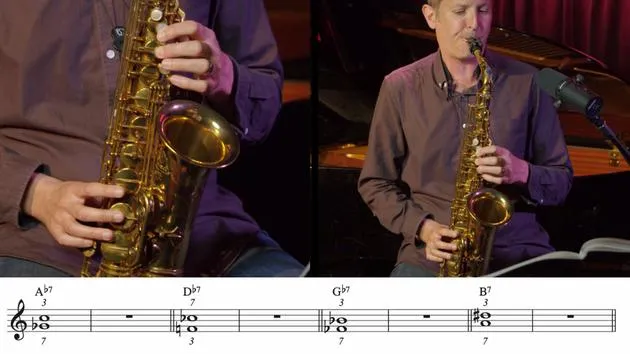
03. Dominant 7 - Cycle of 5ths using 3rs and 7ths
2:16
04. Rhythmic variations using 3rds and 7ths
2:02
05. "Rhythm Changes" using Dominant 7ths and Cycle of 5ths
1:08
06. The II-V-I progression
1:20
07. II-V-I licks in the style of Parker, Coltrane, Adderley
Free lesson4:15
08. Dancing With Duke (II-V-I exercise) - Introduction
1:15
09. Dancing With Duke (II-V-I exercise) - Performance
4:38
10. II-V-I progression conclusion
0:42
01. Finding the relative minor
1:41
02. Using the Harmonic Minor over the V chord
1:15
03. V-I in A Minor with a b9
4:38
04. Minor V-I in all 12 keys exercise
1:43
05. Phrase for practising minor cadences
1:17
06. Minor II-V-I in a chord sequence
5:04
07. Adding the II chord
1:20
08. Autumn Sun - Introduction and Harmony
3:03
09. Autumn Sun Performance
4:44
01. Introduction to Standards
0:52
02. Among the Stars Introduction
3:54
03. Among the Stars Performance
4:23
04. Undying Love - Expanding a chord sequence
4:42
05. Undying Love - Performance
1:12
06. Undying love - Checkpoint
0:47
07. Take the Express Train - The Turnaround
3:21
08. Melodic line examples for turnarounds
1:22
09. Take the Express Train - Introduction
1:28
10. Take the Express Train - Performance
1:12
11. Take The Express Train - Summary
0:39
01. Introduction to Bebop
1:04
02. 52nd Street Blues - Introduction and Head
0:29
03. 52nd Street Blues - Head using I-IV-V progression
0:45
04. 52nd Street Blues - Adding Chromaticism
2:53
05. Adding Jazz Harmony to the Blues
You are here2:39
06. 52nd Street Blues - Head with II-V-I changes
1:05
07. 52nd Street Blues - Performance
3:01
Lesson transcript
Adding Detail to Bebop Progressions
So as well as melodic invention, bebop players added extra detail to their chord progressions as well.
Evolution of the 12-Bar Blues
Far from being just chords I, IV, and V, the 12-bar blues evolved under bebop to have a little bit more detail. Let's look at a few areas where the changes are different:
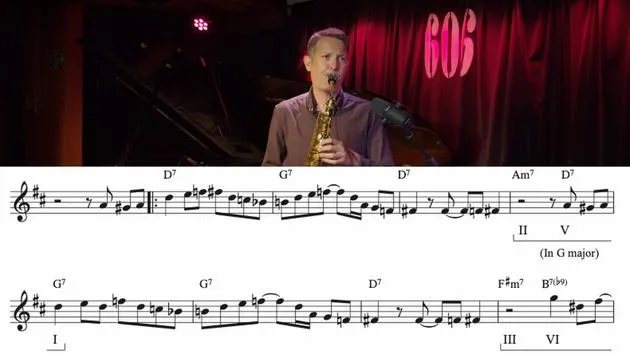
- In the last four bars of the progression, we're used to going:
- Chord V
- Chord IV
- Chord I
Bebop players wanted to make the progression sound more like a jazz progression. So we're going to go 2, 5, 1.
- In this key, we're going to play:
- E minor
- A7
- And back to D.
Adding Further Detail
To add further detail, we're going to prepare our two chord in bar nine with a three, six.
- If you have a look in bar eight, I've put:
- A minor
- 2, 5, 1 into E minor.
So we're adding extra layers of detail to the fundamentally quite simple blues sequence, giving it a new kind of sheen of bebop detail.
Transition from Chord I to Chord IV
There's just one other area I'm going to look at, which is the transition in bar four from chord I to chord IV.
- We're going from D7 to G7.
Bebop players thought they could actually make that a 2, 5, 1 as well. So instead of just going D7 up to G, we're going to put a 2, 5, 1 into G.
- I'm going to go:
- A minor
- D7
- Into G7.
Check out Figure 10.5, which has these extra harmonic layers added.
Bringing It All Together
Here's the head with the rhythm section playing the extra chords.
With my chromaticism, heavy articulation of my offbeat phrasing, short notes, and extra harmony, I've turned traditional I, IV, V, III chord blues into something a little bit more detailed and evocative with bebop.
47 lessons
1h 48m of structured video lessons
Advanced video features
Slow down, loop a passage, follow along
Mobile, tablet & desktop
Practise wherever you are
100% satisfaction guarantee
30-day money-back guarantee
Meet your guru
Meet your guru
Since graduating from the Leeds College of Music (BA Hons) and the Guildhall School of Music (Post Graduate Diploma in Performance), Ollie has built a busy and varied career in music. As a saxophonist he has performed in live and studio settings with artists as diverse as Amy Winehouse, Tim Minchin, Bonobo, Frank Turner, the London Jazz Orchestra, the Hackney Colliery Band, the Ambient Jazz Ensemble and the Nelson Riddle Orchestra. He is also the co-leader of the jazz quartet 'Time Is Of The Essence', and composes and arranges material for this and other ensembles.
Ollie is active in music education, currently as course leader for the jazz department at the Guildhall School of Music and Drama (junior school), where he runs jazz ensembles, big band and theory classes. He has written a series of 'Exploring Jazz' books for Schott Music that are published worldwide and feature on exam syllabuses in the UK. Ollie has also run workshops for Oxford University, Pro Corda Strings and BABSWE, as well as the Guildhall School of Music summer schools.
In his Exploring Jazz Saxophone courses, Ollie takes you from getting started right through to soloing confidently over songs and chord sequences, building the improvising skills that put a real jazz player's vocabulary at your fingertips.







