



2. Warming Up
With
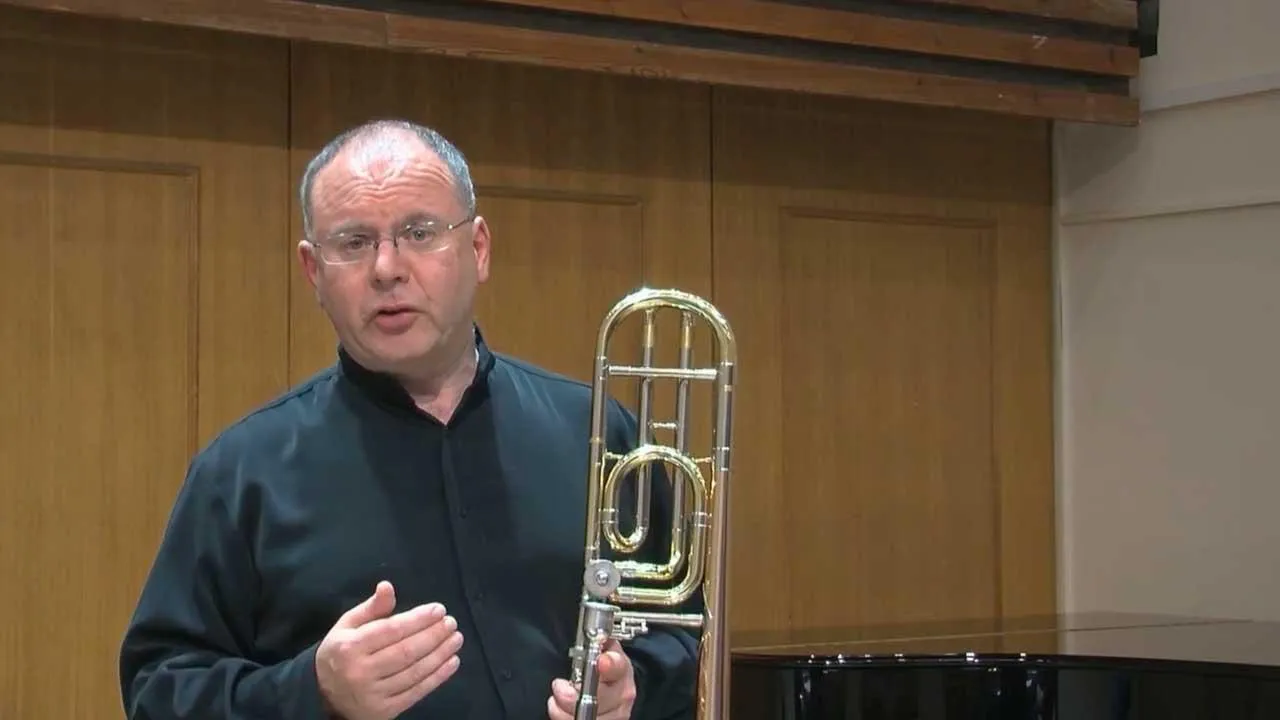
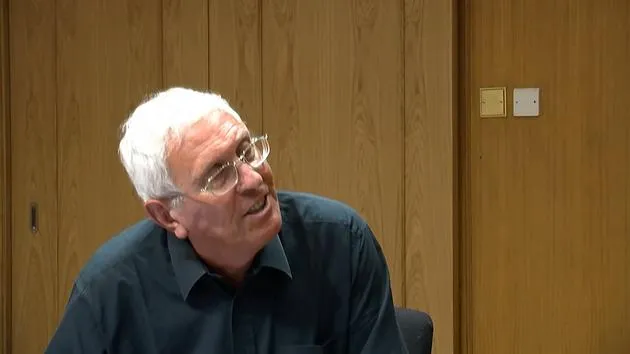
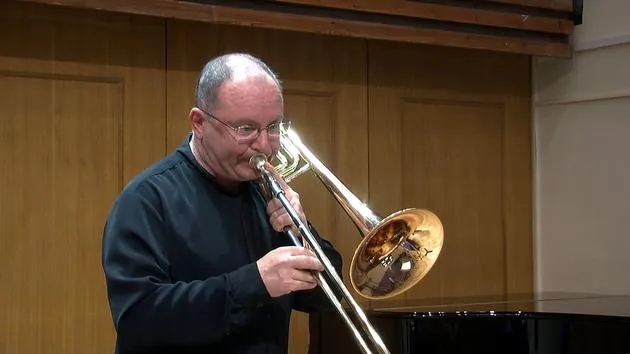
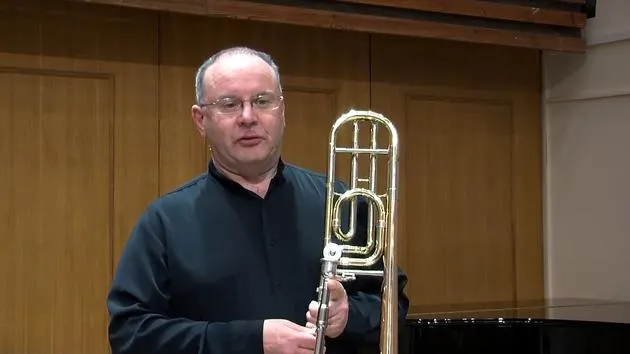
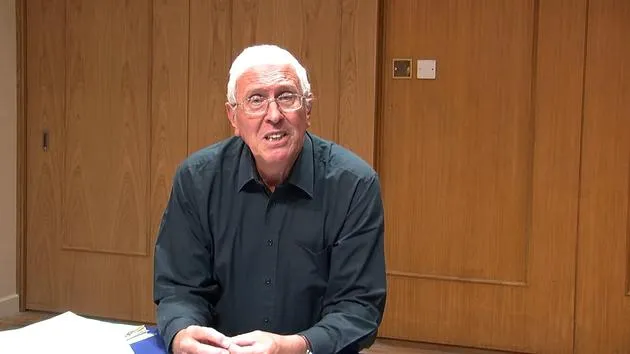
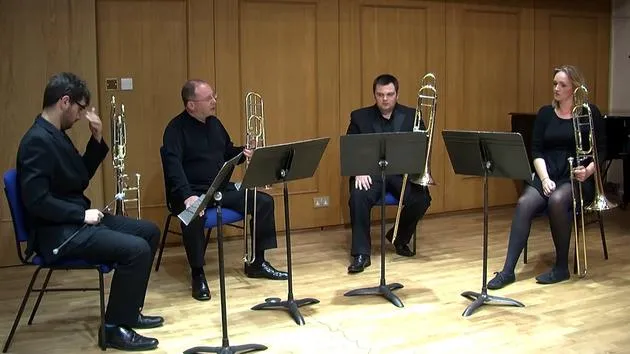
Peter GanePeter and Chris talk about using a proper blend of abdominal muscles and tongue technique to get notes with an even tone quality.
What's in the course
10 lessons (1h 33m) · 1 free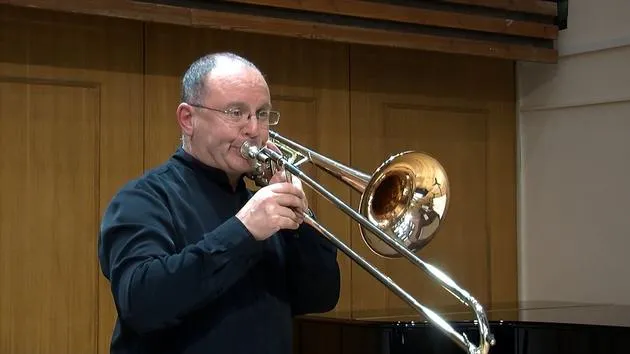
Lesson transcript
Circuit Training Unit 2: Warming Up the Motor
Introduction
Hello and welcome to Circuit Training Unit 2. Today, we will focus on warming up the motor.
Key Principles
When playing separate notes, we really concentrate on getting the abdominal muscles working well so each note has weight and identity.
Demonstration
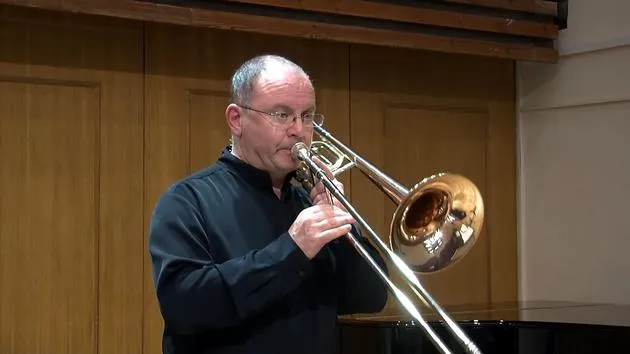
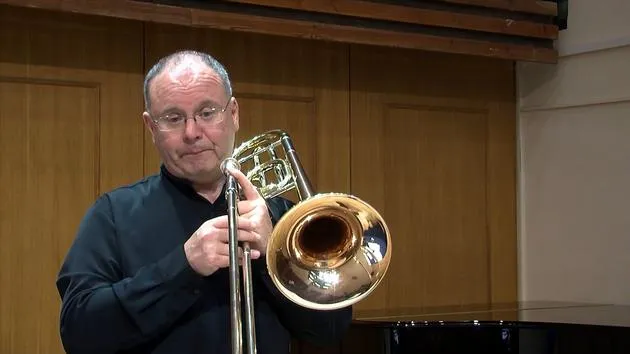
Chris, could you demonstrate the following?
- Figure One: Just with tummy pushes, no tongue.
- Figure Two: Half without tongue and the rest with tongue.
The tummy pushes create the body of the note.
- Notice how I'm pushing out, rather like sighing, and not sucking in.
- I'm also being careful not to use my embouchure and tongue to create a purring effect.
- Additionally, I'm trying to keep the corners of my embouchure set with no air pockets.
Useful Exercises
Another useful exercise is to practice panting like a dog:
- For low register notes: A slow pant like a big dog.
- For middle register notes: A slightly faster pant like a medium-sized dog.
- For high register notes: A faster pant like a little dog.
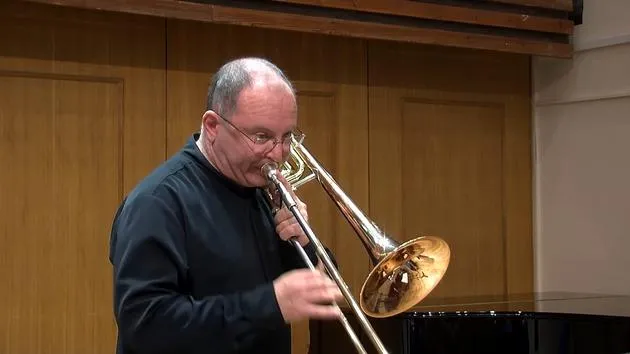
Now, I will play figure two:
- First half without tongue, second half with tongue.
Having a free and well-supported low register is a fundamental building block.
Support Techniques
Chris, could you demonstrate how you support loads in the low register?
To acquire the tone in the low register, I'm using body resonance, that is, opening the throat like an actor or a singer, and not over-opening the aperture.
- If I over-open my aperture, the note dips down below the pitch, making it very hard to focus.
To find out for yourself just where the embouchure should be, try a basic glissando from Bb to F:
- Here, I coordinated the lowering of the jaw, the opening of the aperture, relaxing the lips a little bit forward, and allowing my body resonance to produce the note without over-opening to maintain focus.
Cheek puffing can also add limited benefit to your low register.
However, be cautious:
- There is a serious side effect: your embouchure virtually completely collapses, so try to avoid this one.
Chris, moving forward, your Bb to F glissando.
A good way to encourage the low notes and develop the low register is to practice playing the false harmonics.
- Chris, could you show us how you approach figure 2, the moving on section?
Yep. As I referred before, I'm:
- Coordinating the lowering of the jaw, moving the lips slightly forward, and pushing the instrument very slightly away from me.
That's excellent.
Having a full and well-supported lower distance also acts as a springboard for the high register.
- Chris, could you expand on this by playing maybe, say, exercise seven?
Tone Quality
Before I do, I want to emphasize the importance of getting a good tone throughout the register.
- Try to avoid pinching with the embouchure and throat.
To help this, you can do a little buzzing exercise to highlight the importance of the abdominal support:
- Try resting the mouthpiece on the top lip and half buzz, half play up two octaves.
This simulates the abdominal support I'm going to use in this next exercise in Unit 2.
Summary
In Warming Up the Motor, we have covered:
- Tummy pushes, both with and without tongue.
- Morning yawns exercises, including supporting low register notes.
- False harmonics and expanding your range to consolidate.
Play the complete unit once again.
And don't forget, all we have talked about can be found in Circuit Training, Volume 2.
10 lessons
1h 33m of structured video lessons
Advanced video features
Slow down, loop a passage, follow along
Mobile, tablet & desktop
Practise wherever you are
100% satisfaction guarantee
30-day money-back guarantee
Meet your guru
Meet your guru
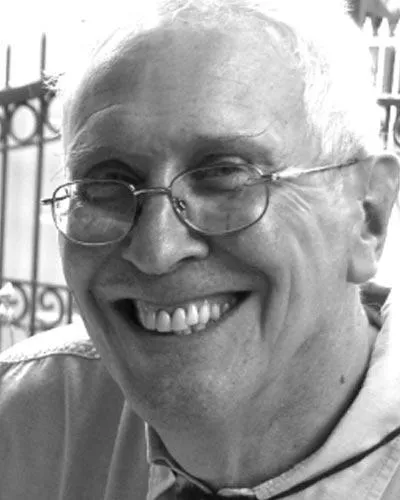
Peter Gane is one of Britain's leading brass specialists and trombonists. At the age of 19 he became a member of the London Symphony Orchestra. He became a professor at the Guildhall School in 1971 and remains so to this day. He was elected a Fellow of the Guildhall School in 1981 and was Head of the Wind, Brass and Percussion from 1988 to 2008. He is Artistic Adviser to the Combret Music Festival, Aveyron, France.
A founder and former president of the British Trombone Association, Peter is a noted educator. He has a long-standing association with the National Youth Orchestra of Great Britain and the European Union Youth Orchestra, where he has been professor of trombone since 1977 and 1984 respectively.
As a teacher, brass specialist and conductor he has taken masterclasses and workshops in many European conservatoires and with professional groups in Germany, France, Denmark, Sweden, Norway, Spain, Holland, Austria, Italy and the US. In 1996 his international reputation was confirmed by the presentation of the Neill Humfeld Award for excellence in trombone teaching by the International Trombone Association.
Peter's publications include: The Good Brass Guide, Trombone Books 1 & 2, published by Trinity Guildhall; Circuit Training for Trombone, volumes 1 and 2, Slide Systems, Five Games, Guildhall 125, World in Motion, Mansion House Fanfare, all published by Warwick Music; How Trombonists Do It, published by Brass Wind; and Brass Medals, published by the Associated Board.
That same Circuit Training approach is what Peter shares with you here: focused, repeatable workouts that build the slide accuracy, breath control, flexibility and tone you need to take real command of the trombone - whatever your level.







