



1. Limbering Up
With
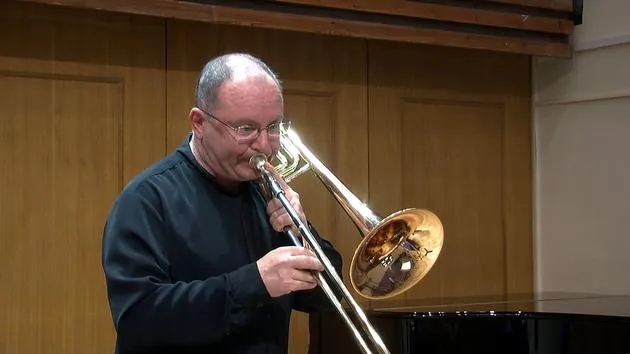
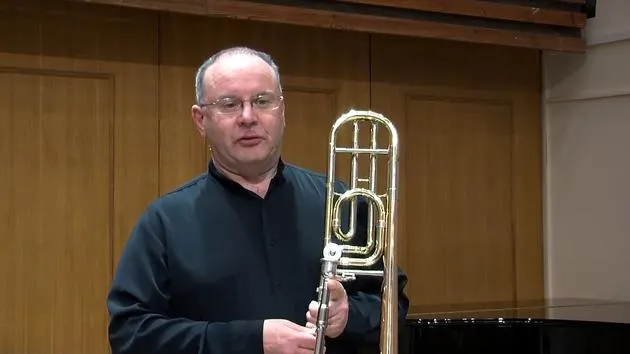
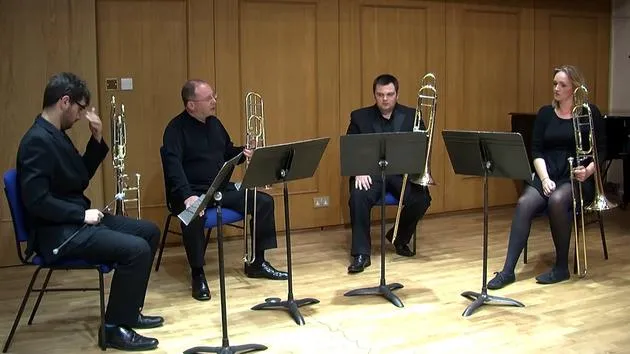
Peter GanePeter and Chris discuss and demonstrate proper posture, breathing, & embouchure, providing techniques to improve these crucial aspects of your playing
What's in the course
10 lessons (1h 33m) · 1 free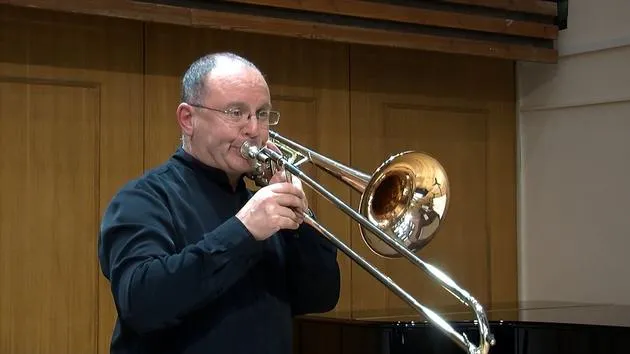
Lesson transcript
Circuit Training DVD - Lesson
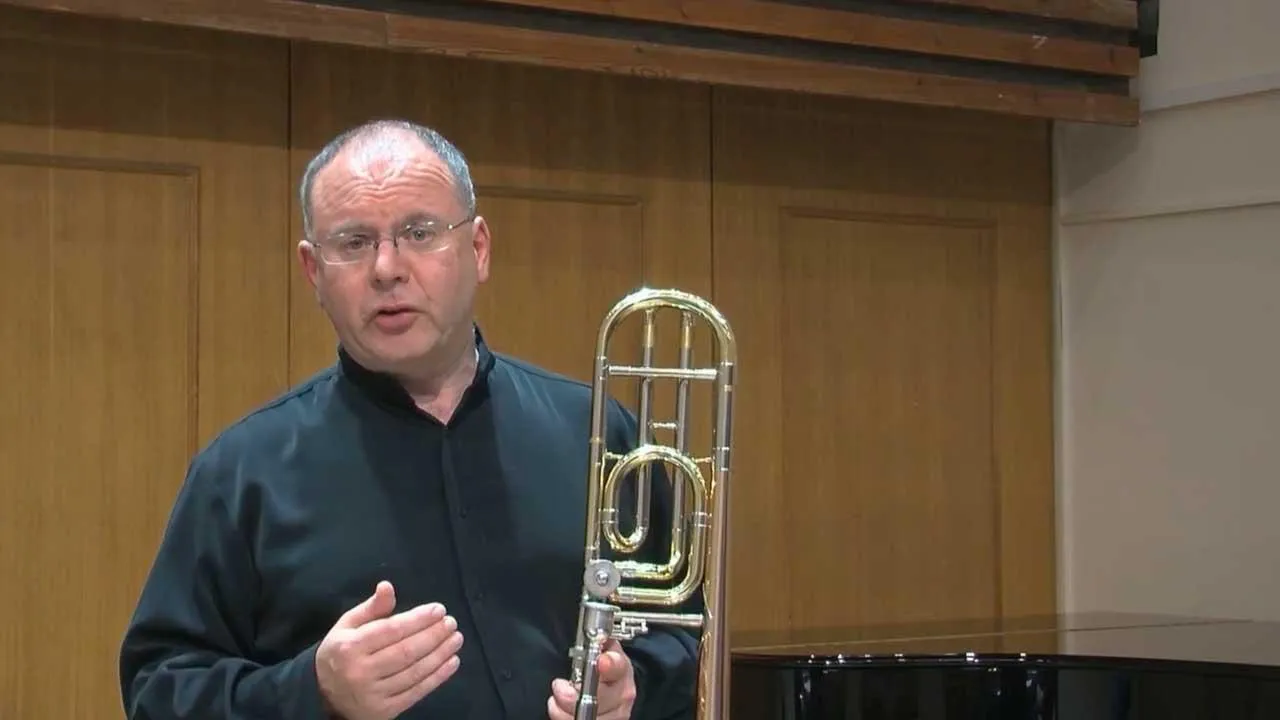
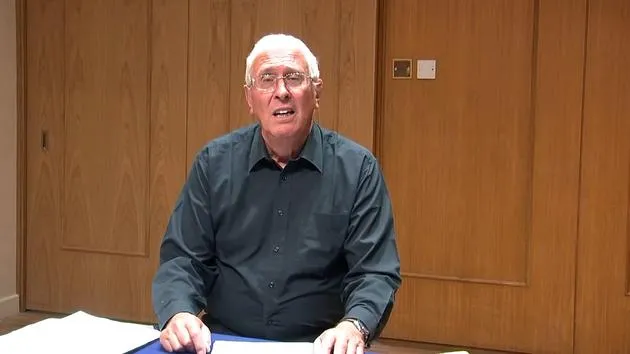
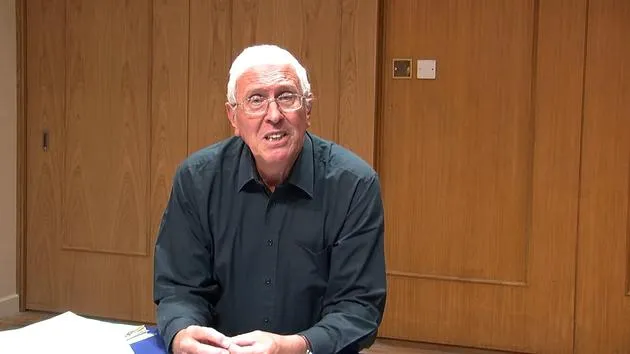
Hello and welcome to the Circuit Training DVD. I'm Peter Gane and here with me is Chris Holding.
In this DVD, Chris and I are going to explore key aspects from Circuit Training Volumes 1 and 2. This DVD will help you:
- Play more fluently
- Learn new musical patterns
- Improve your physical fitness for playing
- Improve your tone production and range
Unit One: Limbering Up
Let's start by exploring good posture and good breathing. From the very beginning of Circuit Training Volumes 1 and 2, the idea of active sitting is introduced.
Chris, could you demonstrate active sitting?
The most important aspect is:
- Keeping a straight back (depending on the quality of the chair, either forward or back)
- Keeping the feet square on the floor for stability
Active sitting will help you to:
- Focus
- Breathe well
- Become more aware and balanced
Sit tall.
Standing Tall
How about standing tall with good posture and breathing?
Chris, when standing, maintain the same straight back:
- Keep feet shoulder-width apart
- Knees relaxed but not locked
This helps to balance our unique instrument.
Breathing Techniques
Inhaling and exhaling is a key aspect in circuit training. For best results:
- Stay relaxed and natural
- Prepare to inhale by emptying out all the old air first, thereby creating a vacuum on a given signal
- Air should then rush in efficiently and naturally
Inhale through the mouth with an open throat, making a "whah" sound. Fill from the lowest point possible:
- Fill the lungs
- Finally, fill the two compartments on the back
"I'm now full of air and ready to play the trombone."
At all costs, resist:
- Short gasps
- Raising the shoulders
- Resulting tension
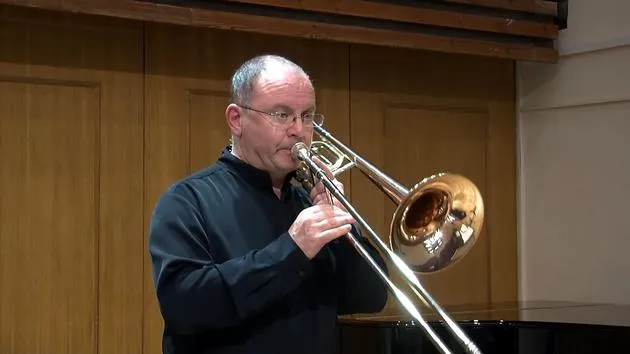
Here is correct breathing. Watch how easily and fluently Chris breathes. No blocking and no unwanted tension. It's excellent breathing, Chris.
Mouthpiece Buzzing and Airflow Exercises
Just as athletes warm up by stretching and gently flexing their muscles, so should brass players.
Could you demonstrate some mouthpiece buzzing and some simple legato airflow exercises?
Mouthpiece buzzing highlights and helps to develop breath support.
- Try to establish a partnership between the abdominal muscles and the embouchure.
- To obtain a higher pitch, use a smaller volume of air traveling very fast.
- To produce a lower pitch, use a larger volume of air traveling much slower.
Remember to activate the breath support before the embouchure.
When changing pitch:
- Keep the lip pursed rather than stretched to maximize the vibration.
Exercises from Page 10
- Notice how the airflow is constant.
- No gaps.
Here again, the airflow is constant with no gaps, but this is on the same harmonic. Therefore, for real playing on the trombone, we have to use either soft tongue or something else to make sure there are no Cassandras between the notes.
Again, airflow is constant. No gaps. All the notes are joined together.
The Concept of Virtual Reality
Another key concept is the virtual reality or the imagined idea.
Chris, do you agree that with or without your instrument or with or without your music, it's very useful to mind play all the features of an exercise or study?
"Yes, Peter, you're absolutely right. Our main consideration here is to create a consistent muscle memory combined with coordination to produce a smooth, mellifluous melodic line."
As we said earlier, when we're crossing the harmonics:
- Maintain the abdominal pressure
- Keep the embouchure pursed and anchored at the corners
- Fill the void between the notes with air as we cross the harmonic, much like crossing a bridge, slowly, deliberately, and positively.
The lips and the throat remain open at all times. Try not to let your tongue cut off the air so the mouth remains open, and the sound rings.
Using the Burp Adapter
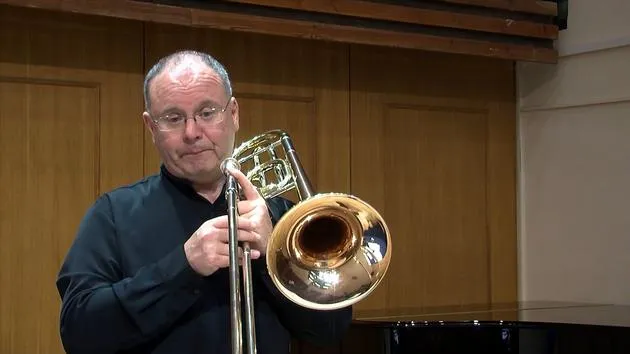
Chris is now using a burp, which is an adapter that you put into your trombone leader pipe, allowing your mouthpiece to sit outside the trombone.
It's a very useful teaching aid because you can really hear as a teacher and as a player whether or not their column is continuous, with no gaps or bulges. Very useful indeed.
Now, Chris, let's see some legato with the notes mainly on the same harmonic.
"Here, Peter, we have to be very careful because the glissando effect when we're playing is undesirable. So we have to try and develop our legato on the same harmonic by first:**
- Stage One: Continuous air
- Stage Two: A fast, precise slide
- Stage Three: The soft tongue using "da" (like saying D at the back of the mouth)
If you close your mouth or move your jaw while doing this, you will get pear-shaped notes, which is also not very desirable.
Try as a practice to form the embouchure and say "da" while singing, without moving the jaw or closing the mouth.
Exercises
Here's an exercise demonstrating:
- Stage One: Legato, continuous air, but with a relaxed slide and no tongue.
- Stage Two: A more precise slide.
- Stage Three: Adding the soft tongue.
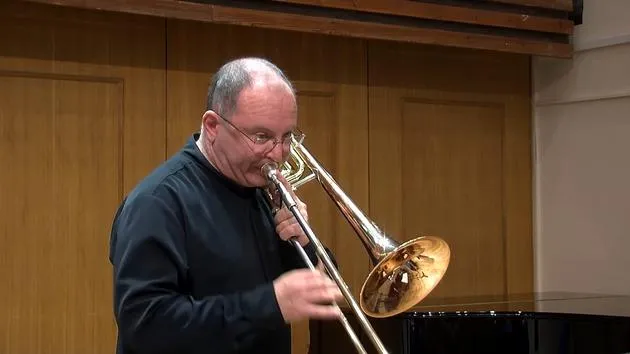
Finally, Chris, let's see how this all works out when you play it on the trombone.
How about playing Exercise 9E, page 15?
Summary
To sum up, we have covered elements of:
- Good posture and breathing
- The idea of active sitting
- Obliterated development and legato
Work through this unit once again. And don't forget that all we have talked about can be found in Circuit Training, Volume 2.
10 lessons
1h 33m of structured video lessons
Advanced video features
Slow down, loop a passage, follow along
Mobile, tablet & desktop
Practise wherever you are
100% satisfaction guarantee
30-day money-back guarantee
Meet your guru
Meet your guru
Peter Gane is one of Britain's leading brass specialists and trombonists. At the age of 19 he became a member of the London Symphony Orchestra. He became a professor at the Guildhall School in 1971 and remains so to this day. He was elected a Fellow of the Guildhall School in 1981 and was Head of the Wind, Brass and Percussion from 1988 to 2008. He is Artistic Adviser to the Combret Music Festival, Aveyron, France.
A founder and former president of the British Trombone Association, Peter is a noted educator. He has a long-standing association with the National Youth Orchestra of Great Britain and the European Union Youth Orchestra, where he has been professor of trombone since 1977 and 1984 respectively.
As a teacher, brass specialist and conductor he has taken masterclasses and workshops in many European conservatoires and with professional groups in Germany, France, Denmark, Sweden, Norway, Spain, Holland, Austria, Italy and the US. In 1996 his international reputation was confirmed by the presentation of the Neill Humfeld Award for excellence in trombone teaching by the International Trombone Association.
Peter's publications include: The Good Brass Guide, Trombone Books 1 & 2, published by Trinity Guildhall; Circuit Training for Trombone, volumes 1 and 2, Slide Systems, Five Games, Guildhall 125, World in Motion, Mansion House Fanfare, all published by Warwick Music; How Trombonists Do It, published by Brass Wind; and Brass Medals, published by the Associated Board.
That same Circuit Training approach is what Peter shares with you here: focused, repeatable workouts that build the slide accuracy, breath control, flexibility and tone you need to take real command of the trombone - whatever your level.







