



4. Dexterity and Flexiblity

With
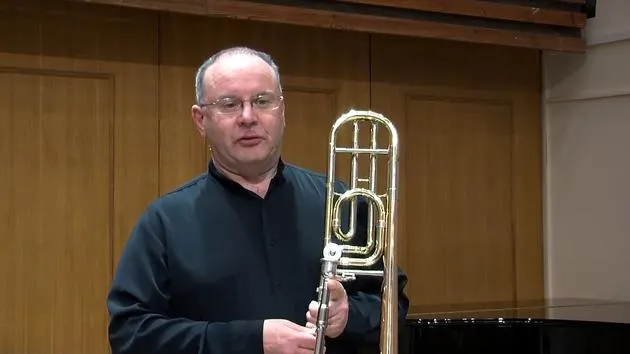
Peter GaneProper tonguing and slide technique are demonstrated, with useful exercises provided for practicing wherever you are
What's in the course
10 lessons (1h 33m) · 1 free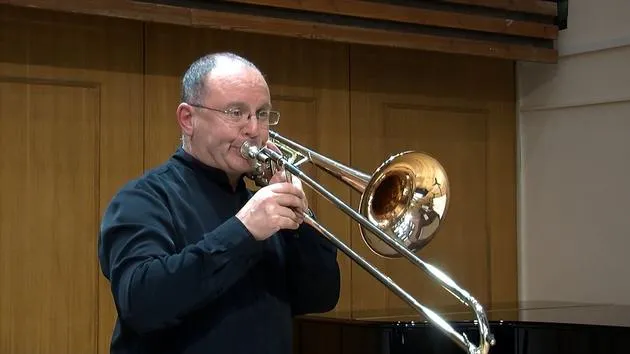
Lesson transcript
Circuit Training: Unit Four - Dexterity and Flexibility
Hello and welcome to circuit training.
Introduction to Unit Four
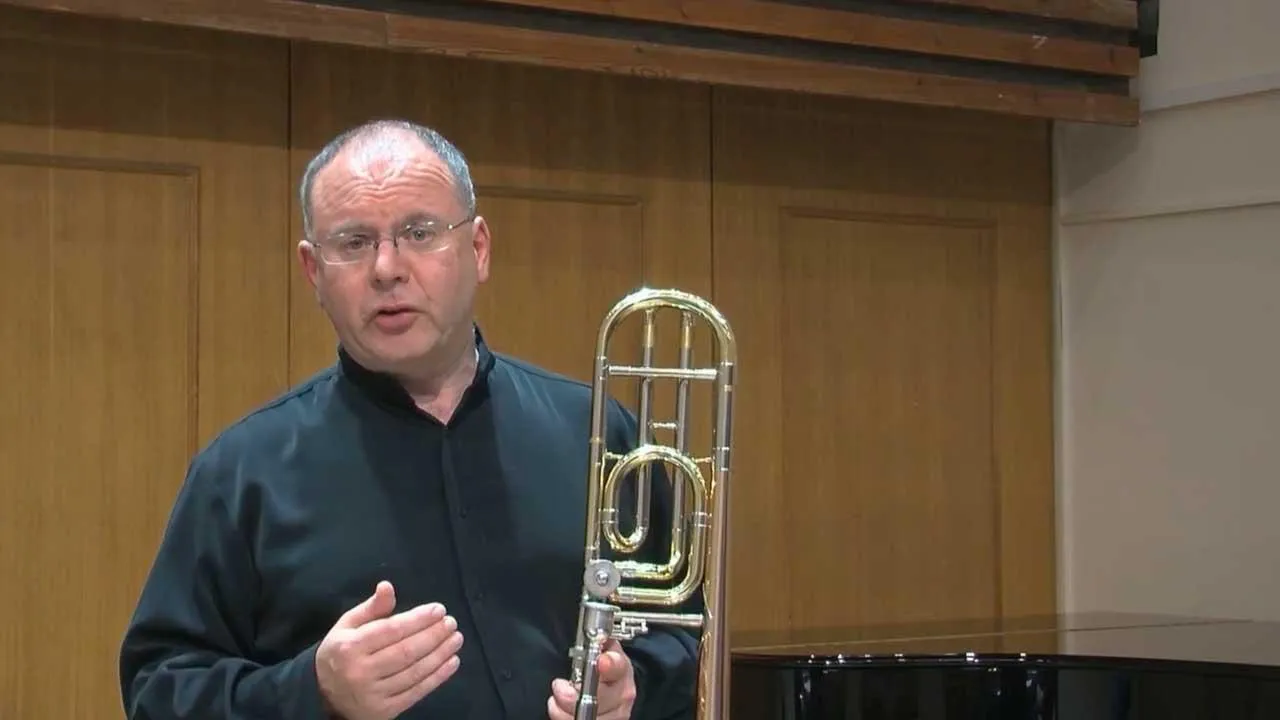
Let's start unit four with lightness of the tongue and slide coordination. Can you demonstrate tongue positions and moving your slide in time with the rhythm of the music? For this, I'm going to use Figure 1 from Lightness of Tongue to illustrate it.
Importance of Coordination
Tongue and slide coordination is crucial to mastering a difficult passage and developing practice technique.
- Repeated breakdowns cause:
- Frustration
- Fatigue
- Incorrect muscle memory
Many difficult passages present no real challenge to the embouchure and the air support. However, the coordination between the tongue and the slide is essential to achieving good melodic coordination.
Practice Air Trombone
Here, we can actually practice air trombone. In other words, rehearse the tongue and the slide away from the instrument. This saves your lip and certainly makes the next time you play more of a revelation.
Also, be careful that when you use the articulation ta, like in the earlier unit, we don't allow jaw movement. This can be rehearsed while walking or on the bus.
Slide Technique
Here's Figure 2. The importance of slide technique can't be underestimated.
- Playing quickly in the low register, due to the distance involved, is far more difficult.
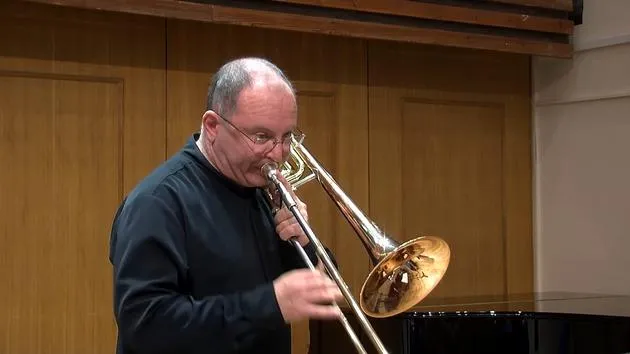
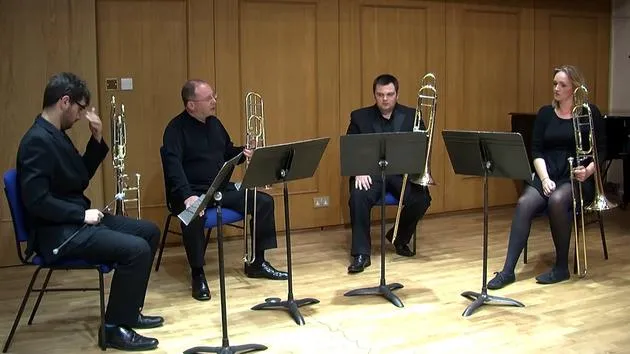
- Chris, could you play Figure 3?
Before I do this, though, we have to realize that moving from an inner position to an outer position very quickly can cause a whipping effect on the slide. This can easily make the instrument go up and down, which will spoil our melodic level.
- So, try and keep the left hand very steady, taking the vertical weight of the instrument.
- Reserve the right hand only to follow the horizontal plane.
Here's Figure 3.
Flexibility and Multiple Tonguing
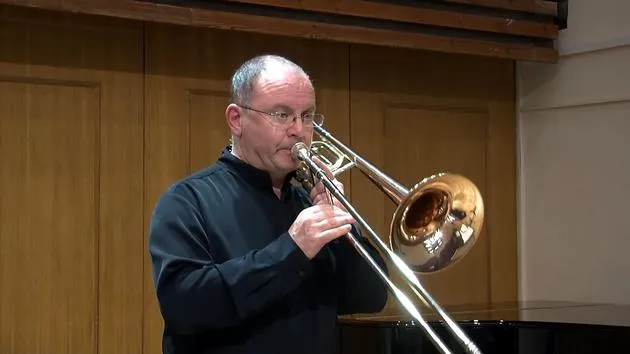
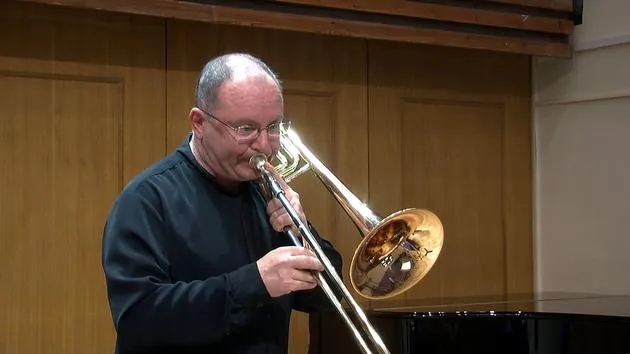
This moves us nicely onto flexibility and multiple tonguing. Could you possibly demonstrate now a double tonguing exercise?
Before I do, can I stress the importance of developing a good overlap between single and double tongue? In reality, we often have to make a split-second decision according to the tempo set by an ensemble or conductor.
Having achieved a reliable overlap, we can then increase the tempo with natural ease.
- Notice how still and firm Chris's embouchure is.
- Ensure that your articulation ta does not encourage jaw movement.
Then rehearse two different ways of triple tonguing away from the instrument.
- For example, I find T K T particularly clear for a symphonic fanfare.
- Whereas T K is more suited for an extended passage of triple tonguing, such as in a brass band air, with variations.
As mentioned earlier, especially with multiple tonguing and flexibility, practicing away from the instrument can be very beneficial.
Integration of Techniques
We must now try to integrate double and triple tonguing with legato flexibilities.
Finally, let us combine mental and physical preparation in Peter Gaines' Challenge: Double Dexterity.
Steps to Follow:
- Establish a good pulse.
- Rehearse rhythm, tongue, and slide.
- Identify any awkward passages and practice separately up to 50 times a day to establish reliable muscle memory.
Remember: Don't just practice until you get it right; practice until you can't get it wrong.
Conclusion
In Unit Four, Dexterity and Flexibility, we have looked at aspects of:
- Dexterity
- Coordination
- Synchronization
- Lightness of tonguing
- Multiple tonguing
To consolidate, work through this unit once again. Don't forget that all we have talked about can be found in Circuit Training, Volume 2.
10 lessons
1h 33m of structured video lessons
Advanced video features
Slow down, loop a passage, follow along
Mobile, tablet & desktop
Practise wherever you are
100% satisfaction guarantee
30-day money-back guarantee
Meet your guru
Meet your guru
Peter Gane is one of Britain's leading brass specialists and trombonists. At the age of 19 he became a member of the London Symphony Orchestra. He became a professor at the Guildhall School in 1971 and remains so to this day. He was elected a Fellow of the Guildhall School in 1981 and was Head of the Wind, Brass and Percussion from 1988 to 2008. He is Artistic Adviser to the Combret Music Festival, Aveyron, France.
A founder and former president of the British Trombone Association, Peter is a noted educator. He has a long-standing association with the National Youth Orchestra of Great Britain and the European Union Youth Orchestra, where he has been professor of trombone since 1977 and 1984 respectively.
As a teacher, brass specialist and conductor he has taken masterclasses and workshops in many European conservatoires and with professional groups in Germany, France, Denmark, Sweden, Norway, Spain, Holland, Austria, Italy and the US. In 1996 his international reputation was confirmed by the presentation of the Neill Humfeld Award for excellence in trombone teaching by the International Trombone Association.
Peter's publications include: The Good Brass Guide, Trombone Books 1 & 2, published by Trinity Guildhall; Circuit Training for Trombone, volumes 1 and 2, Slide Systems, Five Games, Guildhall 125, World in Motion, Mansion House Fanfare, all published by Warwick Music; How Trombonists Do It, published by Brass Wind; and Brass Medals, published by the Associated Board.
That same Circuit Training approach is what Peter shares with you here: focused, repeatable workouts that build the slide accuracy, breath control, flexibility and tone you need to take real command of the trombone - whatever your level.







