



8. Other Modes

With
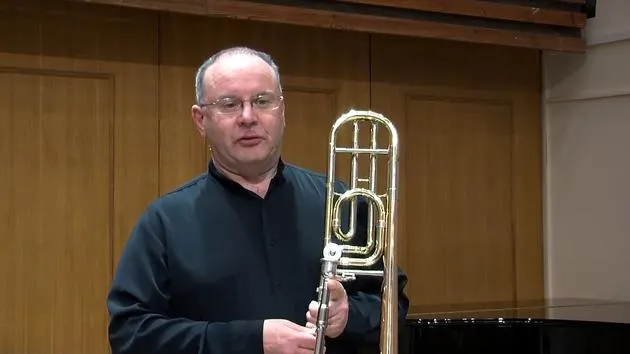
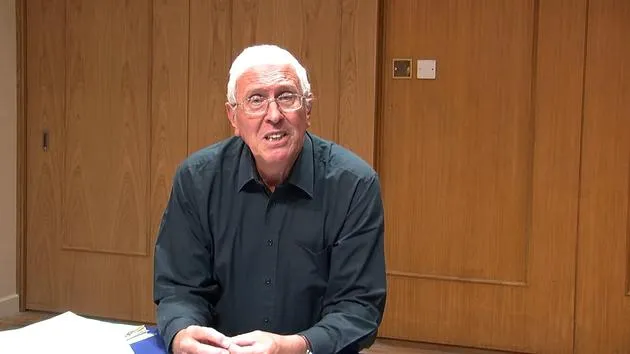
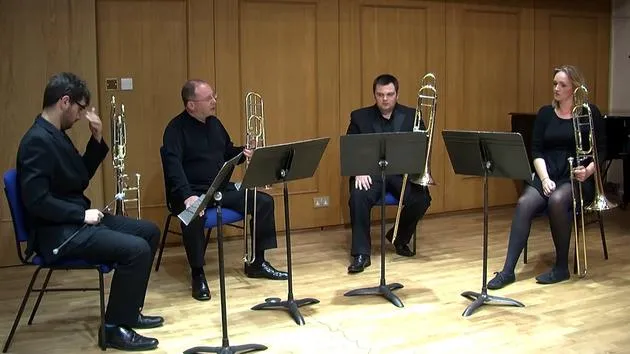
Peter GaneHaving covered major and minor, Peter and Chris work through exercises for the other modes, Dorian, Phrygian and more, and how to apply them on trombone.
What's in the course
10 lessons (1h 33m) · 1 free
Lesson transcript
Circuit Training Unit 8
Hello and welcome to Circuit Training Unit 8.
Overview of Modes
Other modes, all modes, have their distinctive mood, color, and interval relationship.
Dorian Mode
To get this unit off to a good start, Chris will play the famous Dies Irae, which, like Scarborough Fair, is in the Dorian mode. Another familiar example is Scarborough Fair, the Dorian jig. Page 45 captures the mood of the Dorian mode.
- Be sure you create a proper 6/8 lilt.
- Make sure you get three quavers to the beat and not two fours.
Scarborough Fair is also in the Dorian mode, but not quite so obviously here.
Breathing Techniques
I recommend preparing realistic, regular breathing places to maintain a calm poise.
- Irregular and excessive short breaths cause breathlessness, increase stress and tension, and will inhibit your eyes from moving forwards across the page.
Other Modes
Phrygian Mode
Another mode is the Phrygian mode. This mode is like playing all the white notes on the piano, starting and ending on E. It was very popular in the Bach period and can be very wistful.
Lydian Mode
Whole Cell Phone is based on the Lydian mode (F to F) and is the only mode that starts with three whole tones.
- This mode has some very fancy and famous trombone references.
- A tip here is to leave the grace notes late in bars 5 and 7 and sustain the preceding note to avoid rushing and enhance clarity.
Pentatonic Scale
The Pentatonic is a five-note pattern.
Mixolydian Mode
The Mixolydian mode (G to G) and blues scale, when combined, give you wonderful melodic and harmonic possibilities.
- A good example of the pentatonic scale is Nobody Knows the Trouble I've Seen.
- Folk Dance is a good example of the Mixolydian mode.
Be sure to exaggerate the phrasing by using clear articulations while maintaining air support.
Remember, singers have words to help them; instrumentalists only have the phrasing.
Locrian Mode
The Locrian mode, from B to B on the white notes of the piano, is the only mode with a diminished chord as its tonic.
- Chris will play the opening phrase from Brahms' First Piano Concerto, which uses the notes of the Locrian mode in the key of E flat.
- Watch out for Chris's wonderful lip trills.
Lip Trills Practice
Don't be afraid of lip trills! Start to practice regularly between F and G in a slow, even tempo:
- First in crotchets
- Then quavers
- Then triplet quavers
- Semiquavers
- Semiquaver triplets
Then you'll be trilling in Unit 8!
Conclusion
We have covered a lot of material in this unit. We have looked at the modes and heard some great playing from Chris.
To consolidate, play the complete unit once again.
Don't forget that all we have talked about can be found in Circuit Training, Volume 2.
10 lessons
1h 33m of structured video lessons
Advanced video features
Slow down, loop a passage, follow along
Mobile, tablet & desktop
Practise wherever you are
100% satisfaction guarantee
30-day money-back guarantee
Meet your guru
Meet your guru
Peter Gane is one of Britain's leading brass specialists and trombonists. At the age of 19 he became a member of the London Symphony Orchestra. He became a professor at the Guildhall School in 1971 and remains so to this day. He was elected a Fellow of the Guildhall School in 1981 and was Head of the Wind, Brass and Percussion from 1988 to 2008. He is Artistic Adviser to the Combret Music Festival, Aveyron, France.
A founder and former president of the British Trombone Association, Peter is a noted educator. He has a long-standing association with the National Youth Orchestra of Great Britain and the European Union Youth Orchestra, where he has been professor of trombone since 1977 and 1984 respectively.
As a teacher, brass specialist and conductor he has taken masterclasses and workshops in many European conservatoires and with professional groups in Germany, France, Denmark, Sweden, Norway, Spain, Holland, Austria, Italy and the US. In 1996 his international reputation was confirmed by the presentation of the Neill Humfeld Award for excellence in trombone teaching by the International Trombone Association.
Peter's publications include: The Good Brass Guide, Trombone Books 1 & 2, published by Trinity Guildhall; Circuit Training for Trombone, volumes 1 and 2, Slide Systems, Five Games, Guildhall 125, World in Motion, Mansion House Fanfare, all published by Warwick Music; How Trombonists Do It, published by Brass Wind; and Brass Medals, published by the Associated Board.
That same Circuit Training approach is what Peter shares with you here: focused, repeatable workouts that build the slide accuracy, breath control, flexibility and tone you need to take real command of the trombone - whatever your level.







