



Three Note Chords – Triads and Games

With
Talia GirtonLearn how triads (three-note chords) work, hear the difference between major and minor, and lock them in with a few playing games.

What's in the course
21 lessons (0h 42m) · 1 free








Lesson transcript
Understanding Triads
Triads are three-note chords. We had a look at this a little bit earlier with the C major chord and the A minor chord. As you might have guessed, it's called a triad because there are three notes.
Major and Minor Chords
You might recall that we have:
- Major chords which sound happy and uplifting
- Minor chords which sound a bit more melancholy
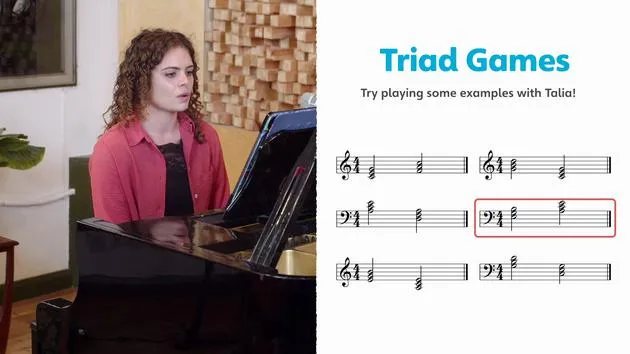
Now, we'll play some triad games to get this into your fingers.
Interactive Exercise
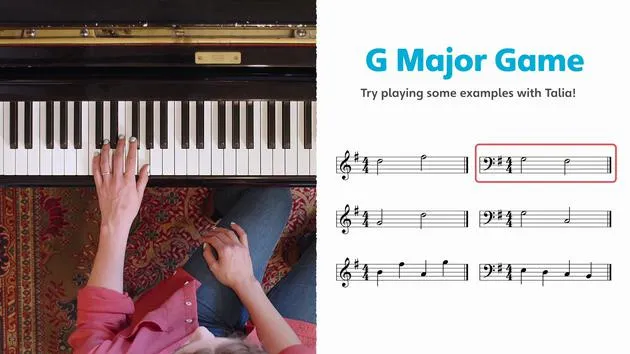
- I'll give you a chance to play, and then I'll show you the right answer, if you'd like to.
- As an added bonus, you can use your ear to see if you think it's a major triad or a minor chord.
(Note: I'll be using the words triad and chord interchangeably.)
Go ahead and hit pause, figure it out, and then come back and check the answer with me.
Example 1
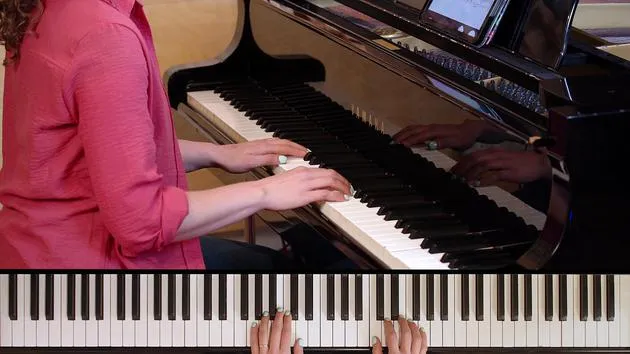
Correct Answer: You might have realized that those were both major chords.
- The first one was C major with the C on the bottom.
- The second one was F major because there's an F on the bottom.
It'll be the same with the rest of the chords throughout this exercise.
Example 2
Once again, pause the video, give it a try, and then you can come back to me to get the correct answer.
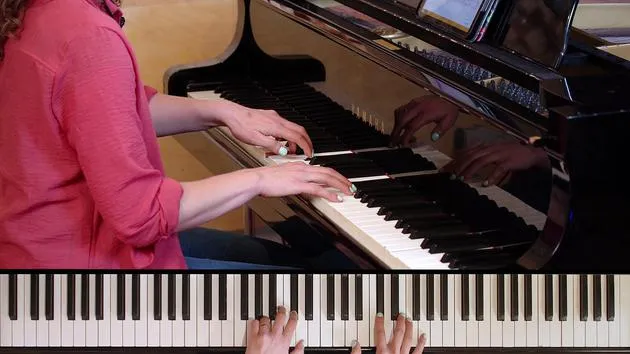
Correct Answer: You may have noticed that those were both major chords.
- We had a G major chord: G, B, and D.
- Then once again, we had our C major chord: C, E, and G.
Example 3
Let's try the next example. Pause the video, figure it out, and then come back when you're ready.
Correct Answer: Hopefully, you noticed that we've switched from the treble clef to the bass clef.
Did you notice that both of those chords were in a minor key? They had a darker, more melancholic sound to them.
- The first one was an A minor chord because it contains the notes A, C, and E.
- The second chord was a D minor chord because it contains the notes D, F, and A.
Example 4
Let's go on to the next example. Pause the video and come back when you're ready.
Correct Answer: You may have noticed that both of those chords were minor.
- The first chord was an E minor chord with the notes E, G, and B.
- The second chord was an A minor chord with the notes A, C, and E (the same one that we saw in the previous example).
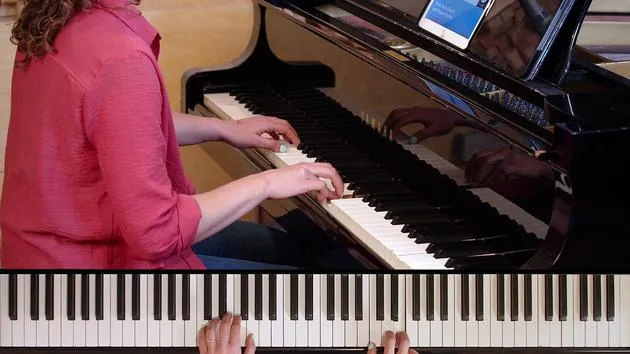
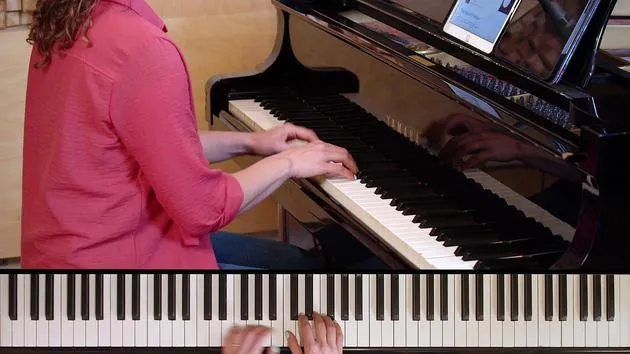
Feel free to experiment with triads going up and down the piano. You could even do them one after the other like this.
You can try with both hands or even with hands together to get a really nice, voluminous sound.
21 lessons
0h 42m of structured video lessons
Advanced video features
Slow down, loop a passage, follow along
Mobile, tablet & desktop
Practise wherever you are
100% satisfaction guarantee
30-day money-back guarantee
Meet your guru
Meet your guru
Talia Girton is a musician and HCPC-registered music therapist, and the founder of The Cycling Music Teachers. Her work brings together music therapy, counselling and education, and she tutors internationally on the music therapy training course at UDELAS in Panama as well as contributing to professional development with the European Piano Teachers Association (EPTA). On MusicGurus she teaches the Piano Method and Piano Foundations courses, guiding complete beginners from first steps through rhythm, both hands, theory and performance.







