



Composer et collaborer
Le contenu du cours
8 leçons (1h 4min) · 1 gratuites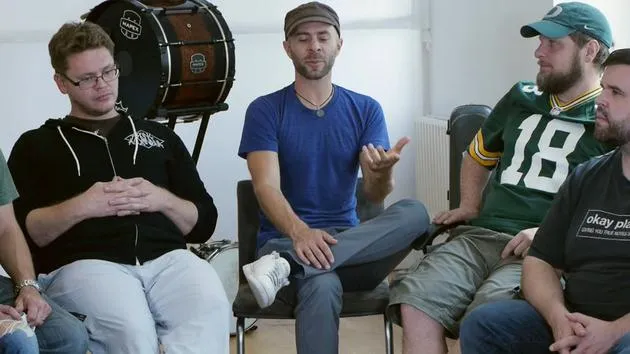
01. Composer et collaborer
Tu es ici11:54
02. Comment ont été écrits les morceaux célèbres de Youngblood
8:33
03. Choisir des morceaux pour les albums ou les concerts
6:18
04. Comment aborder les reprises
8:12
05. Comment reconnaître une "bonne idée"
Leçon gratuite4:44
06. La structure et le développement des idées en un morceau abouti
8:15
07. Qu'est-ce qu'une idée ?!
4:17
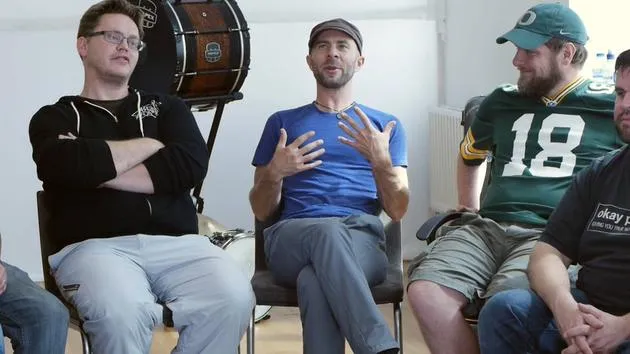
08. Écrire et arranger pour les cuivres
12:18
Transcription de la leçon
Writing Music: Our Diverse Processes
Well, we have a number of ways that we write tunes. People ask us a lot after shows, especially. People come up to us and be like:
"How are you writing the music? Who writes the music? Do you guys just get together and jam when you write music?"
So, we thought it might be good to talk about how we all write, because it's all really different for each one of us. It's kind of a completely different process, all of which are totally valid. I think it's interesting to hear about them.
Nat's Writing Process
I know Nat has a really specific process, so I think he's going to talk about that a little bit.
"In the very early years of the band, I was responsible for the lion's share of the composition and arrangement. I did probably 90% of it. Back then, we had weekly rehearsals."
So basically, all I would do was just go for a walk and think, and I would try and compose a whole tune in my head. A common question we always get is:
"What do you start with? Do you start with a bass line? Do you start with a horn part, or what?"
The answer is, it's different every time, and it doesn't matter. Whichever thing gets the tune started off is what you should go with. If you have an idea that inspires you, then get it going.
In the early days, I would just write the entire song in my head, then teach everybody their parts one part at a time. For example,
"Here's the second trombone part. I'll play it at you, you play it at me."
We would just keep going until they could play it back.
It's not the most efficient way, but the nice thing about that is: within the space of one rehearsal, you not only have an entire tune learned, but you also have it almost memorized. You never had to look at a sheet of music and do that translation that comes from audio to visual.
Now that we're professionals and we live all over the place, we've had to come up with different ways to do things. This also involves a lot of other people getting involved and contributing their own small amounts.
Current Methods
The way that I do things currently is I write in Finale, a music notation program. It works really well for being able to actually remember what you wrote. Although, you know, one of the advantages of writing everything in your head is that if you can't remember it the next day, it probably wasn't that good.
The disadvantage of Finale is that it only plays back to you in MIDI. This can make it really hard to forget that you're writing for real instruments that have a real interpretation.
If you're trying to pitch a part of a tune to somebody else in the band and say, "What do you think about this?", when you play them the Finale playback, they are invariably going to think that it's a lot lamer than you think because it's hard to picture in your head what the end product is going to sound like.
Collaboration Evolution
In the early days of writing, the idea hardly changed at all from the beginning of my thought process to when I taught it to people. It only existed in my head, so nobody could really tell me, "I think this should go a little bit different."
But now that we write in a more collaborative way and we use Pro Tools, we can actually see the thing in front of us. The idea can change a lot. Sometimes, someone will just bring in a germ of an idea, and we all say, "Oh, that's pretty cool."
For example:
"I like this part about it, I like this aspect of it, but I think that for it to sound more like Youngblood or for it to flow more nicely into this next part, we should do this."
It's much more back and forth now than it used to be.
Dave's Writing Approach
Well, yeah. I mean, the way I go about writing stuff is a lot different too, because the studio's at my house, and I'm kind of always on the computer.
Initial Ideas
When I write things, I usually right away put them onto a Pro Tools session. Even if all I'm hearing is a hook, a bass line, or a beat, I'm putting that into a Pro Tools MIDI session with synths right away. Then I ask myself:
"What do I feel is missing? What does it need?"
A lot of times, I'll just beatbox a rough drum rhythm that I might be hearing and just record that. The tunes start out as beatbox and MIDI synth and then just kind of build and build.
Collaborating with Others
As far as theory knowledge goes, a lot of these guys have a much more extensive theory background than I do. It's much easier for me to see the MIDI and hear the tune than it is for me to write it out like Nat does in Finale or to be able to hear all the harmonies in my head.
So, my tunes tend to start as little voice memos on my iPhone where I'm hearing a beat, a hook, or a bass line. Then I just start a session and build from there.
Even with all those sessions, the way we write now is:
"As soon as there's a little bit of a session that you like, we'll start emailing it to each other."
For example, I might send it off to Joe and Matt to be like, "You think this would sound good on trombone? Or, do you have something you could hear over the top of this?"
Collaborative Nature of Writing
What Dave just mentioned reflects my approach too. I'm very much a collaborative writer. I haven't written a full tune; instead, I come up with the germ of an idea. A lot of times, I'll be driving to a gig, listening to the radio or my iPod, and just catch myself whistling something over another song.
"Wait, what is that? I came up with that? What is that?"
I'll get the voice memos out and whistle it. I have, like, 100 voice memos. I go back, and 6 out of 10 of them are like, "What was that?" But occasionally, I'll find one that's actually something.
Recording Ideas
After recording a few trombone tracks or baselines with a melody over the top, I often send them to Matt. He and I have a little wavelength where I send it to him and he responds:
"Oh, I like that. What if we did something more like this?"
Then he'll send a file back to me. Usually, Dave's in the loop on that too, and he'll beatbox a little idea over it.
For instance, on the last album, one song idea that had like three parts ended up just becoming a sample and an intro to one of the songs with a few additional ideas Nat worked with to glue them together.
The Variety of Writing
I think one of the things that's worth mentioning is that part of why we're doing this is because, on our newest record, there are tunes where one person wrote almost the entire tune. For example:
"Tony wrote a tune called Overtime, which he wrote 80%, maybe 90% of."
Then there are other tunes, like the one Joe was just talking about, that started as these little germs of ideas we were sending around via email, where five people equally collaborated.
The point of this discussion is to say there isn't a specific way that we write or a method we think is best. All of us have these completely different ways of doing it, and all of it works, the point is just to create something and get it out there.
Some bands get together in a room and jam for seven hours to come up with a record, seems preposterous to me, but it must happen. The whole point is that any way you're inclined to do it is a totally fine way, because:
"Everybody's always guessing all the time."
Final Thoughts on Collaboration
Well, here's why jamming doesn't work for a band like us:
"We have horn players that are doing chordal roles. If it takes three horn players to play one guitar part, you're not going to wind up composing much in a jam session."
When you just have one guitar player, he can lay down the entire chord progression, and everyone else can pile on that. But for our setup, everybody individually has to contribute to the chords while ensuring they're doing something melodic in its own right.
It's much better to have things premeditated rather than just to sit around and blow in each other's faces to see what comes out.
Changing Roles
That's one of the things that makes the way we compose more fun. We often change who is playing the role of providing harmony or melodic intent.
A lot of times, trombones are playing guitar, quote unquote. So, having two trombones, two saxes, and two trumpets allows for more fluidity in our roles, which I think has really opened it up for us.
For other bands writing music with that many voices, it's important to remember:
"Change that texture. If you're just bass guitar and singing with drums, you might not have much of an opportunity to change who's providing harmony."
This is one of the wonderful things about horns, being able to tailor parts to individuals rather than having the same instrument playing the melody every time.
"We know each other well enough to know where the money spot is for different players."
Each player brings their own flair, which enhances our collaborative writing experience.
8 leçons
1h 4m de leçons vidéo structurées
Fonctions vidéo avancées
Ralentissez, bouclez un passage, suivez la partition
Mobile, tablette et ordinateur
Pratiquez où vous voulez
Satisfaction garantie à 100 %
Garantie remboursement 30 jours
Rencontrez votre guru
Rencontrez votre guru
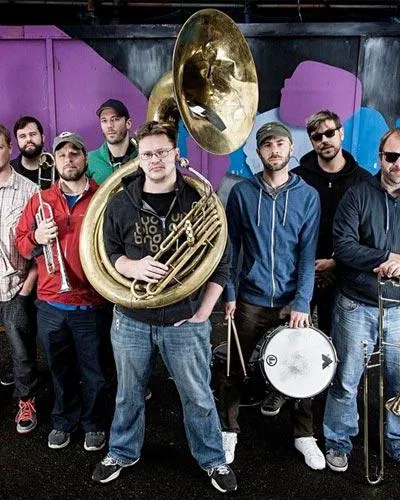
Youngblood Brass Band fusionne les cuivres sans concession de La Nouvelle-Orléans avec l'énergie et le lyrisme du hip-hop. Issu de Madison, Brooklyn, Minneapolis et Chicago, ce groupe de dix musiciens tourne dans le monde entier depuis 2000 et a collaboré avec des artistes tels que Questlove et Talib Kweli. Il est tout aussi à l'aise à mener une fanfare sur ses propres compositions qu'à faire la tête d'affiche d'un festival de punk. Sur MusicGurus, ils décomposent leur son mêlant La Nouvelle-Orléans et hip-hop : comment ils composent et arrangent pour les cuivres, le vocabulaire rythmique et harmonique qui relie le tout, et comment jouer une ligne de cuivre au sein d'une section soudée, y compris les parties complètes de leur morceau 'Brooklyn'.







