



Comment reconnaître une "bonne idée"
The Youngblood Brass Band expliquent comment ils distinguent une bonne idée musicale d'une idée faible, et pourquoi une idée forte t'amène rapidement à la suivante.

Le contenu du cours
8 leçons (1h 4min) · 1 gratuites
01. Composer et collaborer
11:54
02. Comment ont été écrits les morceaux célèbres de Youngblood
8:33
03. Choisir des morceaux pour les albums ou les concerts
6:18
04. Comment aborder les reprises
8:12
05. Comment reconnaître une "bonne idée"
Tu es ici4:44
06. La structure et le développement des idées en un morceau abouti
8:15
07. Qu'est-ce qu'une idée ?!
4:17
08. Écrire et arranger pour les cuivres
12:18
Transcription de la leçon
Music Composition and Collaboration
Understanding Good Ideas
I think you can tell. I think it's easy to tell because, for me, if an idea is good, it leads me to other ideas really quickly. It's not super hard to figure out what more the song needs or whatever.
Trusting Each Other Musically
- The reason we trust each other musically is that as soon as one of us has an idea that we think is good, we tend to share it.
- If eight people say, "hate it," we're probably gonna drop it.
- I trust my instinct on it before I even send it to anyone.
Honest Music Creation
If you're making music that's really honest, there's not really another way to do it. If you try to consider other people's opinions before your own, you're just gonna make music that sounds like a facsimile of something or music that tries to appease some perceived desires of imaginary fans.
That's the game that real musicians aren't supposed to play, right?
The Role of Marketing in Music
That's the game that advertising people are supposed to play. They're good at knowing what people will want to buy by finding the most common denominator and investing a lot of money into it.
What musicians should excel at is:
- Knowing exactly what they want to hear
- Creating the best music from that knowledge
Navigating Musical Preferences
We have spoken and unspoken rules in this band. We all have a pretty good idea of what works and what doesn't work, as well as what we like and dislike about pop music.
I heard an interview with U2 recently, where the guitarist, The Edge, explained that the band decided, as a theory, they didn't want any bent notes. This rule helped them craft a distinct sound.
Forbidden Rhythm
In our band, we have some licks we've given derogatory names. For instance:
- The Forbidden Rhythm: If you play it, you get ridiculed, unless it's done tastefully and ironically.
- Ironically, you can play it as a joke during sound checks or once during a show if there's intent behind it.
Learning from Live Performances
Reflecting on our last album, there were things that worked well in the studio but didn't translate live.
- A couple of tunes I wish we played live were attempted, but something just didn't pop.
- You can create something great in the studio, but it may not work live.
Context Matters
It's not just that it doesn't work live; it may not work live in the context of the show. For example, a song like "August Inside the God" may sound great on the record, but fitting it into the flow of a 75-minute show is challenging.
- It has a down tune with up verses and a weird tonality that makes it hard to place alongside 12 other songs.
Sometimes you have to recognize what sounds good in the context of a set, not just because you love the tune.
Conclusion
To create a cohesive performance, sometimes you have to part with certain songs to ensure that the show flows harmoniously, maintaining the integrity of the music next to each other.
8 leçons
1h 4m de leçons vidéo structurées
Fonctions vidéo avancées
Ralentissez, bouclez un passage, suivez la partition
Mobile, tablette et ordinateur
Pratiquez où vous voulez
Satisfaction garantie à 100 %
Garantie remboursement 30 jours
Rencontrez votre guru
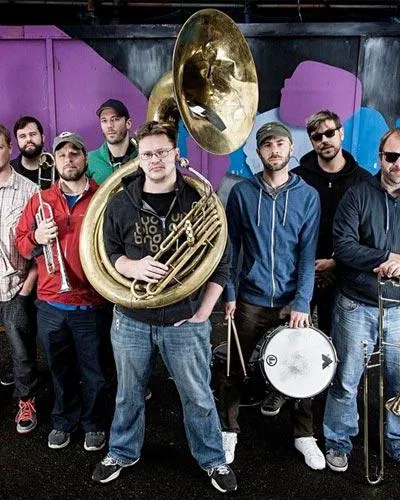
Rencontrez votre guru
Youngblood Brass Band fusionne les cuivres sans concession de La Nouvelle-Orléans avec l'énergie et le lyrisme du hip-hop. Issu de Madison, Brooklyn, Minneapolis et Chicago, ce groupe de dix musiciens tourne dans le monde entier depuis 2000 et a collaboré avec des artistes tels que Questlove et Talib Kweli. Il est tout aussi à l'aise à mener une fanfare sur ses propres compositions qu'à faire la tête d'affiche d'un festival de punk. Sur MusicGurus, ils décomposent leur son mêlant La Nouvelle-Orléans et hip-hop : comment ils composent et arrangent pour les cuivres, le vocabulaire rythmique et harmonique qui relie le tout, et comment jouer une ligne de cuivre au sein d'une section soudée, y compris les parties complètes de leur morceau 'Brooklyn'.







