



Improviser en utilisant les notes d'accord
Utilise les notes d'accord pour improviser sur une progression d'accords complète, et non un seul accord à la fois, et joue tes premiers solos mélodiques.

Le contenu du cours
41 leçons (2h 51min) · 1 gratuites
01. Introduction aux approches de l'improvisation
1:00
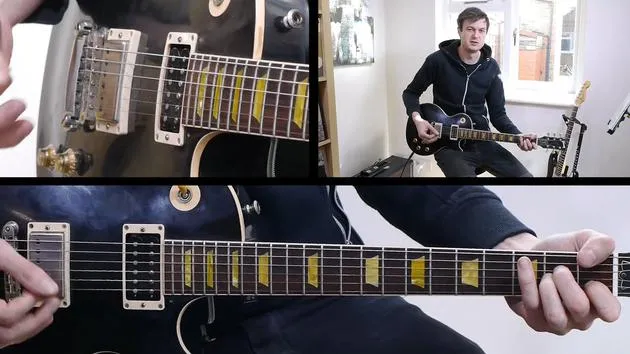
02. Premiers pas avec l'improvisation
9:22
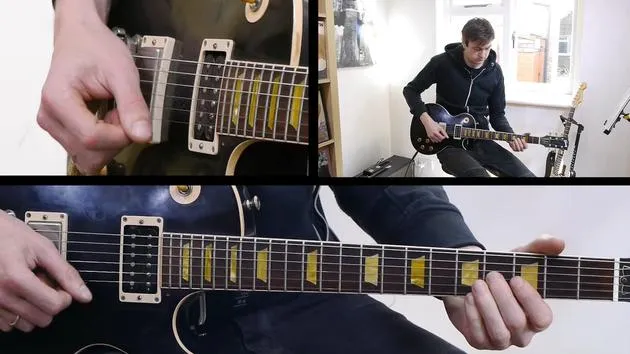
03. Exercice : trouver les notes des accords
4:05
04. Improviser en utilisant les notes d'accord
Tu es ici10:18
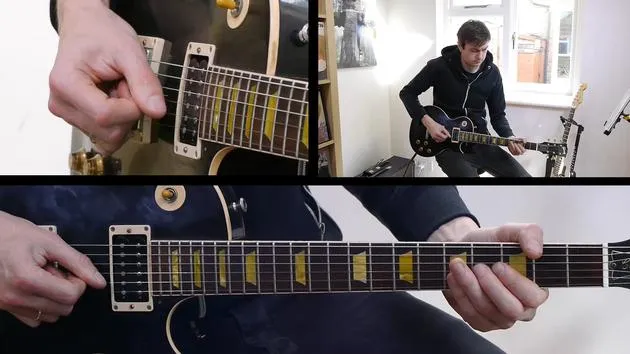
05. Ajouter de l'intérêt rythmique à tes solos
4:11
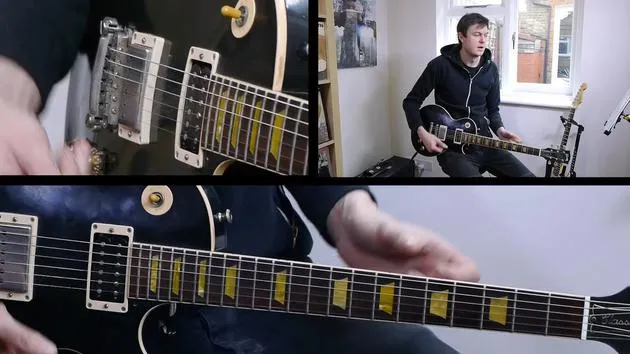
06. Exercice : improviser sur un changement d'accord
2:52
07. Défi : Envoie ton impro
0:24
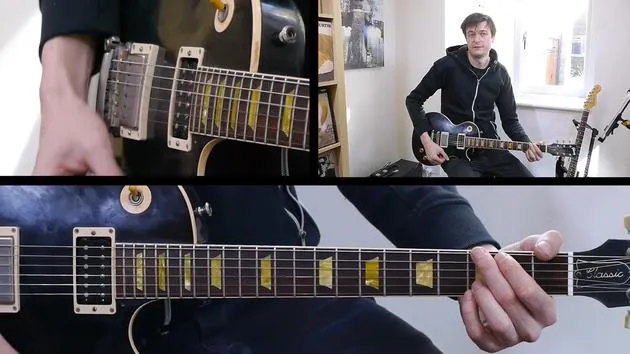
08. Impro rythmique et comping
9:55



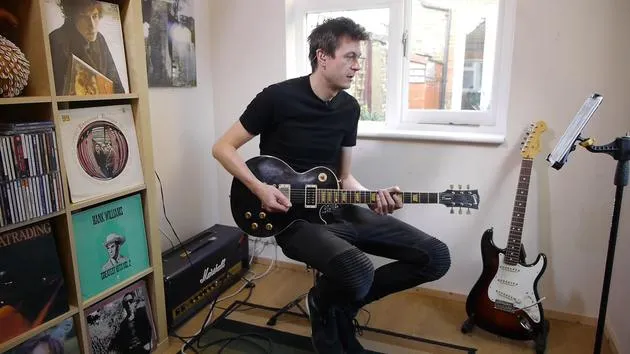
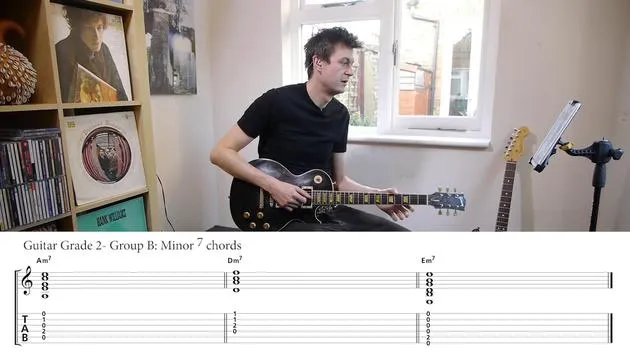
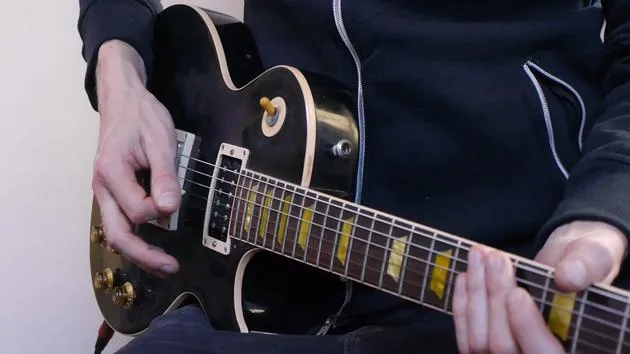
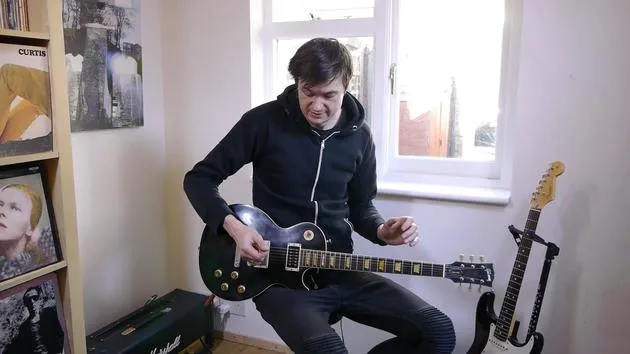
Transcription de la leçon
Music Lesson: Chord Progressions and Improvisation
Okay. So if you listen to any popular song, you're likely going to hear that, in fact, there are more than one chord featured underneath a melody or an improvised section. And this is really important. We need to be comfortable playing over more than one chord, not just one chord at a time. So we're going to tackle that now using exactly the same idea that we've just discussed: the chord tone idea.
Example 1: Chord Progression in C Major
Let's take a look at Example 1 on the PDF. This is a four-chord, four-bar chord progression in the key of C major, featuring the chords:
- C
- A minor
- F
- G
We're going to loop that progression.
Playing the C Major Scale
What I'm going to do to start with is just play the C major scale over that chord progression so you can hear how that scale works at some points and not at others. Then, I'll play a melody that targets specific chord tones in those chords. This is a really great exercise that you can do. We'll simplify this in a second as well.
Let's have a go at it now. So let me just lay down the chords for you.
2, 3, 4...
Okay, so there's our loop going. What I'm going to start by doing is just playing the C major scale for you.
1, 2, 3... Here's chord one.
We can definitely hear that this scale is the correct choice for that particular progression.
Targeting Chord Tones for Melody
Let's just play a little melody now, targeting the specific notes of the chord.
If you remember, we have three notes in each chord:
- For a major chord: root, third, and fifth.
- For the A minor chord: root, flattened third, and fifth.
I'm just going to play some really simple melodies here.
So what I've basically done there is improvised a really simple melody using arpeggios.
Understanding Arpeggios
If the term arpeggio is new to you, it simply means the notes of a chord played individually. So, the whole concept we've been discussing so far revolves around chord tones. If we combine chord tones together, we are playing arpeggios, the notes of the chord individually.
This is a fantastic approach to improvisation because you can't fail to play great notes over the chord at that point in time. Since you're only playing notes that feature in that chord, you can't really go wrong.
Arpeggios is tool number two that is extremely useful to you.
The Importance of Exploring Arpeggios
At the early grades, you might not have access to arpeggio shapes in your grade, but it's well worth exploring these tools. They are just as useful as scales.
Remember, try playing arpeggio shapes over each bar to reflect the chord that you're playing over, and it will sound really great.
Let's pop that one back on again and have a little jam.
The Importance of Repetition in Improvisation
Just towards the end there, something I wanted to demonstrate was that you don't need to come up with new ideas for every single bar.
In a diatonic chord progression like this, where all the chords come from the same scale, many of these chords will feature the same notes. Therefore, we can actually play the same notes over different chords, and that note will have a different relationship to each chord as it changes.
Let's demonstrate that.
I'm going to play a C note over this chord progression, and you'll see how the sound of that C has a different relationship as the chords go by underneath.
3, 4...
Okay?
Hopefully, you heard that the C worked great over chords 1, 2, and 3 (C, A minor, and F) because it is a chord tone in each of those chords.
- In the C major chord, it's the root note.
- In the A minor chord, it's the flattened third.
- In the F major chord, it's the fifth.
Exploring Different Relationships to Chords
So, it had a different relationship to each chord, but it worked because it's a chord tone for each of those.
Now, over the G chord, it didn't necessarily sound bad, but it did have a more pensive, tense sound to it since it's not a chord tone of G. In fact, it's the fourth degree of G. I thought it sounded really cool, actually.
On the repeat, I just lowered that C note to a B, which is a chord tone of G (the third in the key of G). That maintained a resolved sound throughout.
It's another good example of not needing to overcomplicate improvisation.
Using Octave Shapes
If we had a bit of distortion on that, we could apply a restriction and say, "Right, we're going to improvise but use octave chords over that chord progression." I think that would work really well.
*Okay, so that's just me using one technique, an octave shape, to come up with a melody.
There were a few fluffs in there, but that's part of improvisation; you just get on with it and you keep playing.*
Playing Along a Single String
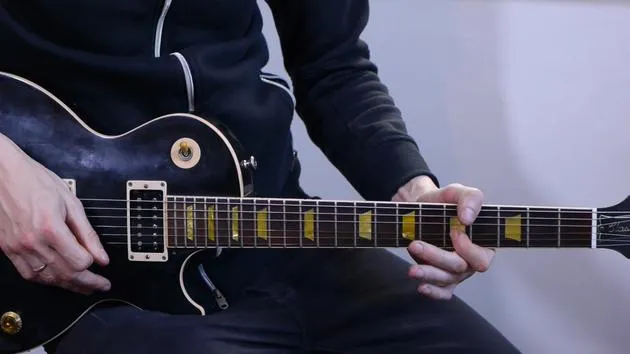
What I'd like to talk about now is playing in that manner on a single string. If you're new to the theory behind scales, it can be tricky to visualize where the notes are that you want to hear within a particular scale shape across the strings.
A great approach is just to pick any string on the guitar and play along that string rather than across. It gives you a better sense of the distances between the notes in the scale.
So, let's pop that loop back on and we'll just play the C major scale up the B string.
We're going to start down here on this C, and if we do it right, we'll end up an octave higher on the 13th fret of the B string.
Okay, let's try that out.
We can start to play with kind of slidy melodies. That's just another way of coming up with some melodies along a single string. You can exaggerate some notes as well, which sounds really cool.
This is just another idea you can try. It works really, really well, so I hope that was useful.
Conclusion
Let's check out another idea.
41 leçons
2h 51m de leçons vidéo structurées
Fonctions vidéo avancées
Ralentissez, bouclez un passage, suivez la partition
Mobile, tablette et ordinateur
Pratiquez où vous voulez
Satisfaction garantie à 100 %
Garantie remboursement 30 jours







