



Ajouter la main droite/comping
Dans cette leçon, tu vas réunir les deux mains. Paddy présente aussi de simples idées rythmiques pour la main droite afin d'ajouter de l'intérêt.
Le contenu du cours
10 leçons (1h 49min) · 1 gratuites
01. Pour commencer : le blues à 12 mesures
12:20
02. La salle des machines : basse à la main gauche
9:31
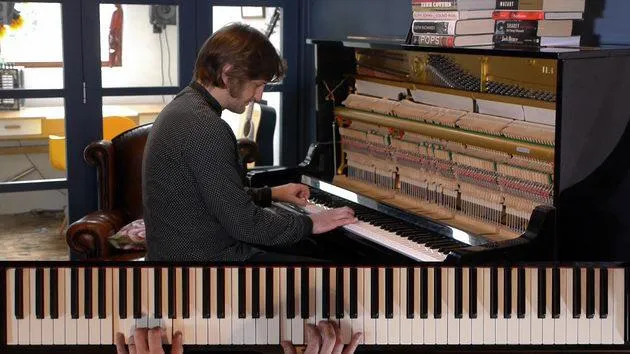
03. Ajouter la main droite/comping
Tu es ici11:47

04. Développer l'harmonie : accords de septième et renversements
15:27
05. Riff main droite n° 1 et variations
13:20

06. Riff de main droite n° 1 : autres variations
14:39
07. La « gamme blues » et ses usages
10:41
08. Fin nº 1 et variations
9:26
09. Tout mettre ensemble
10:34

10. La sale douzaine - Le défi du blues à douze mesures
1:59
Transcription de la leçon
12-Bar Blues: Bringing It All Together
Welcome back! In this lesson, we will:
- Bring the two hands together
- Elevate the 12-bar blues
- Make it more interesting
Getting Started
First, I'm assuming that you've got the left hand down pretty fluently and you can play this pattern throughout the whole 12-bar blues. You really need to master that before we can explore the more fun stuff in the right hand.
Putting It All Together
When we first looked at the 12-bar blues, we played it like this. Now, let's try combining the right hand with the left hand. It should sound something like this:
- Chord of C
- Right hand playing crotchet (quarter note) beats
- Left hand playing the bass pattern
The right hand will play on every other note that the left hand plays. If we play this over the whole 12-bar, it will sound like this:
- Bars 2-5:
Moving from C up to F (with a little variation in the left hand), then to G, back to F, and finishing on G before returning to C to start the whole sequence again.
Practice Tips
The aim is to get this as fluent and automatic as possible. Here are some tips:
-
Start Slow:
Begin at the slowest tempo that feels comfortable. -
Coordinate the Hands:
Ensure you are playing the right hand on every other note of the left hand. -
Smooth Transitions:
Practice changing between chords without breaks.
Specific Chord Changes
You can practice transitions between chords like we did in the previous lesson. For instance:
- C to F
- C to G
- G to F
Break it down to two beats each to improve your flow:
- One measure per chord: e.g., C to F, then back to C.
Feel free to develop your own practice routines.
Creative Practice Techniques
I encourage you not just to learn what I'm teaching, but to come up with your own creative ways to make music. Here are some additional practice tips:
-
Vary Volume:
Play at different volumes. This helps develop muscle memory and a deeper understanding of the music.- Practice quietly and then as loudly as you can.
-
Hands Independence:
Practice each hand at different volumes.- For example, play the left hand loudly and the right hand softly.
Exploring Rhythmic Variations
Once you've got the rhythm down fluently, let's explore playing the right hand on the offbeat. This creates a more authentic blues sound.
- Offbeat Playing:
Rather than playing on the beat, target the second and fourth notes of the left hand.
As you practice the 12-bar progression, it will instantly sound more blues-like. You can hear this style in many songs, especially in jump swing blues records by artists like Louis Prima and Louis Jordan.
Final Rhythmic Variation
Before we finish this lesson, let's look at one more rhythmic variation in the right hand.
- Two-Bar Cycle:
It starts off and smoothly continues with the corresponding chords.
Try to master this rhythm over the 12-bar blues. Remember, you can always rewind and watch it again; feel free to play along with me!
Get Creative
Experiment with your own rhythms. Keep these tips in mind:
-
Driving Forward:
Ensure the music maintains momentum. -
Improvise:
Reverse elements, double them up, or mix them.
This is all about improvisation and bringing your unique style to the music.
Looking Ahead
In the next lesson, we will explore some simple right-hand riffs to show you various techniques for developing and varying them. This will be a great addition to your left-hand patterns!
10 leçons
1h 49m de leçons vidéo structurées
Fonctions vidéo avancées
Ralentissez, bouclez un passage, suivez la partition
Mobile, tablette et ordinateur
Pratiquez où vous voulez
Satisfaction garantie à 100 %
Garantie remboursement 30 jours
Rencontrez votre guru

Rencontrez votre guru
Paddy Milner est reconnu comme l'un des meilleurs pianistes de blues au monde : il est actuellement le claviériste attitré de Sir Tom Jones, après plusieurs années aux côtés du grand et regretté Jack Bruce, mais c'est aussi un superbe auteur-compositeur original et un chanteur au timbre singulier. Il suffit de lire les éloges de personnalités comme Dave Brubeck ci-dessous ! Son jeu figure sur la bande originale du film à succès 'Rocketman' (2019).
Il a remporté à deux reprises le prix du Meilleur claviériste aux British Blues Awards et occupe de longue date une résidence en tant que membre fondateur du Ronnie Scott's Blues Explosion au club mondialement réputé Ronnie Scott's.
Son groupe actuel LONDONOLA joue une musique britannique maison teintée d'une bonne dose d'esprit de La Nouvelle-Orléans, et son projet collectif JAWBONE va de succès en succès depuis la sortie de son premier album éponyme.
- « J'adore... voilà un gars qui sait vraiment jouer du piano » - Dave Brubeck
- « Je le recommande vivement. D'une certaine manière, tout se met à aller beaucoup mieux ! » - Jack Bruce
- « Le meilleur pianiste de blues d'Europe... » - Blues Access, USA
- « Impressionnant et original » - The Times
- « Éblouissant » - The Independent
Au fil de ses cours, Paddy décortique l'authentique shuffle de blues, le slow blues, le boogie-woogie, le rock 'n' roll et le piano de La Nouvelle-Orléans - jusqu'à trois grands classiques du boogie-woogie - pour que vous appreniez ces styles auprès de l'un des tout meilleurs du métier.







