



Fin nº 1 et variations

Lesson time: (9min 18sec)
Dans cette leçon, tu apprendras une fin standard simple pour tes improvisations de blues, ainsi que des variations simples de cette fin.
Course preview
This lesson is part of the course Joue du piano blues authentique
Watch a preview of the full course below.
Lesson transcript:
Ending Your 12 Bar Blues
Welcome back!
So, hopefully, we're at a point where you're playing some pretty cool stuff over at 12 Bar Blues.
The Importance of Ending a Song
What happens when you want to finish the song? You can't just stop and take your hands off the piano.
"Well, you could, as Miles Davis said to Coltrane, just take the horn out of your mouth."
Let's look at a basic ending, which has many variations and extensions to explore.
Common Ending
Here's a common ending that sounds like this: (sample sound here)
In context, if I play the end of a 12 bar, from bar 9 of the 12 bar blues, you'll be able to hear how it sounds in context.
Count: 1, 2, 3, 4.
Notes Breakdown
I will show you a few little variations on that.
Left Hand:
The left hand notes are:
- C
- B flat
- A
- A flat
- G
- G
- A low G (if you want)
- Back to C
- A low C
Right Hand:
The right hand starts on beat two:
- Count: 1, 2, 3, 4, 1.
- You could play the chord C at the end or a C7 even.
- We can be in that third inversion or just play the root position.
Putting Them Together:
Now, I have added a couple of notes there just out of pure habit. I've added that first note, which comes after the first left hand note and before the second left hand note.
Count: 1, 2, 3, 4, 1.
Fingering Options
In terms of fingering, you can either:
- Play in the right hand where the C stays the same as the other fingers go down.
- Or play in a way that feels comfortable for you.
When putting them together, you'll notice those notes are moving at the same time, outlining the basic harmony of this ending.
Expanding the Harmony
To expand further on that, it comes from this kind of 5-1 progression. I will look at all that kind of stuff in more advanced courses.
For now, in the left hand, I've added a seventh. You could also add a sharp five on the G7 chord.
Count: 1, 2, 3, 4, 5.
If we go up the scale and it is sharpened, with that A in the right-hand melody, this gives a distinctive sound, which you'll find a lot in New Orleans music, especially this kind of thing.
Characteristics: Sharp five and the ninth.
Back to the Key of C
Back in the key of C, the ending can be played as some form of C7, whichever C7 you want, really, at the end.
I did a little slide up there, which you can do as well. You can do anything you want, there are no rules in this game.
Practice Tips
I know I've gone off on a bit of a tangent, but here are some practice tips:
- Start at a tempo that's comfortable to you, however slow it might be, use that metronome, it's all good.
- Context: Putting it into context is more difficult, so make it run fluently out of the F chord.
Count: (transition smoothly to ending).
Again, practice it at a slow tempo and gradually increase the tempo.
Thinking Ahead
When changing chords, it's good to think ahead about the notes and the hand position of where you're going to be.
- Perhaps on bar nine, when you're on the G and moving down to the F, just as you're about to hit that ending, really think about where your hands will be.
- From the G, have a think so you're ready, your hands are there.
- Notice that my right hand was ready and waiting for that ending.
The left hand was still busy, so it couldn't move, but it knew where it was going, and that's really important.
Conclusion
That's an ending for you!
In the next video, I'm going to put everything we've learned in this course together. You'll see some of the things we've practiced being put into action, along with suggestions for creative things you can do with it.
I hope you've enjoyed everything so far, and enjoy the last video where I'll show you some of the creative possibilities!
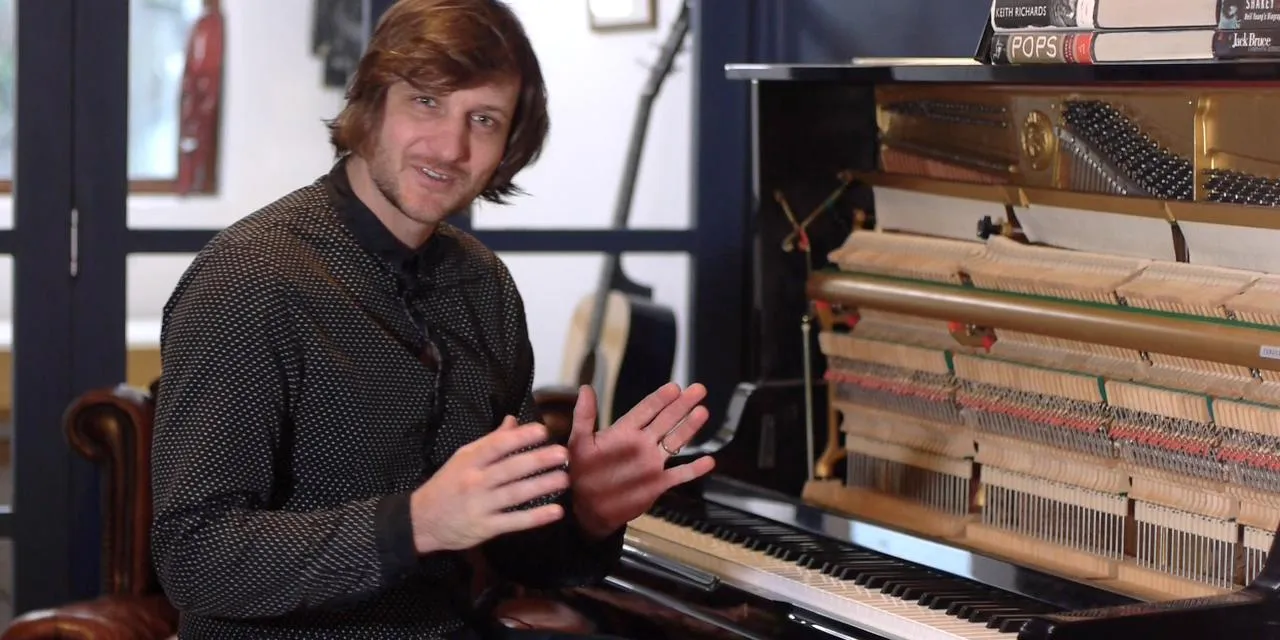
About the instructor
Paddy Milner est reconnu comme l'un des meilleurs pianistes de blues au monde : il est actuellement le claviériste attitré de Sir Tom Jones, après plusieurs années aux côtés du grand et regretté Jack Bruce, mais c'est aussi un superbe auteur-compositeur original et un chanteur au timbre singulier. Il suffit de lire les éloges de personnalités comme Dave Brubeck ci-dessous ! Son jeu figure sur la bande originale du film à succès 'Rocketman' (2019). Il a remporté à deux reprises le prix du Meilleur claviériste aux British Blues Awards et occupe de longue date une résidence en tant que membre fondateur du Ronnie Scott's Blues Explosion au club mondialement réputé Ronnie Scott's. Son groupe actuel LONDONOLA joue une musique britannique maison teintée d'une bonne dose d'esprit de La Nouvelle-Orléans, et son projet collectif JAWBONE va de succès en succès depuis la sortie de son premier album éponyme. « J'adore... voilà un gars qui sait vraiment jouer du piano » - Dave Brubeck « Je le recommande vivement. D'une certaine manière, tout se met à aller beaucoup mieux ! » - Jack Bruce « Le meilleur pianiste de blues d'Europe... » - Blues Access, USA « Impressionnant et original » - The Times « Éblouissant » - The Independent Au fil de ses cours, Paddy décortique l'authentique shuffle de blues, le slow blues, le boogie-woogie, le rock 'n' roll et le piano de La Nouvelle-Orléans - jusqu'à trois grands classiques du boogie-woogie - pour que vous appreniez ces styles auprès de l'un des tout meilleurs du métier. read more