



La salle des machines : basse à la main gauche

Lesson time: (9min 24sec)
Paddy Milner enseigne un motif de basse blues classique à la main gauche sur la forme à 12 mesures, avec des conseils de pratique et une variation pour aller plus loin.
Course preview
This lesson is part of the course Joue du piano blues authentique
Watch a preview of the full course below.
Lesson transcript:
Introduction to Blues Piano: Lesson on Left Hand Pattern
Welcome back to this Introduction to Blues Piano course. In this lesson, we're going to be looking at our first left hand pattern, which is a very authentic left hand pattern that piano players have been using for decades.
Historical Context
This pattern is featured on loads of classic records by renowned artists like:
- Johnny Johnson
- Pine Top Perkins
The Left Hand Pattern
The left hand pattern is very simple, and it goes like this:
- Start with two notes together: C and G
- Followed by another two notes together: C and A
We are playing it with a shuffle rhythm:
- Two notes together, then another two notes with that interval.
Technique
- Keep the bottom note: Stay on C.
- Change the top note: Alternate between G and A.
Note: Using different fingers for the top notes requires no hand movement. While you could use your thumb for the G, that movement is best to avoid, as a good piano player is an efficient one. Less movement requires less energy.
Applying the Pattern to 12 Bar Blues
To apply this pattern to our blank canvas of the 12 bar blues, we play:
- 4 bars of C
- 2 bars of F
- Then transpose the bass line up to F:
- Move the pattern up to the F chord: F (fifth) and D (sixth).
- Up to G: G (fifth) and E (sixth).
Example Playthrough
If I play that bass line over the whole 12-bar sequence, it sounds like this:
- 1, 2, A
- 1, 2, 3...
- 4 (3 bars)
- Up to F6
- Down to C (7, 8)
- Up to G9
- Down to F
- Back to C
- G for the last bar
- Back to C to start the sequence again.
So there you go! That is an authentic left hand pattern.
Practicing the Pattern
To practice:
- Make it automatic and fluent.
- Changing between chords should have no gaps.
Practice Tips:
- You can practice the whole sequence.
- Focus on a bar of each chord:
- Example: A bar of C (2, 3, 4), then a bar of F, then back to C.
Once it feels natural, try not to look at the keys.
- Start at a slower tempo. Using a metronome can help.
- Ensure a steady tempo; master the changes before increasing speed.
As you practice:
- Start slowly, focusing on the transition to F, ensure there is no break.
- Gradually increase speed while maintaining fluency.
Importance of a Steady Left Hand
This left hand is essential as it serves as the engine room and rhythm section underneath what you will learn for the right hand. Ideally, if you can read a book while playing the left hand pattern, you're in a good place!
Additional Practice
- Change between chords: Focus on transitions like C to G and G to F.
- You can also reduce practice to two beats each to get accustomed to the chord changes.
Adding Variations
As you become comfortable, consider adding a seventh:
- In the key of C, this would be B flat.
- In F, it's E flat.
- In G, it would be F.
Demonstration
I'll demonstrate this with some right hand ideas (not for you to learn yet) to show how the left hand fits in with it.
Listen for the little variation in the left hand, it's not every time, but you'll hear it.
Conclusion
You've just learned how to incorporate a left hand pattern into your blues piano playing. Keep practicing those transitions and variations, and you'll be right on track!
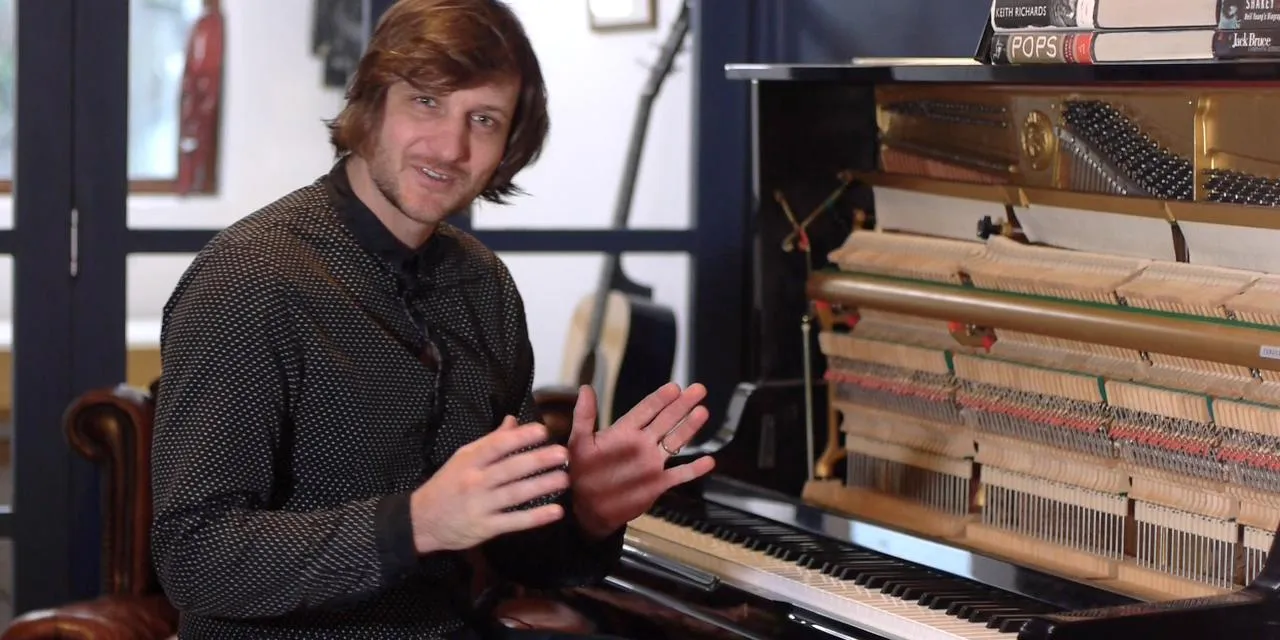
About the instructor
Paddy Milner est reconnu comme l'un des meilleurs pianistes de blues au monde : il est actuellement le claviériste attitré de Sir Tom Jones, après plusieurs années aux côtés du grand et regretté Jack Bruce, mais c'est aussi un superbe auteur-compositeur original et un chanteur au timbre singulier. Il suffit de lire les éloges de personnalités comme Dave Brubeck ci-dessous ! Son jeu figure sur la bande originale du film à succès 'Rocketman' (2019). Il a remporté à deux reprises le prix du Meilleur claviériste aux British Blues Awards et occupe de longue date une résidence en tant que membre fondateur du Ronnie Scott's Blues Explosion au club mondialement réputé Ronnie Scott's. Son groupe actuel LONDONOLA joue une musique britannique maison teintée d'une bonne dose d'esprit de La Nouvelle-Orléans, et son projet collectif JAWBONE va de succès en succès depuis la sortie de son premier album éponyme. « J'adore... voilà un gars qui sait vraiment jouer du piano » - Dave Brubeck « Je le recommande vivement. D'une certaine manière, tout se met à aller beaucoup mieux ! » - Jack Bruce « Le meilleur pianiste de blues d'Europe... » - Blues Access, USA « Impressionnant et original » - The Times « Éblouissant » - The Independent Au fil de ses cours, Paddy décortique l'authentique shuffle de blues, le slow blues, le boogie-woogie, le rock 'n' roll et le piano de La Nouvelle-Orléans - jusqu'à trois grands classiques du boogie-woogie - pour que vous appreniez ces styles auprès de l'un des tout meilleurs du métier. read more