



3 exercices de bending avec pistons
Avec
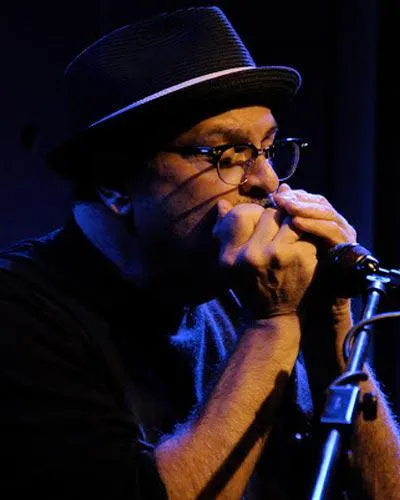
PT GazellPT Gazell passe en revue des exercices de bending avec pistons qui travaillent le draw bend du trou sept, le valve draw bend et le blow bend du trou six, en visant des bends propres et détendus.
Le contenu du cours
10 leçons (0h 50min) · 1 gratuites
01. Comment cibler et affiner notre technique de bending
5:35
02. Comprendre les bends avec valve
Leçon gratuite4:59
03. Un autre exercice de bend en demi-piston
5:09
04. 3 exercices de bending avec pistons
Tu es ici4:45
05. Utiliser des bends avec et sans pistons pour explorer tout l'instrument
3:54
06. Utiliser un valve blow bend dans une mélodie (My Romance)
6:05
07. Exploiter l'émotion supplémentaire qu'offre la méthode Gazell
6:59
08. Le mineur en 5e position comme alternative au mineur en 3e position
5:07
09. Apprends le thème du morceau « Sugar » en 5e position mineure
3:40
10. Apprendre un solo pour « Sugar » et comment jouer le morceau en entier
4:11
Transcription de la leçon
Valved Bending Exercises
Alright, I'd like to play another valved bending exercise that I want you guys to practice. This one starts on the seven draw bend and ends up using the seven draw bend, valve draw bend, and the six blow bend.
Exercise Overview
- Starting Note: Seven valve draw bend
- Ending Note: Sixth valved blow bend
Listen to what I play.
I'll play it again. The important thing here is to get good clean bends again.
- Don't force it.
- Stay relaxed.
- Use the increments of your mouth and that focused stream that we talked about to be able to execute the seven draw bend and the six blow bend.
Key Points
- Remember: the valve bends happen more towards the front of the mouth, similar to our conventional blow bending at the top of the harmonica, but even up one more notch is probably a good way to think about that.
I'll play this exercise one more time, and you can check that, of course, on your PDF and practice it on your own as well.
Second Valved Bending Exercise
Okay, here's the second valved bending exercise. This is another good little routine for you to start to get the feel for how to:
- Move around
- Connect the valved bends as half steps into the riffs that you already know
This one employs:
- Six blow bend
- Five blow bend
- Seven draw bend
- Eight draw bend
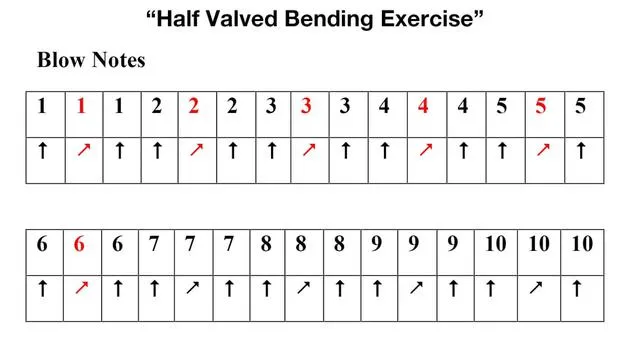
Listen to me play it. I'm going to play it slower. Follow along on the PDF so you can see how I'm playing the notes.
- Remember, the ones in red are the valved bends.
Third Valved Bending Exercise
Great. And finally, here's the third valved bending exercise. This one's not only designed to get you used to playing some of the valved bends, both blow and draw, but it's also designed for you to utilize:
- A conventional blow bend at the top
- A valved blow bend at the bottom
It covers running from the top of the harmonica all the way to the bottom. It's a great exercise.
Let me play it for you at speed and then we'll slow it down and I'll play it again. Follow your tab.
- Remember: the red indicates that it's a valved bend that I'm doing.
I'm going to play it slow now, so we're starting on nine blows.
One more time slowly. Listen for that number two valved blow bend at the bottom. The valve bend was the second last note.
I'll play it one more time.
Practice that one hard. Because you're not only using valve bends and conventional bends, but you're going from the top of the harmonica all the way to the bottom.
It's a great exercise that really gets you familiar with where all the notes are on the harmonica.
10 leçons
0h 50m de leçons vidéo structurées
Fonctions vidéo avancées
Ralentissez, bouclez un passage, suivez la partition
Mobile, tablette et ordinateur
Pratiquez où vous voulez
Satisfaction garantie à 100 %
Garantie remboursement 30 jours
Rencontrez votre guru
Rencontrez votre guru
PT Gazell a gagné sa place de maître de l'harmonica diatonique. Après des années comme accompagnateur et musicien de studio très demandé pour certaines des plus grandes pointures de Nashville, PT a découvert le half-valving et sa musique s'est littéralement envolée vers de nouveaux sommets.
Aucun autre instrumentiste ne combine comme lui son phrasé, son style mélodique, ses choix de morceaux et ses capacités d'improvisation : au bout du compte, c'est un style qui n'appartient qu'à lui. À l'aide de son propre instrument signature, l'harmonica diatonique Gazell Method fabriqué par Seydel, PT prouve que l'harmonica est capable de bien plus que ce que la plupart d'entre nous imaginent.
Régale-toi !
Dans ses cours, PT enseigne le half-valving directement à la source, afin que tu puisses débuter avec le Gazell Method, maîtriser les bends valvés et les intégrer à tes propres morceaux.







