



Blues : Knox County Blues (leçon)
Avec
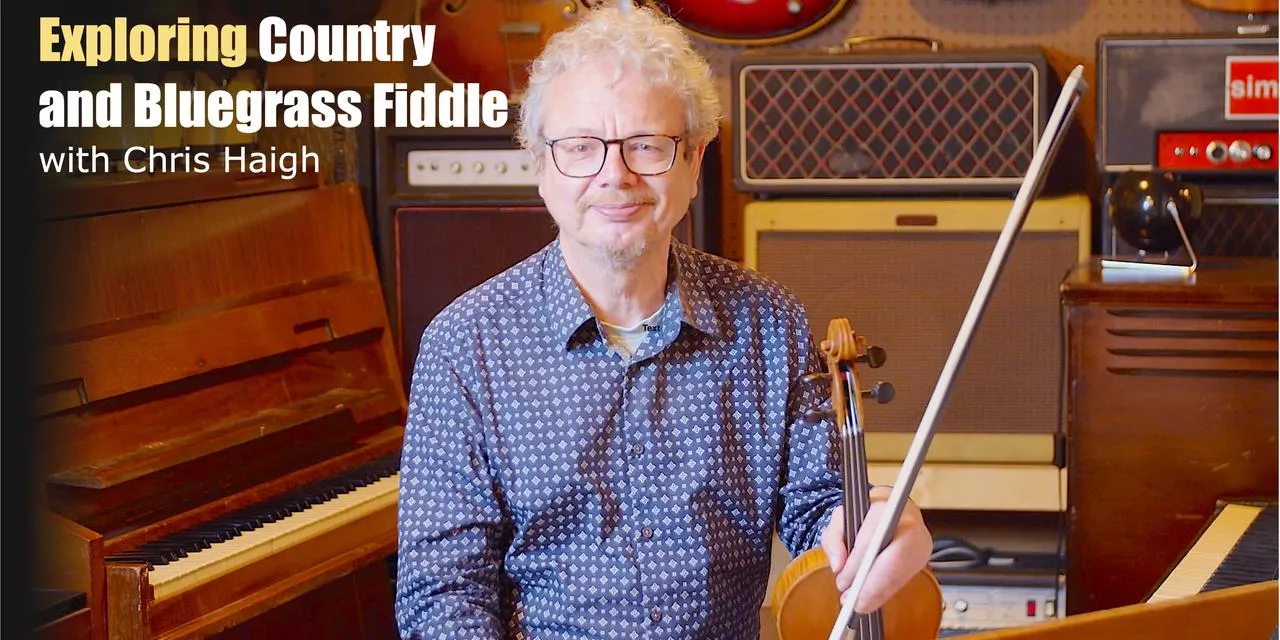
Chris HaighChris Haigh explore l'influence du blues sur le violon country à travers 'Knox County Blues', en abordant les bends de note, les slides et la syncope.
Le contenu du cours
25 leçons (1h 30min) · 1 gratuites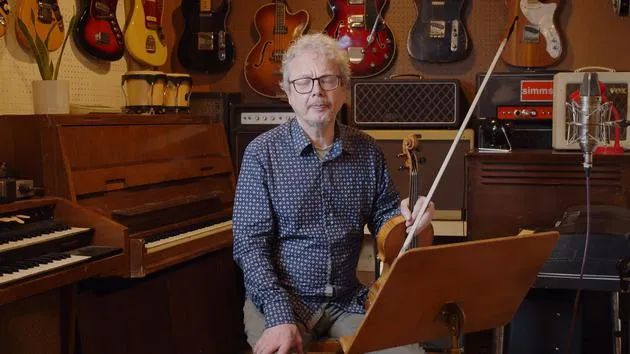
01. Le Georgia Shuffle
5:42
02. Whiskey Before Breakfast (Performance)
0:44
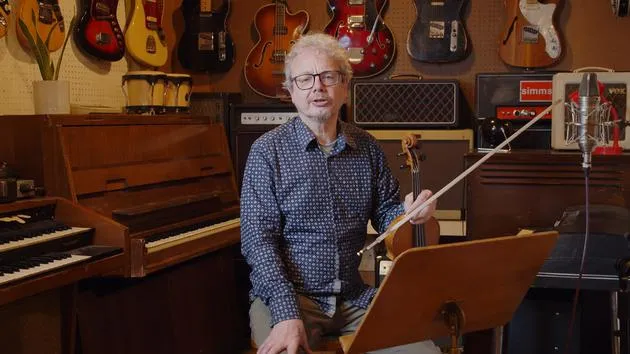
03. Doubles cordes dans Wednesday Night Waltz
8:34
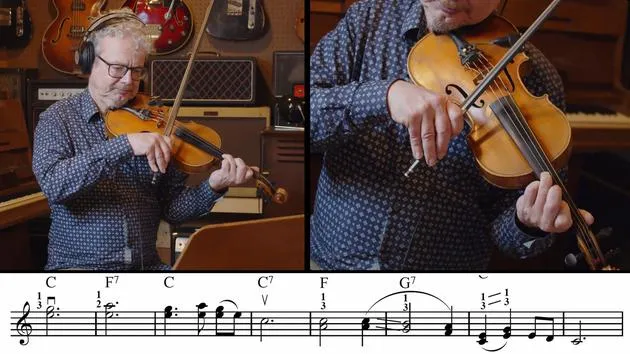
04. Wednesday Night Waltz (interprétation)
0:54
05. Plus de doubles cordes : Cheatem County Breakdown
4:06
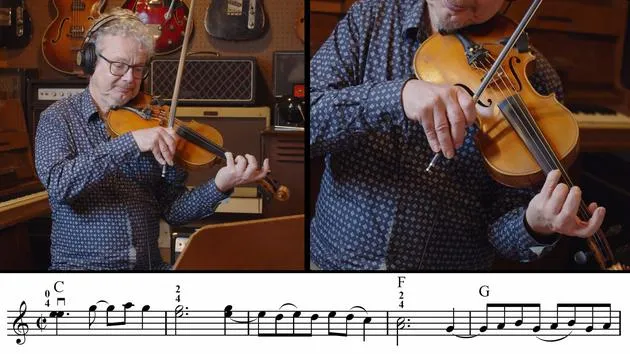
06. Cheatem County Breakdown (Interprétation)
0:44
07. Cowboys chantants : Yellow Rose of Texas
5:34
08. Yellow Rose of Texas (Interprétation)
0:22
01. Western swing : Beaumont Rag
9:50
02. Beaumont Rag (interprétation)
1:12
03. Bob Wills - Red River Valley
5:25
04. Red River Valley (Interprétation)
0:33
05. Violon à deux voix : gamme, Goodbye Liza Jane
3:35
06. Solos en Western Swing
5:06
07. Goodbye Liza Jane (interprétation en solo)
1:17
08. Licks de Western swing
9:19
09. Girl I Left Behind Me (analyse du solo)
2:33
10. Girl I Left Behind Me (performance solo)
0:28
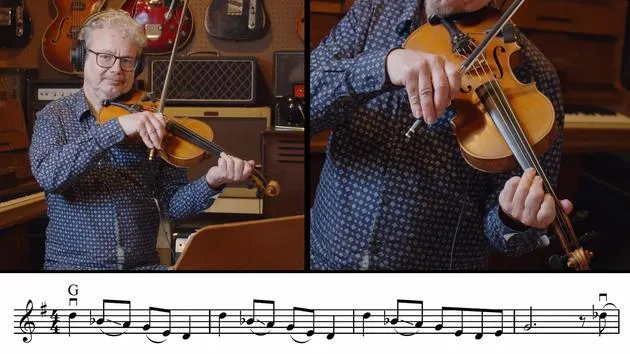
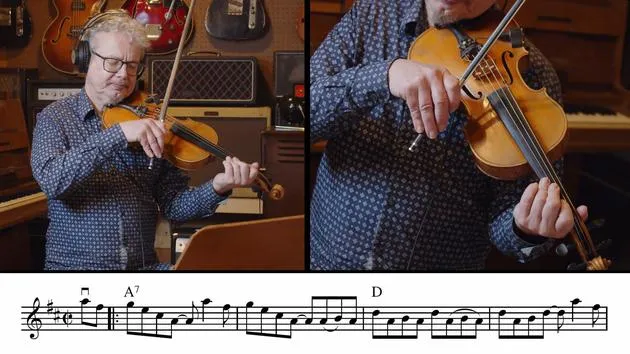
Transcription de la leçon
Music Lesson: The Blues
In this lesson, we're going to talk about the blues.
Importance of Blues in Country Music
Blues is a very important part of country music, originating from African American influences. Although country music is often seen as "white person's music," the African American contribution is essential. Here are four key elements we derive from African American traditions:
-
Bending and Sliding of Notes
This technique is fundamental to capturing the essence of the blues. -
Syncopation
Syncopation refers to when the accent in a bar comes in an unexpected place. For example:
(demonstrate with a rhythm)
This concept is crucial in old-time music and is heavily influenced by African American styles. -
12-Bar Blues Structure
The 12-bar blues is a sequence based on a specific set of chords. An example structure is as follows:- 4 bars of G
- 2 bars of C
- 2 bars of G
- 2 bars of D
- 2 bars of G
Any tune based on this chord sequence can be identified as a 12-bar blues.
-
Blue Notes
Blue notes, often flattened thirds, are a vital part of bluegrass, western swing, and country music.
All these features can be seen in the playing of early Black musicians.
The Knox County Blues
We're going to play a tune called The Knox County Blues, derived from the playing of the Tennessee fiddler Karl Martin, who recorded it in the 1930s. I strongly recommend checking out some of his recordings.
Chord Sequence of the Tune
Let's revisit the chord sequence of this tune:
- 4 bars of G
- 2 bars of C
- 2 bars of G
- 2 bars of D
- 2 bars of G
This is your standard blues sequence.
Playing the Tune
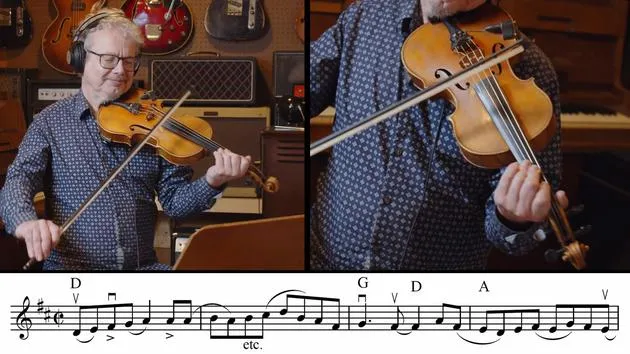
Now, I'm going to play through this slowly without backing and then we'll do it with backing. We'll incorporate lots of bending of notes.
Count:
1, 2, 3, 4.
For now, the hardest phrase is the last one:
- Start with the fourth finger playing a D on the G string.
- Slide down around a semitone, followed by an open G.
- Slur the three notes together.
- Use the second finger to play B flat and B for the last three bars.
Let's repeat that one more time slowly, and then we'll play with the backing.
Count Again: 1, 2, 3, 4.
Assignment for This Lesson
Your assignment for this lesson is:
- Listen to any blues music of your choice.
- Try to identify the key of what you're listening to.
- Follow along with the chords, identifying the I chord, the IV chord, and the V chord.
- Finally, attempt to play along with the blues song, particularly focusing on the roots of the chords.
25 leçons
1h 30m de leçons vidéo structurées
Fonctions vidéo avancées
Ralentissez, bouclez un passage, suivez la partition
Mobile, tablette et ordinateur
Pratiquez où vous voulez
Satisfaction garantie à 100 %
Garantie remboursement 30 jours
Rencontrez votre guru
Rencontrez votre guru
Chris Haigh est violoniste professionnel depuis 25 ans et possède une expérience dans de nombreux genres. Il a joué sur plus de 75 albums, aux côtés d'artistes comme Alison Moyet, Bob Geldof, All About Eve, Michael Ball, David Soul, Oumou Sangare, The Quireboys, Riverdance, Morcheeba, James Galway et Steps.
Il a joué du swing et du jazz avec The Kimbara Brothers, Diz Disley, Le Jazz, The Hot Club of London et les Quecumbar Allstars, et dirige un ensemble de swing soviétique à sept musiciens, The Kremlinaires.
Chris donne des cours et des ateliers sur la technique du violon jazz et a enseigné le violon jazz aux universités de Middlesex, Brunel et Newcastle ainsi qu'au Truro College. Parmi ses ouvrages figurent neuf livres consacrés au violon, dont The Fiddle Handbook.
Il anime également Fiddling Around (fiddlingaround.co.uk), sans doute la source d'information sur le violon la plus complète et la plus consultée du web.







