



Bluegrass : le chop
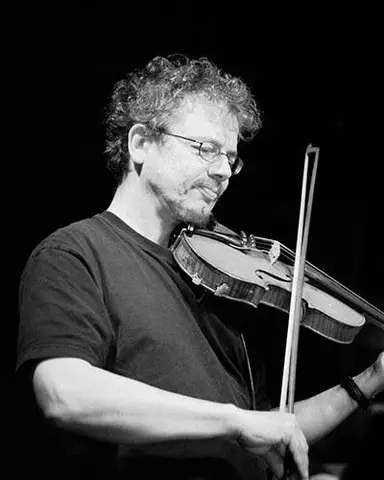
Lesson time: (7min 3sec)
Chris Haigh présente le 'chop' du bluegrass, la technique percussive de violon à contretemps utilisée pour accompagner les accords, les solos et le chant.
Course preview
This lesson is part of the course Fiddle bluegrass et country moderne
Watch a preview of the full course below.
Lesson transcript:
Music Lesson: Understanding the Chop
In this lesson, we're going to look at the chop. The chop has two meanings:
The Old Fashioned Chop
- This is an off-the-beat, percussive, two-finger technique.
- You can use it in bluegrass behind chords, someone else's solo, or singing, it's discreet and doesn't get in the way.
Richard Green's Technique
- Richard Green, the fiddle player who played with Bill Munro, developed his chops at the tip of the bow.
- He discovered that this method didn't provide much attack or control, so he shifted to chopping lower on the bow.
- With this technique, he replicated what the mandolin does as backing, creating a very percussive sound with minimal notes.
Exploring the Dual Sounds
- As you bring the bow off, you create two distinct sounds:
- On (dead sound)
- Off (musical notes)
This duality of sound is intriguing and adds depth to the chop technique.
The Influence of Darrell Unger
- Darrell Unger, a fiddle player in the mid-70s, played with the Turtle Island String Quartet, blending jazz, country, bluegrass, and rock.
- Without drums or guitar, the chop became essential to compensate for their absence.
- He developed the chop further by introducing a forward and backward bow movement, angling the bow slightly forward and playing at the heel.
Casey Dreeson's Evolution
- Darrell Unger taught this technique to Casey Dreeson, who took it to the next level.
- Casey began alternating chops with bowed notes, creating rock-type riffs and complex rhythms.
The Chop in Detail
I won't delve deep into this now, as it's a vast subject. Personally, I first learned the chop while writing Exploring Country in Bluegrass Fiddle. Inspired by Casey Dreeson, I became determined to master this technique.
Caveats of Chopping
- One downside of chopping is shown here on my fiddle, where I've worn off the varnish from frequent use.
- Another danger is social: if overly used at the wrong time or place, chopping can be annoying, leading to potential loss of friends and gigs!
Getting Started with Chopping
The Basics
-
Learn two-note chords to pair with any chord.
- For C, for example:
- First finger over third finger
- First finger over open
- Two over one
- Two over three
- Open over two
- For C, for example:
-
Chop Pattern:
-
Use the two-note finger shapes on the off-beats:
- 1, 2, 3, 4, 1
-
Instead of regular playing, perform the chop:
- Angle your bow forward, get down at the heel, push down hard for the 'on' sound, and lift for the 'off'.
-
This creates a pattern:
- Cha ka, check out.
- Example: "1, 2, 3, 4, 1, check out, check out, chat, check out, chat, check out, chat."
-
Practical Application
- You can integrate this with songs like Rolling My Sweet Baby's Arms for added rhythm.
- It's important to keep the chop in the background, unless you're Casey Dreeson, then the chop can take center stage.
Your Assignment
-
Watch Casey Dreeson's YouTube video, Working on a Building, where he chops while singing in a gondola up a mountain. This video inspired me to master chopping.
-
Practice obsessively for the next four years!
-
Avoid being fired from every band and losing all your friends!
Engage with this technique thoughtfully, and have fun!
About the instructor
Chris Haigh est violoniste professionnel depuis 25 ans et possède une expérience dans de nombreux genres. Il a joué sur plus de 75 albums, aux côtés d'artistes comme Alison Moyet, Bob Geldof, All About Eve, Michael Ball, David Soul, Oumou Sangare, The Quireboys, Riverdance, Morcheeba, James Galway et Steps. Il a joué du swing et du jazz avec The Kimbara Brothers, Diz Disley, Le Jazz, The Hot Club of London et les Quecumbar Allstars, et dirige un ensemble de swing soviétique à sept musiciens, The Kremlinaires. Chris donne des cours et des ateliers sur la technique du violon jazz et a enseigné le violon jazz aux universités de Middlesex, Brunel et Newcastle ainsi qu'au Truro College. Parmi ses ouvrages figurent neuf livres consacrés au violon, dont The Fiddle Handbook. Il anime également Fiddling Around (fiddlingaround.co.uk), sans doute la source d'information sur le violon la plus complète et la plus consultée du web. read more