



Bluegrass : Licks de Chubby Wise
Lesson time: (5min 25sec)
Chris Haigh décompose les licks caractéristiques de violon bluegrass de Chubby Wise, le violoniste de Bill Monroe, y compris les mouvements d'accords classiques G7 et C7.
Course preview
This lesson is part of the course Fiddle bluegrass et country moderne
Watch a preview of the full course below.
Lesson transcript:
Lesson on Chubby Wise and Moore Bluegrass
Hello! In this lesson, we're going to explore Moore bluegrass through the playing of Chubby Wise.
Who is Chubby Wise?
- Chubby Wise was the fiddle player for Bill Monroe and the Bluegrass Boys from 1942 to 1948.
- He later joined the Foggy Mountain Boys, which was the band of Earl Scruggs and Lester Flatt.
- Many of Bill Monroe's fiddle players eventually joined this group.
- Chubby Wise set the standard for all future bluegrass players and had many standard licks and approaches that fiddle players have copied for generations.
Chord Changes and Techniques
By this time, the chords used in bluegrass had developed slightly. Here are some common chord transitions:
- When moving from a G to a C, you'd often go from a G to a G7, then from a C to a C7, back to the G.
- Chubby Wise often signposted these changes with his fiddle playing.
Example Lick
- Start with G over B.
- Play an F natural, this serves as the seventh of the G7, indicating the next chord will be a C.
- Next, play a B flat under the C, which is the seventh of the C.
- This smoothly transitions back into the G chord.
Chubby Wise emphasized chord changes, often highlighting them in his play.
Bluesy Influences
Chubby Wise had a bluesy style, utilizing many flattened thirds and flattened sevenths. Here's a little phrase that incorporates both:
- Start with G.
- The second note is a flattened seventh followed by a flattened third.
- Slide up from the flattened third (the blue note) to a natural third.
Tip: When playing this lick quickly, try to incorporate some slurs to accomplish the entire movement in two bows.
Root Over Fifth Technique
Another distinctive bluegrass sound is the root over a fifth technique:
- For an F chord, play the fifth below it using the second finger.
- Move this technique to G (play the fifth below it) and to A, using the first finger on A in the third position.
- Incorporate this into solos or as part of the melody for added flair.
Hemiola Technique
Chubby Wise also enjoyed using a hemiola, a three-note phrase repeated immediately several times:
- Since it's played over 4/4 time, every repetition will land in a different part of the bar.
Double Stop Hemiola
For a double stop hemiola:
- Start with an F sharp and a C sharp below it (first finger over second finger).
- Begin this phrase 1/2 step down and count it out: 1, 2, 3, 4, 1.
This technique adds a significant depth to your playing. It may sound complex, but it's quite accessible once you get the hang of it.
Assignment
Your assignment for this lesson is to:
- Listen to Chubby Wise solos. Focus on the earliest Bill Monroe recordings with his Bluegrass Boys from 1942 and the following years.
- Try to identify some of his licks or ideas.
- Experiment with these licks in different keys, such as D or G. Mastering the ability to move licks into various keys will enhance your versatility as a bluegrass player.
Now, let's play Rolling My Sweet Baby's Arms again, this time incorporating some Chubby Wise licks in the key of A!
About the instructor
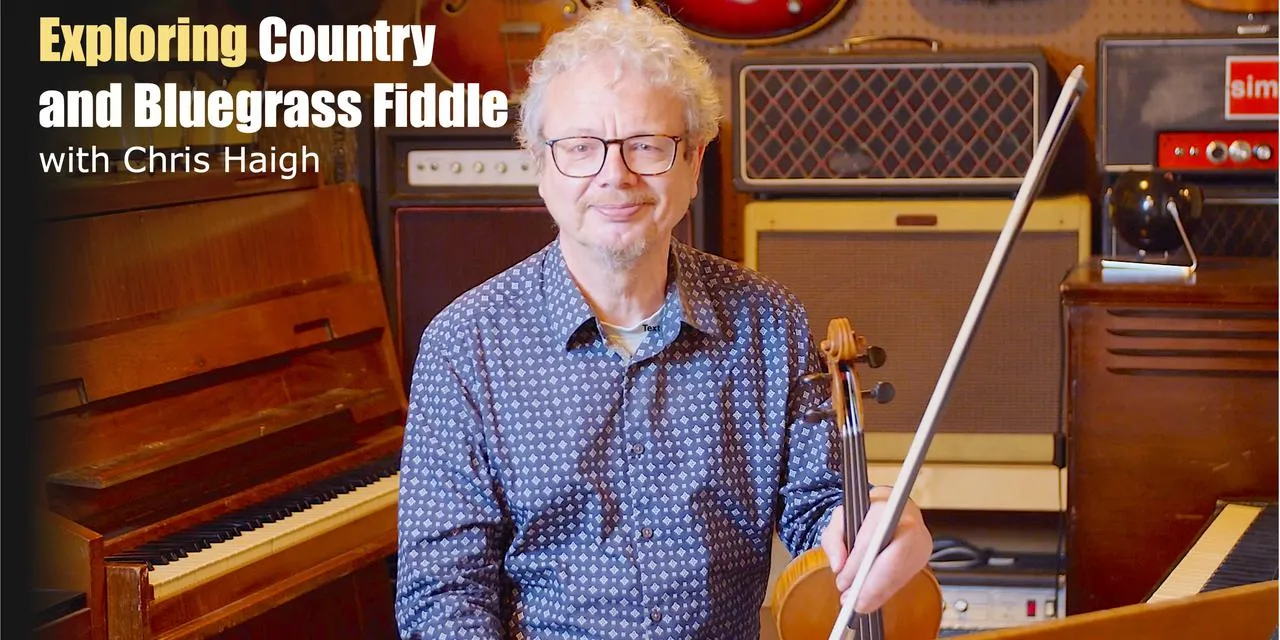
Chris Haigh est violoniste professionnel depuis 25 ans et possède une expérience dans de nombreux genres. Il a joué sur plus de 75 albums, aux côtés d'artistes comme Alison Moyet, Bob Geldof, All About Eve, Michael Ball, David Soul, Oumou Sangare, The Quireboys, Riverdance, Morcheeba, James Galway et Steps. Il a joué du swing et du jazz avec The Kimbara Brothers, Diz Disley, Le Jazz, The Hot Club of London et les Quecumbar Allstars, et dirige un ensemble de swing soviétique à sept musiciens, The Kremlinaires. Chris donne des cours et des ateliers sur la technique du violon jazz et a enseigné le violon jazz aux universités de Middlesex, Brunel et Newcastle ainsi qu'au Truro College. Parmi ses ouvrages figurent neuf livres consacrés au violon, dont The Fiddle Handbook. Il anime également Fiddling Around (fiddlingaround.co.uk), sans doute la source d'information sur le violon la plus complète et la plus consultée du web. read more