



El pelo del arco y la cuerda
Lesson time: (5min 18sec)
Course preview
This lesson is part of the course Los secretos de la producción de sonido, Parte 1: conoce tu instrumento
Watch a preview of the full course below.
Lesson transcript:
Understanding Bow Technique in String Instruments
An interesting question to ask, and really the first question to ask, is: What exactly does the hair of the bow do to the string?
The Function of Bow Hair
Most people answer that the hair makes the string vibrate. But then the next question is: What does "make the string vibrate" mean?
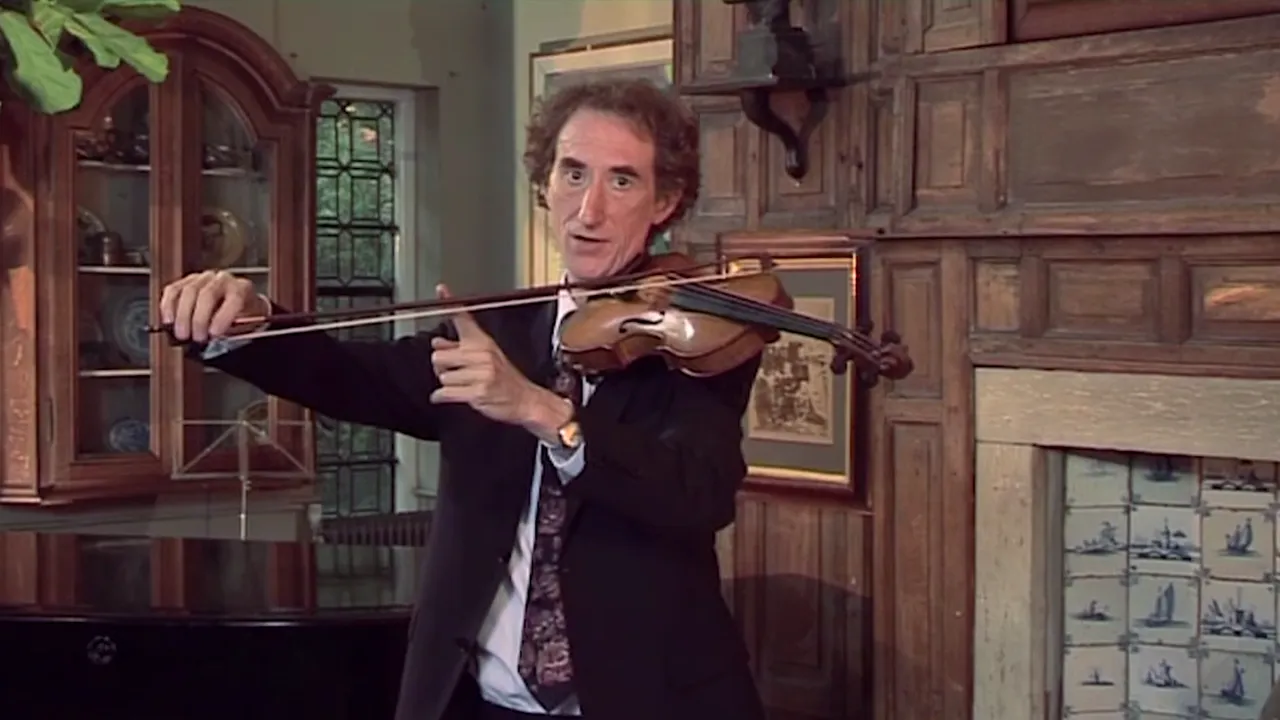
The answer is that the friction of the bow makes the string swing from side to side, a bit like that on the down bow.
- The hair catches the string and pulls it sideways to the right.
- You can see the string bending.
- As it does so, the tension of the string naturally increases.
This sideways bending can only go on for so long before the tension is so great that the string springs back in the opposite direction to the left. It's then caught again by the hair, pulled to the right again, and the next cycle begins. Millions of these cycles make up one single bow stroke.
And of course, the reverse happens on the up bow:
- The bow hair pushes the string to the left.
The Catch, Pull, Click Sequence
I just made those clicks with the bow in my fist and my thumb on the bridge. It's very easy like that.
However, it takes much more control to do it using a normal bow hold. You can make this catch, pull, click sequence into an excellent exercise.
- Therefore, the string moves sideways under the bow, to and fro.
- This sideways movement is called the amplitude.
Understanding Amplitude
The amplitude is the blur that you can see around the string and is widest at the middle point between the bridge and the nut, or between the bridge and the finger (which is a movable nut, if you like).
- The wider the amplitude, the more carrying the tone.
- But the pitch of the note remains the same.
Whatever the amplitude, the note A vibrates.
- In other words, the string swings from side to side 440 times each second, whether it's played pianissimo or fortissimo.
- The distance the string swings from side to side is narrower when it's quieter and wider when it's louder.
The Importance of Bow Pressure
This is 440, and so is this. But the sound is different because of the different amplitude.
If the downward pressure of the bow into the string is too much, it prevents the string from swinging freely side to side.
- It's like the string is trying to swing, but you're inhibiting its movement.
- Then, although you're pressing hard and it feels as though you should be getting a lot of sound and projection, you actually get more if you release the pressure slightly and let the string go.
The First Rule of Tone Production
This leads to the first rule, if you like, of tone production: To base everything on speed of bow, not pressure.
- Think of lifting or pulling the sound out of the string rather than trying to press it out.
- Even in a strong, sustained passage, you can easily hear the difference.
Using bow speed, you can draw the sound out even in forte. When using pressure, it's as though you're trying to drive the sound down in the direction of your feet instead of up and out.
You can see it as clearly as you can hear it. If you look at the width of the vibrating string, try alternating between over-pressing with the bow and lightening.
- Look just here, midway between the finger and the bridge.
- I'll over-press and see how narrow the amplitude is.
- And now look at this! So much wider.
The Secret to Rich Tone
Lifting the sound out of the instrument so that it sings and resonates is one of the secrets of playing with a tone that is big, warm, rich, and yet soft, sweet, and unforced.
Pressing or pushing the tone out produces one that is smaller, thinner, and harder.
It's significant anyway that we speak of bow strokes, not bow pressers.
About the instructor
Simon Fischer disfruta de una distinguida y polifacética carrera como intérprete, pedagogo y artista de grabación. Ha actuado por todo el mundo como recitalista y ha grabado tres Sonatas de Brahms, una grabación que recibió grandes elogios en la revista Gramophone. Simon está reconocido como uno de los profesores de élite del mundo. Es profesor en la Guildhall School of Music y ha ocupado cargos en la Yehudi Menuhin School, la Wells Cathedral School y la Purcell School, y durante 15 años fue profesor visitante en la Royal Scottish Academy of Music. Tras estudiar en Londres con Yfrah Neaman y en Nueva York con Dorothy DeLay, el enfoque de Fischer une los mejores elementos de las tradiciones violinísticas francesa, rusa y estadounidense. La obra publicada de Fischer ejerce una gran influencia en la enseñanza del violín. Autor de artículos para la revista The Strad desde 1991, sus columnas mensuales han atraído seguidores en todo el mundo. Publicados por Edition Peters, sus libros de técnica Basics and Practice (traducido al coreano, italiano y alemán), Scales y The Violin Lesson, así como el DVD The Secrets of Tone Production (ahora disponible en streaming a través de MusicGurus), se han convertido en referencias en muchos continentes. Su libro y DVD Warming Up fue descrito por la revista The Strad como "23 páginas de oro técnico puro". En 2014, Simon Fischer recibió el premio de la European String Teachers Association "en reconocimiento a toda una vida de contribución a la enseñanza de instrumentos de cuerda". En su curso de cuatro partes Secrets of Tone Production, Simon te guía para que conozcas tu instrumento y luego trabajes sus ejercicios fundamentales de sonido paso a paso, de modo que puedas producir un sonido más rico, más controlado y más hermoso con el violín. read more