



Bonus: Stevie Ray / Lonnie Mack
Lesson time: (3min 49sec)
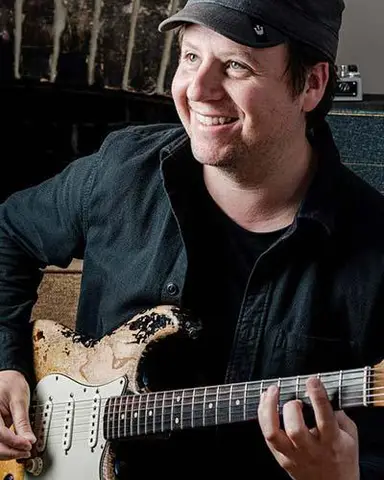
Scott te muestra un lick clásico al estilo de Stevie Ray / Lonnie Mack
Course preview
This lesson is part of the course Toca auténtica guitarra de blues de Texas
Watch a preview of the full course below.
Lesson transcript:
Introduction to Stevie Ray Vaughan's Style
So I grew up being a big Stevie Ray Vaughan fan. I first heard Stevie Ray Vaughan when a friend of my dad showed us a video of him when I was like 10. I just thought he was the best thing, like, ever.
Influence of Lonnie Mack
A lot of Stevie's stuff is kind of based on his technique. He uses a lot of hammer-ons and open E sort of stuff. I think that style comes from another Texas guy called Lonnie Mack, who, in the 50s and early 60s, had a song called "Wham."
- It was all that bit, like what Stevie went on to do with "Scuttle Buttin'."
- All that open E stuff's really cool.
Breaking Down a Simple Lick
Here's a simple lick:
If I break that down, it's like:
-
First Part: (Insert the tab or notation here)
It ends with a real big accent, which I love.
-
Second Half:
Stevie would do a lot of that kind of playing. You could go on all day if you wanted. Once you've got it down, you can kind of get faster with it.
The Illusion of Speed
It's a bit of an illusion, that one, because it sounds really fast, but it's not. You have all those open strings, and you can hammer-on and pull-off. It's quite snappy to play.
- Key Point: It's much easier to play that sort of stuff with the open strings when you're in the E position than when you have to fret all the other notes.
Adding Dynamics
One thing on that second half, the second part of the lick:
-
After it goes, you just kind of scrape upwards, again accenting it:
"Ding. A ding, ding, ding."
It's got its own sort of timbre to it.
- The dynamics really go up and down.
Conclusion
And again, if you play that with drive, you've got to have fun with it. Anything in that?
About the instructor
Scott McKeon ha dedicado toda una vida a su oficio como guitarrista. Inspirado inicialmente por el amor de su padre por el blues, el soul y el rock, cogió la guitarra a los cuatro años y se ha ganado la reputación de ser uno de los guitarristas más solicitados del Reino Unido, tanto en el estudio como en directo. En 2014, Scott recibió una llamada para tocar en la banda de Sir Tom Jones, junto a Robbie McIntosh y el batería de Pink Floyd Gary Wallis. El repertorio, orientado al blues, el rock 'n' roll y el gospel, permite a Scott recurrir a sus primeras influencias y recorrer el mundo. Las actuaciones hasta la fecha han incluido cinco giras europeas, tres giras por EE. UU. y Sudamérica y giras por Australia y el Lejano Oriente, así como apariciones en televisión como Later... with Jools Holland y TFI Friday, y tocar en el New Orleans Jazz Festival en 2019. El tercer álbum de Scott, 'New Morning', es un disco terroso, crudo y liderado por la guitarra que muestra su registro y su capacidad como guitarrista. El álbum se grabó en directo en el estudio de RAK en Londres, capturando la energía y la espontaneidad de las sesiones. Fue producido por Paul Stacey (Black Crowes/Oasis), y cuenta con Jeremy Stacey (Sheryl Crow/Tal Wilkenfeld) a la batería, Rocco Palladino (Tom Misch/D'Angelo) al bajo y Gavin Conder (Rufus Black/The Kondoors) como vocalista en varios temas. Scott también tiene un pedal de fuzz de firma y pastillas de firma, modeladas a partir de su Strat del 62. En su curso, Scott comparte el tono, el fraseo y el feel que hay detrás de la auténtica guitarra de blues de Texas, mostrándote cómo hincar el diente al estilo y hacer que cada nota cante. read more