



Sharp Suit (Repaso)

Con
Talia Girton
Qué incluye el curso
21 lecciones (0h 42m) · 1 gratis










Transcripción de la lección
Music Lesson: Sharp Suit
Let's have a look at Sharp Suit. In my opinion, this is the trickiest piece in the entire course. So, take your time, go slowly, and be patient with yourself.
Rhythmic Patterns
We're going to explore some of the rhythmic patterns that show up several times in the piece.
Bass Clef
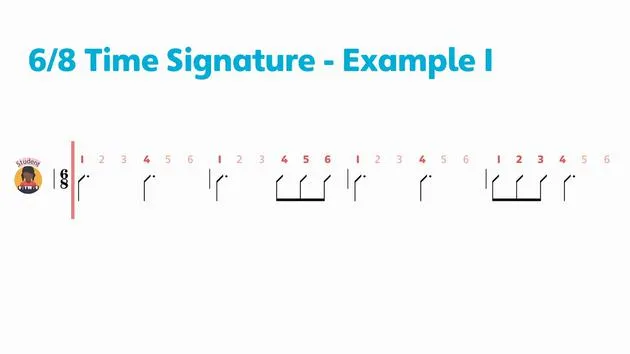
Let's first look at the bass clef of bar one. You can see that there is:
- A dotted quarter note
- Followed by an eighth note
- Another dotted quarter note
- And another eighth note.
If I snap that rhythm, it sounds like:
1 and 2 and 3 and 4.
The same rhythmic pattern repeats for all of the bass clef notes, with some minor variations for the rest of the piece.
Right Hand Rhythms
There's also some tricky right hand rhythms, so I want to do a couple of those with you.
Bars Two to Three
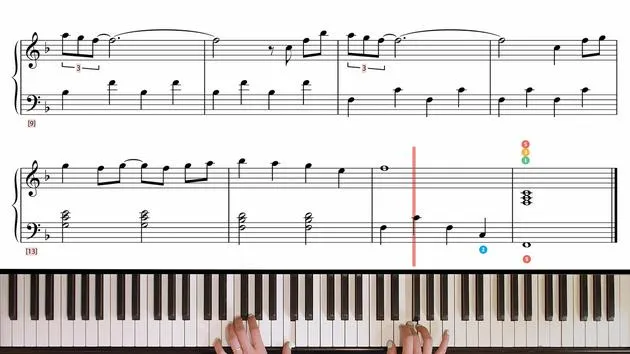
First, have a look at bars two to three in the treble clef.
I'll count you in:
1 and 2.
Then I'll try playing the right hand part here:
1 and 2 and 3 and 4 and 1 and 2 and 3 and 4.
Bars Six to Seven
There's another tricky rhythmic part in bars six to seven. Watch out for those tied notes here as well. It sounds like this:
I'll count to four first:
1 and 2 and 3 and 4 and 1 and 2 and 3 and 4 and 1 and 2 and 3 and.
So, you're really going to have to be careful with that syncopation.
Practice Tips
Once again, take this piece slowly.
- Do it separate hands first
- In very small chunks.
Then you can try it with the backing track.
Remember: You've got the interactive sheet music, so you can speed up and slow down the track as needed, allowing you to go at a pace that's comfortable for you.
Demonstration
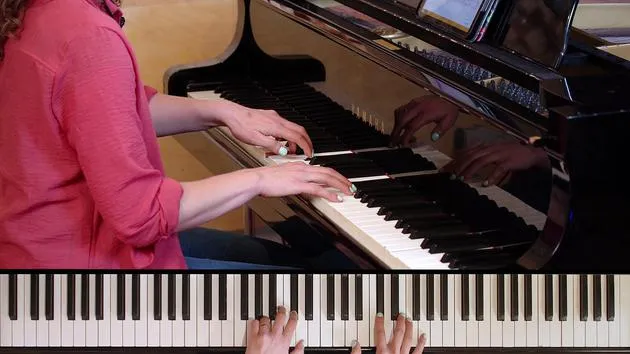
Let's have a listen to what this song would sound like:
1 and 2 and 3 and 4 and 1 and 2 and 3 and 4 and 1 and 2 and 3 and 4 and 1 and 2.
3 and 4 and 1 and 2, 3 and 4 and 1 and 2 & 3 and 4.
And 1 and 2 and 3 and 4 & 1 and 2 and 3 and 4.
And 1 and 2 and 3 and 4.
And 1, 2 and 3 and 4.
And 1 and 2 and 3 and 4, and 1 and 2 and 3 and 4 and 1 and 2 and 3 and 4.
Finger Numbers and Position Changes
Be sure to watch out for the finger numbers because they're going to be really helpful where you need to make those changes. You might also need to pay attention to where you need to change your finger position, but it's actually not written in the music for you.
Conclusion
So, take some time to think about this again. This is a really, really tricky piece, so take your time, be patient with yourself, and break it down into small chunks. If you ever get frustrated, take a break and come back to it.
Let's now have a look at what this would sound like with the backing track.
21 lecciones
0h 42m de lecciones en vídeo estructuradas
Funciones de vídeo avanzadas
Ralentiza, repite un pasaje, sigue la partitura
Móvil, tablet y ordenador
Practica donde quieras
Garantía de satisfacción 100%
30 días de garantía de devolución
Conoce a tu gurú
Conoce a tu gurú
Talia Girton es músico y musicoterapeuta registrada en el HCPC, y fundadora de The Cycling Music Teachers. Su trabajo une la musicoterapia, el asesoramiento y la educación, y da clases a nivel internacional en el curso de formación en musicoterapia de la UDELAS en Panamá, además de contribuir al desarrollo profesional con la European Piano Teachers Association (EPTA). En MusicGurus imparte los cursos Piano Method y Piano Foundations, guiando a principiantes absolutos desde los primeros pasos a través del ritmo, ambas manos, la teoría y la interpretación.







