



Armaduras de clave y líneas adicionales

Con
Talia Girton
Qué incluye el curso
21 lecciones (0h 42m) · 1 gratis











Transcripción de la lección
Understanding Key Signatures: G Major
Music is often arranged in families of notes called keys or key signatures. So far, we've been working in the key of C major, which means that we have all white keys. Different key signatures will have sharps or flats.
Key of G Major
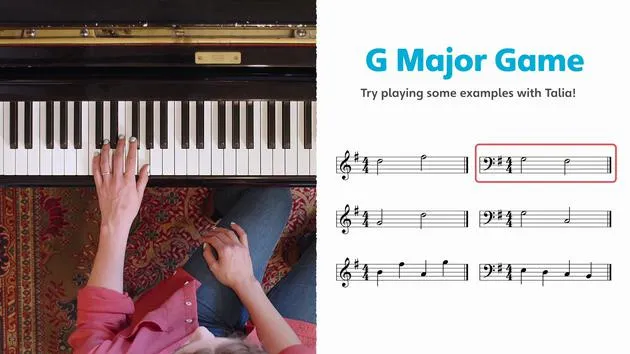
For example, in the key of G major, instead of having an F, there is an F sharp. This is the key that we're going to be working on now.
Important Note
- Anytime you see an F in the music, remember to play an F sharp instead.
- The sharp won't be written next to the music, but instead, it will appear next to the treble and bass clef at the beginning of each line of the stave.
You'll recognize that a key is in G major when you see an F written next to the treble clef and the bass clef at the start of every line of music.
Memorization Tip
Unfortunately, you won't see an F sharp next to every F to remind you to play it that way. You'll just have to remember that anytime there's an F in the piece, you need to play it as F sharp.
G Major Scale
Every key signature has a scale that goes along with it. The key of G major has a G major scale that would look like this:
- We will learn your C major and A minor scales a bit later on.
Understanding Ledger Lines
Now, let's have a look at ledger lines, which you've already encountered in your previous pieces.
What are Ledger Lines?
- Ledger lines go below and above the stave and show notes that are:
- Lower on the piano if they are going down
- Higher on the piano if they are above the stave
For example, middle C, the first note that you learned, is located on a ledger line right below the stave.
Visual Reference
If you look at the graphic, you'll probably recognize middle C as the third note. Working backwards:
- The note just below that (which is a space note) is B.
- Going down one more to that first note gives you A.
You can work backwards and also in the opposite direction.
On the graphic you see here:
- The first note is A.
- The next ones follow as B, C, D, and it continues in that order all the way up the stave.
Counting Ledger Lines
You can count up or down to ledger lines by:
- Counting one from a space note to a line note
- Or from a line note to a space note.
With these tools, you'll be better equipped to navigate your music pieces!
21 lecciones
0h 42m de lecciones en vídeo estructuradas
Funciones de vídeo avanzadas
Ralentiza, repite un pasaje, sigue la partitura
Móvil, tablet y ordenador
Practica donde quieras
Garantía de satisfacción 100%
30 días de garantía de devolución
Conoce a tu gurú
Conoce a tu gurú
Talia Girton es músico y musicoterapeuta registrada en el HCPC, y fundadora de The Cycling Music Teachers. Su trabajo une la musicoterapia, el asesoramiento y la educación, y da clases a nivel internacional en el curso de formación en musicoterapia de la UDELAS en Panamá, además de contribuir al desarrollo profesional con la European Piano Teachers Association (EPTA). En MusicGurus imparte los cursos Piano Method y Piano Foundations, guiando a principiantes absolutos desde los primeros pasos a través del ritmo, ambas manos, la teoría y la interpretación.







