



Análisis de la página 1

Lesson time: (4min 18sec)
Annabel Thwaite trabaja la primera página de Für Elise de Beethoven, empezando por su famoso y evocador motivo de semitono.
Course preview
This lesson is part of the course Aprende clásicos favoritos al piano
Watch a preview of the full course below.
Lesson transcript:
Music Lesson: Exploring Tempo and Melodic Structure
Now we've looked at the tempo and negotiated what is a good speed.
Page-by-Page Breakdown
We're going to look at the piece page by page.
Page One: The Haunting Melody
- The first page has this wonderful beginning of semitones.
- It's a really famous haunting melody that'll be with you. You'll hear it everywhere.
- This E flat, or as it's written here as D sharp, is apparently the same note as written in German, Es.
- So, E flat = Es.
- Some people believe that this little melody, this motif, this little snippet, is actually representative of the word Elise.
Hands in Harmony
- Look at the left hand and the right hand:
- They are both in arpeggiated forms.
- Arpeggiated meaning the chords of A minor and E major.
Practice Recommendations
I would recommend practicing:
- Staccato and legato for your arpeggios:
- Maybe A minor legato or even staccato.
- Staccato and also an E.
This way, you have an idea of how the hands relate to each other, especially the thumbs.
- Remember that the thumb is a very strong finger. Well, it's a thumb.
- You want more emphasis on the little finger of the left hand because you don't want to hear thumping like that.
- You want to hear more of the downbeat.
And of course, this is all within pianissimo.
Differentiating the Melody
Let's also look at how the melody can be differentiated because it appears several times on:
- Page one
- Page two
- Finally on page three.
It's a rondo, a recurring theme, so look at how intricate it actually is.
- It begins with A minor, then E major, and there's a melody that goes up and then finishes there.
You might be able to bring out the octave intervallic tension as opposed to the semitone.
Transition to Major Key
Later on, when you get to the major key at bars 10 and 11 (C major):
- You have this wonderful seventh, and another one, and another one; also, there's this descending seventh idea.
- All of that is in the space of three lines of music.
Creating Musical Vocabulary
You can always create a musical vocabulary:
- Bring a little bit more out,
- Bring a little bit less,
- Or bring it back in a bit more.
Focus on Bar 14
Let's take a brief moment to have a look at Bar 14.
- We have these octaves, and sometimes we don't want that third E to pop out in the left hand.
- To address this, you could take it over with the right hand or simply be very careful:
- Place more emphasis on your little finger of the left hand on the first beat so that it doesn't clash in the middle of the bar.
Understanding Diminuendo and Ritenuto
Lastly, let's have a look at the dim avrit.
- That means diminuendo and rittenuto, getting softer and slowing down.
- I would take these very gently, with a pinch of salt, because:
- You don't want to slow down too much; they're probably editorial.
- Just have the idea of relaxing a bit, not slowing down in a romantic fashion, because that's 19th-century music and we're in the 18th century.
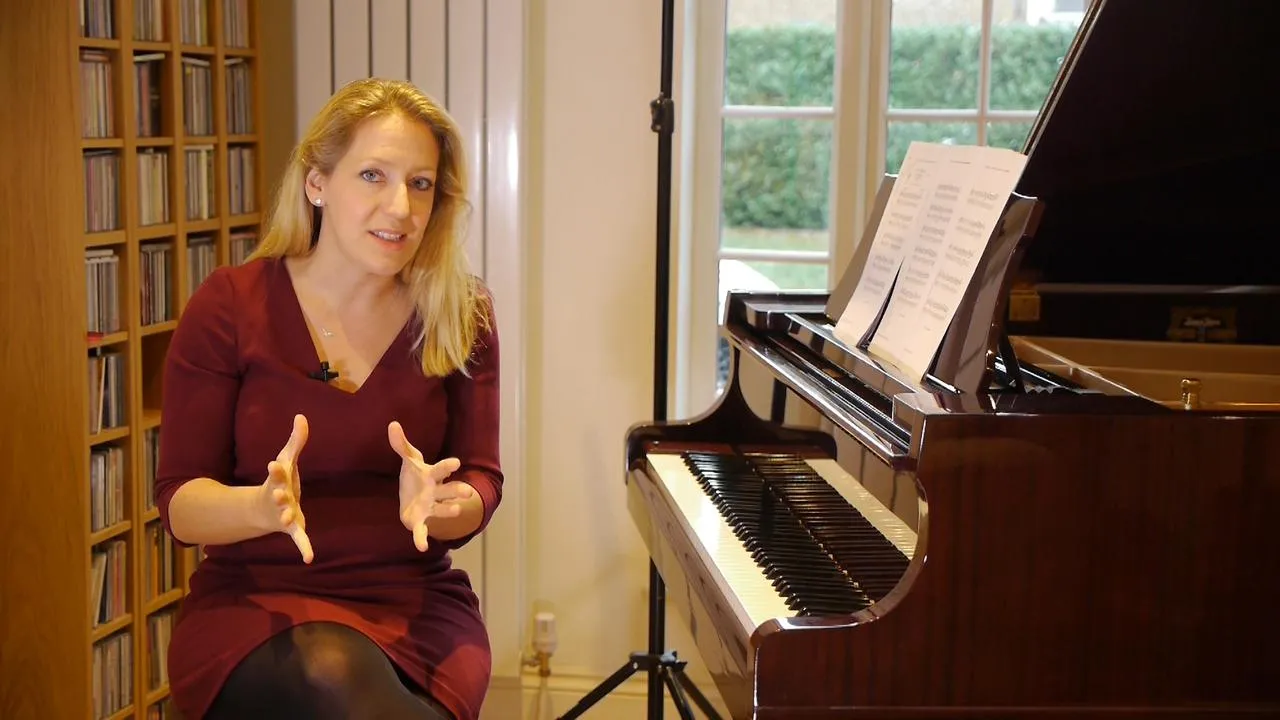
About the instructor
Reconocida como una de las pianistas más versátiles y carismáticas de Gran Bretaña, Annabel Thwaite disfruta de una carrera diversa como solista, música de cámara, artista de grabación, docente y examinadora, y ha ganado todos los principales premios de acompañamiento, incluidos los prestigiosos Kathleen Ferrier, Gold Medal y Richard Tauber Piano Prizes. Ha colaborado con artistas de renombre como Roberto Alagna, Bryn Terfel, David Kempster y "Only Men Aloud!" Annabel ha grabado para Universal records con el "Scottish Tenor", cuyo álbum fue nominado a un Classical Brit Award y suena con regularidad en Classic FM. Dos veces acompañante del Festival of Welsh Male choirs, sus actuaciones en el Royal Albert Hall fueron grabadas por Sain y emitidas en S4C. También es pianista de sesión de cine, habiendo grabado en Abbey Road la música de la película "Awake", la serie de la BBC sobre Jane Austen "Emma", "The Secret Diaries of Miss Anne Lister" y, más recientemente, ha aparecido tanto en Blue Peter como en "The Rob Brydon Show". "...sin duda ayudada por los acompañamientos de piano evidentemente brillantes de Annabel Thwaite... sumamente disfrutable." En sus cursos de MusicGurus —Learn Christmas Classics on Piano, Learn Classical Favourites on Piano y Growing Chamber Groups and Small Ensembles— Annabel comparte la musicalidad que hay detrás de esa carrera versátil. Aprenderás a dar vida al piano a piezas navideñas y clásicas muy queridas, a desarrollar tu toque y tu fraseo y, apoyándote en su experiencia premiada como acompañante, a descubrir cómo escuchar, liderar y tocar en conjunto al hacer música con otros músicos en grupos de cámara y pequeños conjuntos. read more