



La 'escala de blues' y sus usos

Lesson time: (10min 34sec)
En esta lección aprenderás un riff de blues basado en la escala de blues. Paddy explicará la escala de blues en detalle.
Course preview
This lesson is part of the course Toca piano blues auténtico
Watch a preview of the full course below.
Lesson transcript:
Lesson on the Blues Scale
Welcome back! In this lesson, we're going to look at what's kind of known as the blues scale. It might be a bit ambiguous as a concept, but the sound of it is widely used in the blues genre. What's more important, however, is how it's utilized in music.
The Blues Scale
The blues scale can be thought of as these notes in the key of C:
- C
- E flat
- F
- F sharp
- G
- B flat
- C
This scale has a distinct "bluesy" sound. However, you can't just go up and down it; otherwise, it will sound repetitive and boring. I want to help you play blues music in an authentic way, and it's really about how you mix it up with other aspects of improvisation.
Getting Familiar with the Sound
The important thing for you to grasp now is to become familiar with the sound of this so-called scale and get it feeling natural under your fingers. Key elements include:
- Strong flat fifth: This dissonance sounds great when it resolves.
Riffs and Melodic Ideas
Let's explore some little riffs and melodic ideas you can improvise using the blues scale. Rather than just moving up and down the scale, consider this example:
Example Riff
Hear that in there? The notes are just the first five notes of the blues scale, rolled down:
- Start on G
- Move to F sharp
- Then to F
- Followed by E flat
- End on C
I'm sliding off the F sharp to the F with my third finger.
Timing and Practice Tips
- Play the strongest sounding note in terms of timing with the G starting in the left hand.
- Hit the second note of the left hand with C.
For practice, start at the slowest tempo that you find convenient, then gradually work up to a faster pace. This technique can create a pretty cool blues riff!
More Variations
You could also use repeated notes:
- Example: I'm just playing repeated notes from the blues scale.
- You could add C to create different variations.
Mixing Riffs
Now, let's mix those two riffs up.
For instance:
- Analyze how you can use the riffs over all the chords in the 12-bar blues sequence.
- It works on C, F, and can also be applied to G.
Repetition and Context
Something remarkable about the blues scale is that you can play the same riff over different chords, giving it a new context and character. Adding C to the repeated G provides extra weight, allowing you to enter the realm of classic blues records.
Examples
Try incorporating sounds like:
- A jangly high-end piano sound
- Utilizing the scale in various octaves
Aim for Authenticity
The objective now is to start mixing things up. With our blues scale ideas and previously learned riffs, you can generate authentic and classic-sounding blues piano pieces.
Demonstration
Before we finish this lesson, I will go around the 12-bar structure a couple of times, demonstrating different variations you can use with the blues scale.
Don't worry if some of it seems a bit ambitious at the moment; this is just to provide some ideas. You can always replay the video to see what I'm doing!
Here we go!
A one, two, a one, two, three, four...
You'll notice some complex elements there, but everything is built upon the blues scale. Have a go at working out some of the things I did, and I'll provide as much of this material as possible in the PDF for you to check out.
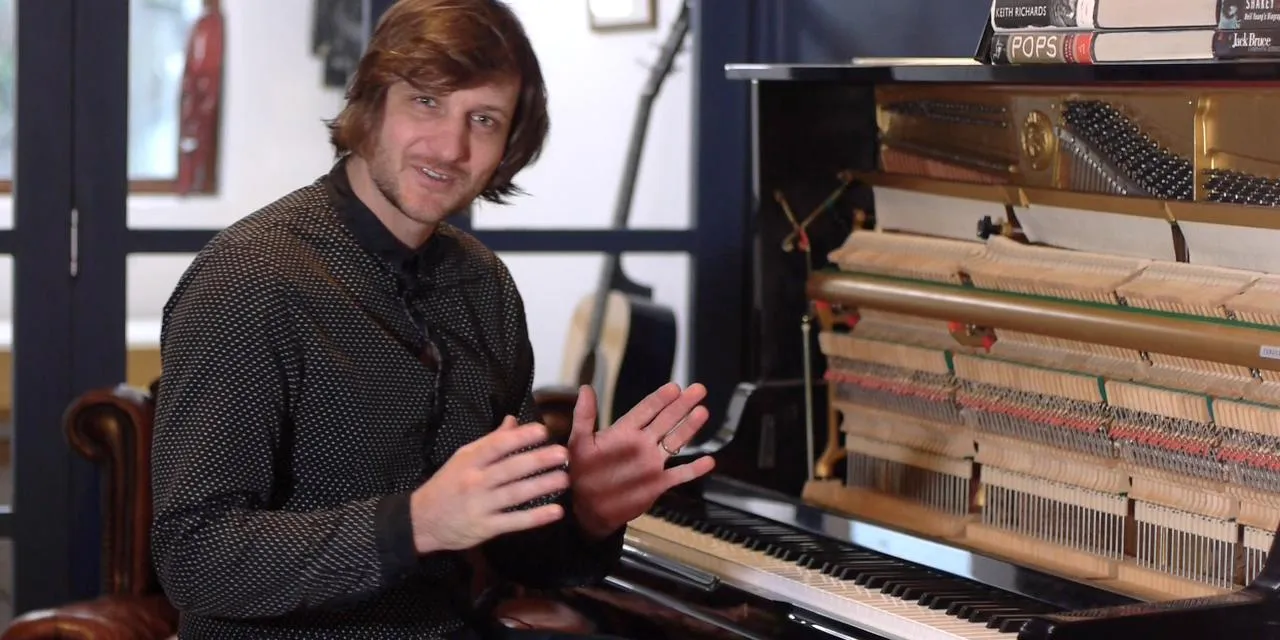
About the instructor
Paddy Milner está reconocido como uno de los mejores pianistas de blues del mundo: actualmente es el teclista de confianza de Sir Tom Jones, tras varios años con el gran y ya desaparecido Jack Bruce, pero también es un magnífico compositor original y un cantante con personalidad propia. ¡Basta con leer los elogios de figuras como Dave Brubeck que aparecen más abajo! Su forma de tocar apareció en la banda sonora de la exitosa película de 2019 'Rocketman'. Ha ganado dos veces el premio al Mejor teclista en los British Blues Awards, y mantiene una residencia de larga trayectoria como miembro fundador de la Ronnie Scott's Blues Explosion en el mundialmente famoso club Ronnie Scott's. Su grupo actual LONDONOLA toca música británica de cosecha propia con una buena dosis de espíritu de Nueva Orleans, y su grupo colaborativo JAWBONE va de fuerza en fuerza tras la publicación de su álbum de debut homónimo. "Me encanta... hay un tipo que sabe tocar de verdad el piano" - Dave Brubeck "Lo recomiendo encarecidamente. ¡De algún modo las cosas empiezan a sentirse mucho mejor!" - Jack Bruce "El mejor pianista de blues de Europa..." - Blues Access, EE. UU. "Impresionante y original" - The Times "Deslumbrante" - The Independent A lo largo de sus cursos, Paddy desglosa el auténtico shuffle de blues, el slow blues, el boogie-woogie, el rock 'n' roll y el piano de Nueva Orleans -incluidas tres canciones clásicas de boogie-woogie- para que aprendas estos estilos de uno de los mejores del oficio. read more