



Riff de mano derecha n.º 1: más variaciones

Lesson time: (14min 58sec)
En esta lección, Paddy te da más ideas para ampliar el Riff n.º 1, como notas encadenadas, el fraseo de 'pregunta y respuesta' y la extensión a las séptimas.
Course preview
This lesson is part of the course Toca piano blues auténtico
Watch a preview of the full course below.
Lesson transcript:
Expanding the Riff: A Music Lesson
Introduction to the Riff So, yeah, in the previous lesson, we looked at this riff which is just based on literally going between those two chords. Let's explore some more fun things we can do with that and how we can extend it.
Rocking and Variations
- We looked at rocking, breaking it up, and rocking between the C and the other two parts of that riff.
- We added the crush note.
- We could kind of roll the notes.
This is another cool variation. All I'm doing there is using all the same notes. I'm playing them like this:
[Insert musical notation or sound example]
Fingering Options
You could either use Option A or Option B for fingering.
Contextual Practice: The 12 Bar
Let's look at that in context. How would that sound over a 12-bar sequence?
I'll add a few crush notes in there as well. It sounds something like this:
1, 2, 3, 4.
I'm going to stop there because it already sounds a bit repetitive. Right? It's just too much of the same thing going on.
Mixing it Up
I think it would be cool to mix it up. Let's break it up into phrases so we get more of a question and answer thing going on rather than just repeating the same thing over and over again.
Let's have a go:
1, 2, 3, 4.
Just vary them and put them side by side. Notice the one on the F I played there? I started predominantly with the C, then just added that little broken-up chord at the end, which on the C is that.
Instantly, just through those two or three different variations of that basic riff, it's already sounding much more bluesy, spontaneous, and free.
Experiment and Explore
And of course, I know that you'll have all kinds of ideas to try out on it. So, do anything you want. Try things! Sometimes they work; sometimes they don't. The only way of finding out is by really trying again.
"Try and get all those things going freely between the chords."
However repetitive that might sound from a practice point of view, it might be a good idea to try going around a whole 12-bar of that to get it under your fingers, really working on that muscle memory.
Get your fingers feeling those different hand patterns and shapes more intuitively and naturally.
A Full 12-Bar Practice
So, over that 12-bar, I'm going to play it to you just so you can see. This would be a good practice exercise:
Play a whole 12-bar with that kind of rolling riff.
1, 2, 3, 4.
As I said, this does sound a bit repetitive, but as a practice thing, it would be really useful to do. Play it loudly and softly over the whole 12-bar practice between the chords.
In my previous PDF, which you can download, there will be more practice tips and exercises that you can do with that.
Extending to the Seventh
Now, let's look at one more thing on this riff before we move on to something else. In the next video, we're going to extend this riff to the seventh.
Remember when we looked at the dominant seventh chords, we added the B flat and the different inversions?
With this, we'll extend this riff up to the seventh. Essentially, we're going between three different variations, and we can do exactly the same things as we've done with the basic riff, now with the extension to the seventh.
For example:
- We can add the crush note on the F, which would be from the F7.
- On the G, it will be from the G7 chord.
Additional Variations
Get that under your fingers, maybe play that over the 12-bar sequence, and get the chord changes as fluently as possible. Again, use the same practice techniques:
- Go between the chords.
- Play loudly and softly, all the usual stuff.
Why not?
Also, we can add a funky little crush note on the fifth.
- On the F, the fifth note is C, so the crush note would be the one, the semitone below it, which is B.
- And on the G, it will be the D.
If we play that over a 12-bar sequence, it will sound a bit like this:
[Insert musical example]
Building Comfort and Complexity
It's already sounding bigger, fuller, and fatter. This might be quite demanding to start with. If it is, then perhaps go back to the riff without the seventh in it, without both crush notes, and just do what's comfortable for you.
"Don't stretch yourself so hard that your hands hurt."
It's important that it's comfortable for you. Start off at a slow tempo where it is comfortable and gradually work up.
Exploring More Variations
Applying the other variations we discussed, we could also do the rocking motion with the C. It would sound like this:
[Insert musical example]
And on the G, it sounds a bit like that:
[Insert musical example]
Of course, you can add the crush notes on the F and the G as well! We could even implement the rolling technique discussed in the previous lesson.
Now suddenly, we're getting into more complex and involved material.
Demonstration of Variations
I'm going to play around a couple of 12 bars now to demonstrate the kinds of things you could do with variations on that riff, both using that and going up to the seventh.
Here we go:
1, 2, 3, 4.
Then we go up the octave.
So, suddenly it's getting more interesting. You may have noticed a couple of extra things I was doing. I was adding a triplet as well.
If you've got the other stuff down, then feel free to experiment with the triplets too!
Conclusion
There's so much more we can explore with this. That's what I love about blues music, and music in general , it's a whole world of things to explore.
For this course, that's perhaps as far as we'll go, but there will be all sorts of materials we can carry on exploring in the more advanced courses I'm teaching.
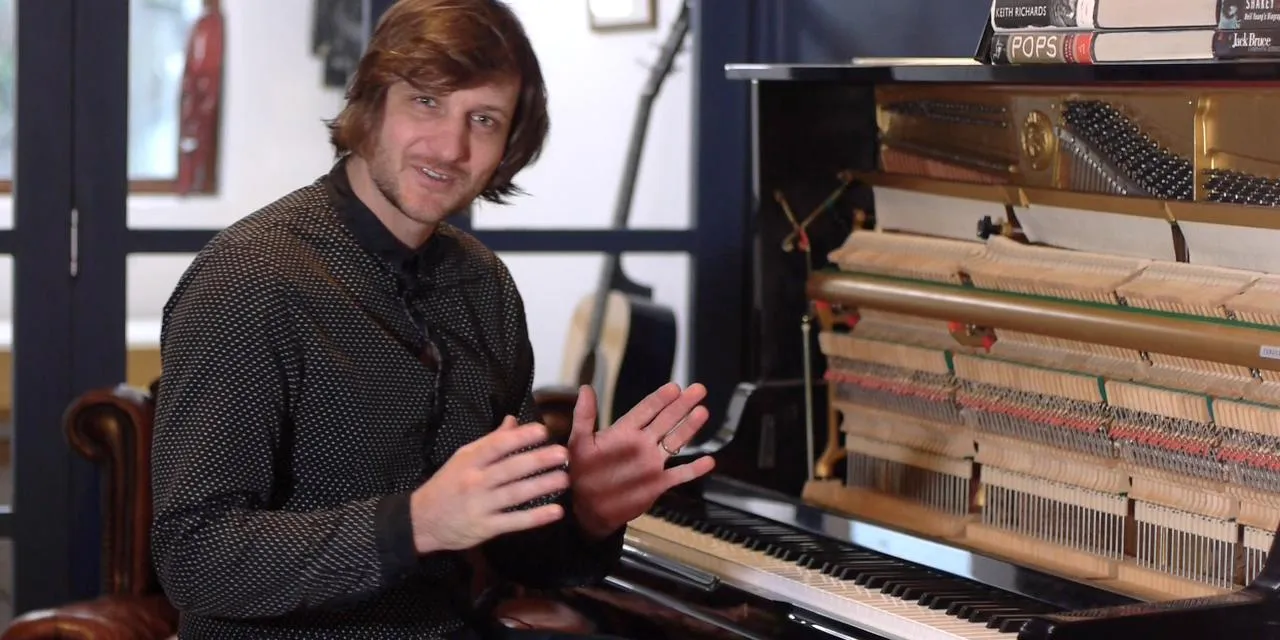
About the instructor
Paddy Milner está reconocido como uno de los mejores pianistas de blues del mundo: actualmente es el teclista de confianza de Sir Tom Jones, tras varios años con el gran y ya desaparecido Jack Bruce, pero también es un magnífico compositor original y un cantante con personalidad propia. ¡Basta con leer los elogios de figuras como Dave Brubeck que aparecen más abajo! Su forma de tocar apareció en la banda sonora de la exitosa película de 2019 'Rocketman'. Ha ganado dos veces el premio al Mejor teclista en los British Blues Awards, y mantiene una residencia de larga trayectoria como miembro fundador de la Ronnie Scott's Blues Explosion en el mundialmente famoso club Ronnie Scott's. Su grupo actual LONDONOLA toca música británica de cosecha propia con una buena dosis de espíritu de Nueva Orleans, y su grupo colaborativo JAWBONE va de fuerza en fuerza tras la publicación de su álbum de debut homónimo. "Me encanta... hay un tipo que sabe tocar de verdad el piano" - Dave Brubeck "Lo recomiendo encarecidamente. ¡De algún modo las cosas empiezan a sentirse mucho mejor!" - Jack Bruce "El mejor pianista de blues de Europa..." - Blues Access, EE. UU. "Impresionante y original" - The Times "Deslumbrante" - The Independent A lo largo de sus cursos, Paddy desglosa el auténtico shuffle de blues, el slow blues, el boogie-woogie, el rock 'n' roll y el piano de Nueva Orleans -incluidas tres canciones clásicas de boogie-woogie- para que aprendas estos estilos de uno de los mejores del oficio. read more