



El multivitamínico
Lesson time: (17min 42sec)
Un calentamiento con glissando para una columna de aire fuerte y rápida y una posición de lengua adelantada al descender, que lleva al ejercicio de trompeta integral "Multivitamin" de Gerard.
Course preview
This lesson is part of the course Enfoque interno para tocar la trompeta
Watch a preview of the full course below.
Lesson transcript:
Lesson: The Multivitamin Exercise
This next lesson is my exercise entitled The Multivitamin, and you'll find out why in a moment.
Preparing for the Multivitamin
Before we dive into the Multivitamin, we need to do a glissando exercise. As you may have noticed from previous lessons, this exercise doesn't sound great, but it is essential for focusing on:
- A strong air stream
- A fast air stream
- A central tongue position further forward as you descend
The Glissando Exercise
Exercise Overview:
- This exercise is like a flexibility exercise.
Procedure:
- Anytime you ascend, perform the airspeed warm-up (as in lesson one).
- When descending, get to the top note (e.g., C to G):
- Speed up your air massively.
- Slowly glissando downwards.
Note: This will not sound nice, but it's a necessary part of the process. We are trying to break the laws of physics with the trumpet, playing across those breaks and glissando slowly.
It's okay if it sounds horrible, it has to! Focus on:
- Fast air
- Tongue very far forward
- Slowly crossing the harmonics
I'll demonstrate it one more time. If you accidentally jump down, that's fine; it's a part of development.
Transition to the Multivitamin
Now, let's move into The Multivitamin. This exercise combines the airspeed warm-up without the glissando while descending.
The Exercise Steps
- Get to the top of the little arpeggio exercise.
- When you reach the C, imagine a stereo dial turning up the volume quickly, this represents speeding up your air.
- Descend a little slower than how you ascended, playing it loudly.
Example Pattern:
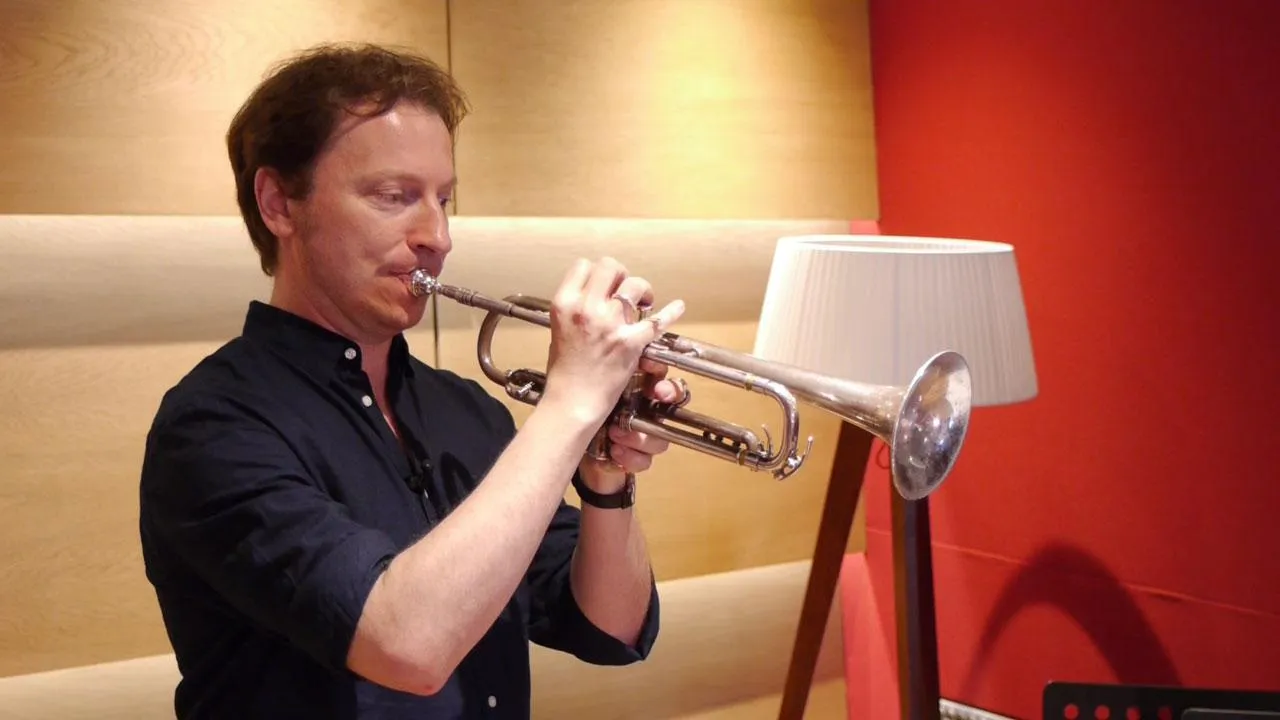
- If I play C, G, C, G, C, it would sound like this. You can see the movement in my face.
The aim is to develop a blowing technique where you maintain a steady air stream without shifting your embouchure significantly in the lower register.
Adding Staccato
After playing the exercise twice, we will take the same notes and play them as very short staccato.
Rules for Staccato:
- Staccato should be shorter than you think.
- Say it like: da da da da da da da da da.
If you see eighth notes written as staccato, play them like 16th notes:
- Instead of da da da da da da da, go with da da, da da da da da da da da.
Demonstrating the Exercise
Now, I will demonstrate the exercise to you.
Note: Simply descend in half steps.
Concluding the Exercise
Once you've reached the bottom of the trumpet, ideally:
- Because of the 1, 2, 3 placement, your aperture (the hole) has not opened as much as it might normally.
- You may need more air as you descend lower.
Breathing Technique:
- When taking a breath, don't play from where you left off; go back a bit.
- Take your breath as if you were smelling something pleasant: breathe in slowly and play.
This process helps keep you relaxed.
Focus on Staccato
When starting with staccato or short staccato:
- Look at the top center of your bell.
- Keep your air flowing.
Demonstrating Focus:
- When I look at my bell, the difference is considerable. More focus means less movement, leading to a steadier air stream with very short tonguing.
Stages of the Conclusion
Stage 1
At the end, after reaching F sharp:
- Go from off to off and take your time.
- Remember to turn the dial up quickly to reach the top note.
Stage 2: Staccato Alone
Now, let's go up and down with the pattern using only staccato.
Articulation Practice:
- Put the trumpet near your face and articulate without pitch.
Example:
- Say it quickly da da da da da da.
This transition helps in creating a smoother relation between saying and playing, speeding up your single tonguing.
Stage 3: Legato Version
The final stage:
- A legato version incorporating everything we've done but with less movement.
- Maintain a steady airflow and slightly crescendo on descent for safety.
Remember, the goal is to:
- Reduce the movement at the five to one transition.
Good luck!
About the instructor
A lo largo de los últimos 25 años, Gerard Presencer se ha labrado una formidable reputación como uno de los trompetistas más respetados de la escena europea. Irrumpió en la escena internacional a los 18 años, cuando US3 le pidió que tocara la parte solista en Cantaloupe Island de Blue Note (reimaginada como Cantaloop Flip-Fantasia), que se convirtió en uno de los discos de jazz más vendidos de los años 90. Desde entonces ha actuado con un quién es quién de los artistas de jazz internacionales, y sigue exigiéndose a sí mismo y a su instrumento, saliendo de su zona de confort para desarrollarse como intérprete y compositor. En otros géneros, Gerard ha grabado como músico de sesión con artistas como Sting, Jamiroquai, Zero 7, James Brown, Ray Charles, Joni Mitchell y Jonny Greenwood. Gerard también ha sido un miembro esencial de los diversos grupos de jazz de Charlie Watts durante los últimos 25 años, girando por todo el mundo y publicando varios álbumes con el amante del jazz de los Stones. Como educador, Gerard fue jefe de Estudios de Jazz en la Royal Academy of Music de Londres de 1999 a 2010, y actualmente es jefe del Departamento de Metales en el Jazz Institut de Berlín. En este curso comparte su enfoque interno para tocar la trompeta -los hábitos mentales y físicos que hay detrás de un gran sonido- para que puedas desarrollar el sonido, el control y la musicalidad desde dentro hacia fuera. read more