



Solo sencillo de 12 compases

Lesson time: (3min 50sec)
Mat Walklate construye un solo de blues sencillo de 12 compases con la armónica a partir de solo cuatro notas de la escala de blues, estirándolas y repitiéndolas para crear tensión.
Course preview
This lesson is part of the course Ganar fluidez en la armónica de blues
Watch a preview of the full course below.
Lesson transcript:
Developing Solos Using the Blues Scale
Hello, my name's Matt. This lesson involves trying to develop solos using the blues scale. Just to remind you, in case you've forgotten, the blues scale consists of six notes in total.
Constructing a Solo
One way of constructing a solo is to take four notes from that scale and create a riff.
- Imagine this:
- If you had the six notes written on cards, shuffled them, and scattered them in front of you,
- You could pick four at random to create a riff.
- While it might not be brilliant, technically, it wouldn't be wrong.
It's worth experimenting with the blues scale to pick out riffs and develop them into a solo.
Example Riff
To start the ball rolling, here's a very simple example:
- Using the first four notes of the blues scale from hole number two:
- 2 draw
- 3 draw
- 4 blow
- 4 draw
This gives us this initial riff.
Now, we can develop a solo out of it.
First Four Bars
- Over the first four bars of the 12-bar structure, we play the riff twice.
- Elongate one of the notes, making one note longer than the others.
In this case, I'm going to make the second note longer. It would sound like this:
- Demonstration:
- 2, 3, 4 and 2, 3, 4
Changing the Chord
After the first four bars, the chord will change on the guitar or any accompanying instrument, and we will change the riff.
- For bars 5 and 6 of the 12-bar structure, we play each note pretty much the same value, once per bar.
Building Tension
For bars 7 and 8:
- Remove the last note from the riff and play the three remaining notes.
- We play this little three-note riff four times.
This builds up some tension, snowballing toward bar number nine.
The Apex of the Solo
Bar number nine is often, not always, the apex of a blues solo.
What we do here:
- Play something big, powerful, and noisy, like four and five draw, followed by four and five blow for bar ten, because it works.
Conclusion
Finally, we finish off with the initial riff again. At the very end, we play what we started with in the beginning, and that completes the 12-bar solo.
In a moment, I'll try and drag the rest of the band out of the pub, and we'll record an example of this for you.
Now that the guys are here, we're going to play 112 bars using the rules I described before. We're going to take four notes from the blues scale and turn them into a solo.
Are you ready? After a count of four:
1, 2, 3, 4.
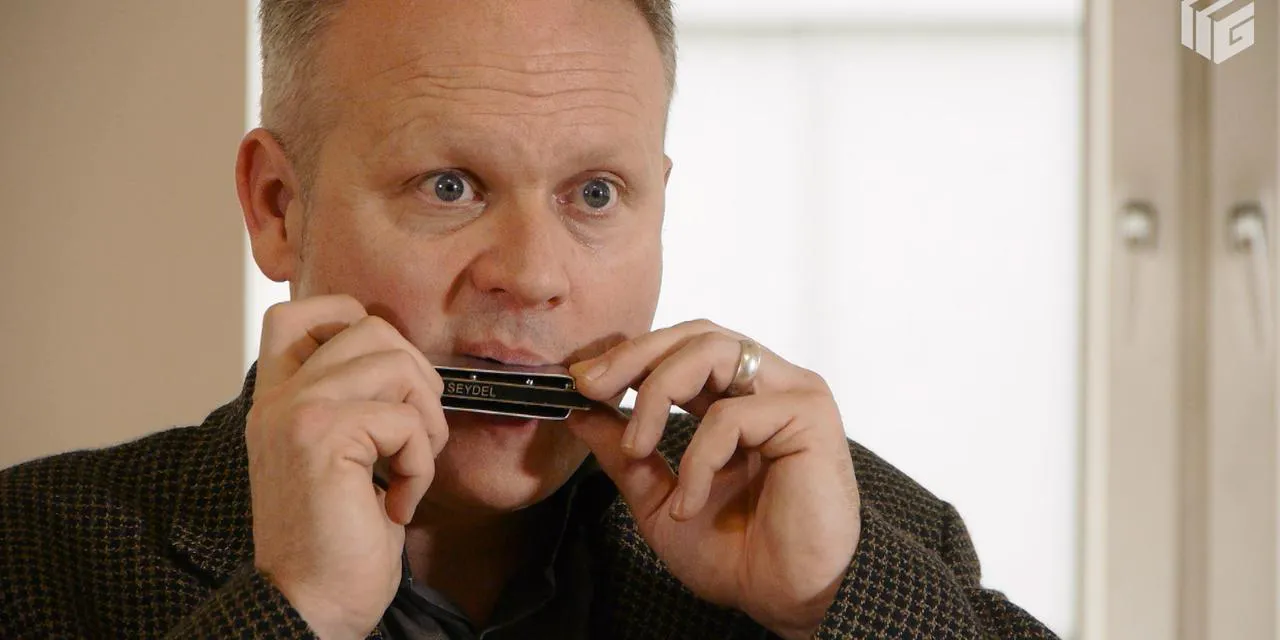
About the instructor
Mat Walklate es un armonicista y profesor afincado en Mánchester que trabaja en el blues y el folk, y que también toca la flauta, el whistle y la gaita uilleann y canta. Ganó el British Blues Harmonica Championship en 1992 y el All-Britain Fleadh Cheoil de armónica en 1993, y es artista avalado por Seydel.A lo largo de una trayectoria de treinta años ha girado por Europa con bandas como The Moochers y el grupo de música irlandesa The House Devils, ha grabado y mezclado unos catorce álbumes entre 2001 y 2021 —entre ellos Sea of Blues y Traditional Harmonica— y ahora actúa en dúo con el cantante y guitarrista Alex Haynes y junto al estudioso del blues Dr Tom Attah. Enseña armónica en el Leeds Conservatoire y de forma privada.En MusicGurus sus cursos te llevan desde tus primeras notas con una armónica en Do —embocadura, la posición de cross-harp, los bendings y tu primera improvisación— hasta un blues fluido, con vibrato, posiciones alternativas y el fraseo que hace cantar a un solo. read more