



Desarrollar solos más interesantes

Con
Mat WalklateMat Walklate muestra cómo dar a un solo de blues dramatismo y un arco narrativo, construyendo un riff repetido hacia un clímax ardiente.
Qué incluye el curso
11 lecciones (1h 4m) · 2 gratis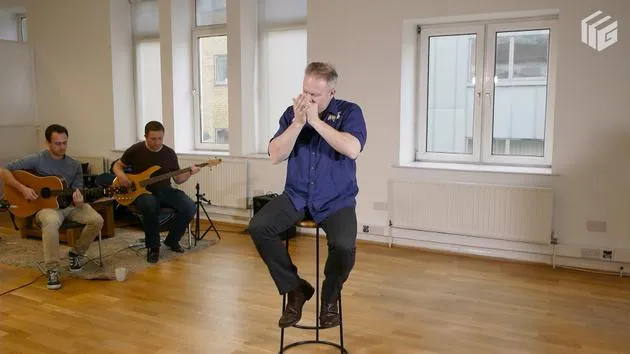
01. Tocar el blues, una demostración
Lección gratis2:14
02. Repaso de la escala de blues de G
2:31
03. Bending de notas para conseguir notas adicionales
9:12
04. Solo sencillo de 12 compases
3:50
05. Improvisar usando la tónica de los acordes de la progresión de blues
5:57
06. Vibrato
6:37
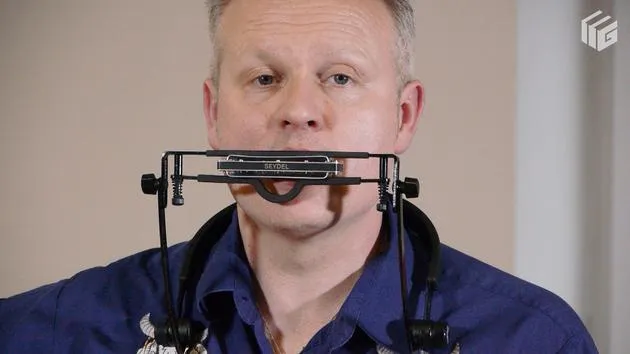
07. Desarrollar solos más interesantes
Estás aquí7:43
08. Bloqueo de lengua avanzado
10:22
09. Escalas de blues en primera posición
5:48
10. Escalas de blues en tercera posición
6:22
11. BONUS: Aprende a tocar "Sex & Drugs & Rock & Roll" de Ian Dury en la armónica blues
Lección gratis3:36
Transcripción de la lección
Developing Interesting Solos: A Lesson with Matt
Hello, I'm Matt, and this lesson is hopefully going to help you:
- Develop interesting solos
- Add some drama to your solos
- Give your solos a narrative arc
Riff Repetition
So, what can we do? One effective approach to constructing a solo that adds a bit of spice and drama is to find a little riff and repeat it.
- Sometimes, you can repeat it to the point where people think you're going to overdo it.
- Then, transition into a big fiery note; this can create a strong apex for your solo.
Most good riffs involve draw notes and possibly bends as well. For instance, you might start fairly simply, something like this, and then begin to develop a riff. It's not the only way to create a solo, but it does work.
Structuring Your Solos
You're not going to use this method for every solo, hopefully, as you want to experiment with different approaches. However, this is one rewarding method of playing.
Often, the apex of the solo comes around bar number nine, where you have the big lift. Not always, but it's one way of doing things.
Exploring Different Riffs
- There are lots of different riffs out there.
- You can be as simple or as busy as you like.
Consider starting from the bottom of the harmonic scale. This could be tricky in a jam situation, but if you know how many solos you're expected to play, you can structure them based on that length of time:
- If you're playing only one 12-bar solo, then you'll want to showcase as much as possible.
- If you're getting two or three, think about structuring your solos to avoid using all your best stuff in the first 12 bars.
This can involve keeping some ideas in reserve if you have multiple solos in a row.
Playing Through the Turnaround
If you're playing two 12-bar solos (or maybe three), you can:
- Stop and start the next solo, or
- Play through the turnaround, which can be quite effective.
As I said, there's not just one approach to constructing a solo; there are many, and you can adjust based on your preferences.
The Importance of Simplicity
Being fast and busy doesn't necessarily make a solo better. You can say a lot with very few notes. Things like tone and vibrato can help to enhance your sound significantly.
Many blues harp solos from the 40s, 50s, and 60s often didn't stray above hole number four. They managed to create diverse-sounding solos using just those four holes.
Quick Demonstration
As a quick demonstration, I'll illustrate what you can do with the first four holes. Let me think...
And that's just two possibilities out of thousands of permutations you can create using those holes!
Exercise Recommendation
To practice after this lesson, you might consider restricting yourself to the first four holes on your harmonica. You could even physically tape over holes five through ten! Try to create something using just:
- 1, 2, 3, 4 draw notes
- Blow notes: 3 blow (same as 2 draw) and 4 blow for variety
- Be cautious with 1 blow (don't linger) and stay away from 2 blow, as it's the weakest of the bunch.
With bends in 1, 2, 3, and 4 draw, you have quite a few notes to work with. By limiting yourself to these four holes, you may discover new ideas and sounds that emerge from this exercise.
Happy playing!
11 lecciones
1h 4m de lecciones en vídeo estructuradas
Funciones de vídeo avanzadas
Ralentiza, repite un pasaje, sigue la partitura
Móvil, tablet y ordenador
Practica donde quieras
Garantía de satisfacción 100%
30 días de garantía de devolución
Conoce a tu gurú
Conoce a tu gurú
Mat Walklate es un armonicista y profesor afincado en Mánchester que trabaja en el blues y el folk, y que también toca la flauta, el whistle y la gaita uilleann y canta. Ganó el British Blues Harmonica Championship en 1992 y el All-Britain Fleadh Cheoil de armónica en 1993, y es artista avalado por Seydel.
A lo largo de una trayectoria de treinta años ha girado por Europa con bandas como The Moochers y el grupo de música irlandesa The House Devils, ha grabado y mezclado unos catorce álbumes entre 2001 y 2021 —entre ellos Sea of Blues y Traditional Harmonica— y ahora actúa en dúo con el cantante y guitarrista Alex Haynes y junto al estudioso del blues Dr Tom Attah. Enseña armónica en el Leeds Conservatoire y de forma privada.
En MusicGurus sus cursos te llevan desde tus primeras notas con una armónica en Do —embocadura, la posición de cross-harp, los bendings y tu primera improvisación— hasta un blues fluido, con vibrato, posiciones alternativas y el fraseo que hace cantar a un solo.







