



Fake books y lead sheets/Secuencias II-V-I en los estándares de jazz

Con
Tim RichardsTim Richards explica cómo los músicos de jazz leen el formato reducido de melodía y acordes de los fake books y lead sheets, dejando los voicings de la mano izquierda a criterio del intérprete.
Qué incluye el curso
29 lecciones (1h 51m) · 1 gratis
01. El ciclo diatónico
4:01
02. Ritmos brasileños
3:29
03. BOSSA NOVA COMPING #1 - Interpretación
1:12
04. Acordes de sexta mayor y menor
3:28
05. FLY ME TO THE MOON - Interpretación
0:54
06. Dominantes secundarias
2:15
07. Improvisación horizontal y vertical
3:22
08. Abrir los acordes de la mano izquierda
3:57
09. AUTUMN LEAVES - Interpretación
1:35
10. Sincopar la melodía
5:16
11. La escala de blues
3:24
01. Shells
5:42
02. ORNITHOLOGY - Interpretación
2:54
03. Turnarounds e improvisación vertical
9:51
04. Comping a dos manos
2:09
05. Secuencias II-V largas y cortas
2:43
06. Ciclos II-V-I
5:14
07. II-V-I ARPEGGIO WORKOUT - Interpretación
1:41
08. Usar el cromatismo y el encircling
6:53
09. Fake books y lead sheets/Secuencias II-V-I en los estándares de jazz
Estás aquí3:24
10. Finales
2:07
Transcripción de la lección
Understanding Fake Books and Lead Sheets
In this lesson, I want to talk a bit about fake books and lead sheets.
What is a Lead Sheet?
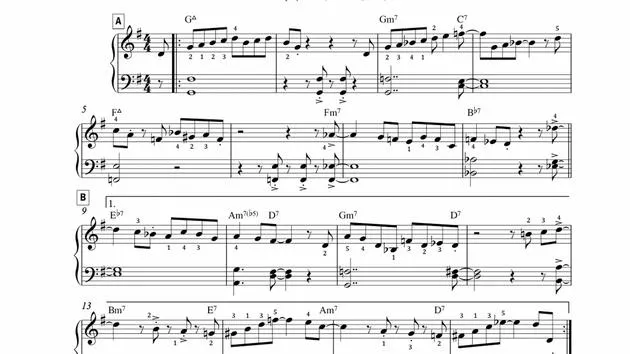
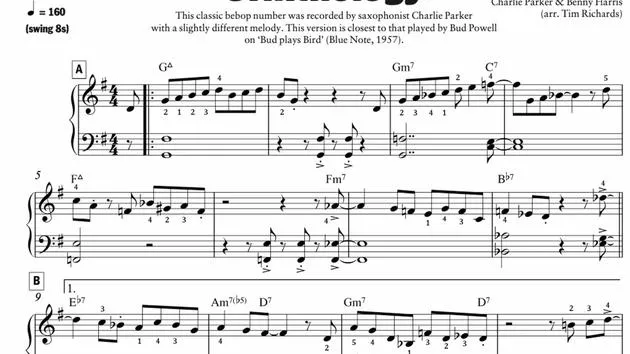
- If you look at the chart that you've got for "Ornithology," the right hand is basically what you get in a lead sheet:
- A single line melody
- Chord symbols
However, on a lead sheet, you wouldn't get any left hand chord voicings. You wouldn't be told what to do in the left hand.
Choice with Lead Sheets
- Lead sheets give you a lot of choice.
- One of the main skills of being a jazz pianist is deciding:
- How to interpret the chord symbols
- What to do in the left hand specifically
What is a Fake Book?
A collection of lead sheets is a bunch of tunes given as single lines and chord symbols only, collected into a book. This compilation is called a fake book.
History of the Fake Book
- The original fake book was called the Real Book, a sort of play on words.
- It was a bootleg publication, but now there are lots of legal versions available. Just search for "Real Book," and you'll find them.
Most jazz musicians have several of these because no fake book is really going to give you all the tunes you need.
Why is it Called a Fake Book?
Well, it's almost like you're faking knowing, faking knowledge of a tune, but you've got the bare bones of it, the information you need.
Why Jazz Musicians Prefer Fake Books
The reason jazz musicians like to work from fake books is because they provide:
- Maximum choice: They don't want to play somebody else's arrangement of a tune.
- The ability to make their own decisions about:
- Chord voicings
- Harmony
- Tempo
- Texture
On piano, that's a lot of different variations, lots of different parameters.
Getting Started with Fake Books
It's really important, at some stage, that you get your own fake book and start playing some of the tunes in it.
Interpreting Fake Books and Lead Sheets
To interpret fake books or lead sheets convincingly, you need to have a grasp of various harmonic concepts to apply them to different situations, tunes, and keys.
Recognizing Common Patterns
It's also useful to recognize tried and tested patterns. For instance:
- Many tunes have bridges, which are common chord sequences.
A very common example of a bridge is the dominant seventh cycle, which we saw in the theme in Part One of this course:
- Four dominant seventh chords going up in two bars
- Each going up in fourths, ending on the five of the key
You'll find that bridge in "I Got Rhythm," for instance. It's often known as a Rhythm Changes bridge.
Another common pattern is 2, 5, 1s, with four bars each going down a tone. You can see this in tunes like:
- "I Can't Get Started"
- "Lover Man"
- "Wave"
- "One Note Samba"
If you'd like to check out the PDF that is attached, you can see a list of different bridges and the tunes they are found in.
Conclusion
Recognizing these formats is quite useful because once you've done it once, it's much easier to tackle when you encounter it again in another key.
29 lecciones
1h 51m de lecciones en vídeo estructuradas
Funciones de vídeo avanzadas
Ralentiza, repite un pasaje, sigue la partitura
Móvil, tablet y ordenador
Practica donde quieras
Garantía de satisfacción 100%
30 días de garantía de devolución
Conoce a tu gurú
Conoce a tu gurú
Aclamado por la crítica, el pianista y compositor de jazz Tim Richards es uno de los educadores de jazz más experimentados de Gran Bretaña, y ha enseñado piano de forma privada durante más de 30 años, además de en el Morley College, el Goldsmiths College, la University of Surrey, Premises Studios y otros centros del Reino Unido y del extranjero. Ha producido numerosos títulos para Schott Music, entre ellos los superventas en dos volúmenes Exploring Jazz Piano, Blues, Boogie & Gospel Collection y el aclamado Improvising Blues Piano. También es coautor, junto con John Crawford, de Exploring Latin Piano y Brazilian Piano Collection.
Más recientemente, Schott ha publicado Jazz, Latin & Modern Collection (15 piezas para piano solo), que reúne originales de Tim Richards junto a piezas de Duke Ellington y Thelonious Monk, y el estuche de dos volúmenes Beginning Jazz Piano (ahora un curso de MusicGurus en dos partes).
“La verdadera alegría de la música de Tim… es que resulta a la vez enormemente didáctica y tremendamente divertida de tocar. Cualquiera con el más mínimo interés en aprender a tocar o a enseñar piano de jazz debería hacerse sin falta con una colección de los libros de Tim.” PianoDao
Como intérprete, Tim ha sido una presencia en la escena del jazz británico desde la década de 1980, tocando también el blues con leyendas del Reino Unido y de Estados Unidos como Otis Grand, Earl Green, Dana Gillespie, Larry Garner, Joe Louis Walker y Mojo Buford. Ha publicado más de una docena de álbumes como líder (con muchos de los mejores músicos de jazz de Londres, entre ellos Pete King, Gilad Atzmon, Tony Kofi, Jason Yarde, Seb Rochford, Ed Jones, Dick Pearce y muchos otros) y ha girado por toda Europa con formaciones que van del dúo al noneto. Su última grabación, el álbum ‘Telegraph Hill’ del sexteto Hextet, fue descrita en The Observer como "Una auténtica delicia de principio a fin".
Puedes encontrar más información en su sitio web www.timrichards.ndo.co.uk







