



Wie spielt man die Trompete so hoch?
Lesson time: (8min 56sec)
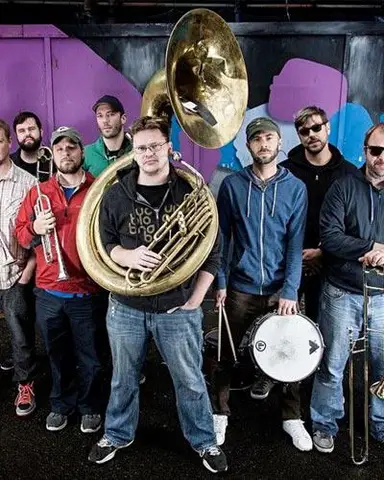
Charlie Wagner von der Youngblood Brass Band geht der Frage nach, die sich jeder Trompeter stellt - wie man in der hohen Lage spielt -, wobei er die Herangehensweise über das Equipment stellt.
Course preview
This lesson is part of the course Brass-Band-Musikalität und Improvisation mit Youngblood
Watch a preview of the full course below.
Lesson transcript:
How to Play High Notes in Trumpet
Hi, I'm Charlie Wagner from Youngblood Brass Band. The number one question we get asked at the end of every show in the trumpet section is:
"How do you play so high?"
There are many reasons and answers we could discuss, ranging from equipment to the trumpet player mentality. It's essential to know how to play high, because what other point is there to playing the trumpet, right?
Equipment vs. Approach
I'm going to skip over the sometimes more fun conversation about equipment, like which mouthpiece I use or what kind of trumpet you have.
Take Arturo Sandoval, for example. He is one of the masters of high note trumpet playing of all time, and he uses what many consider a very standard mouthpiece. For most people playing lead trumpet or high-note trumpet stuff, it would be considered a big mouthpiece.
A Physiological Approach
What we all share as trumpet players is a physiological approach to playing. To start this conversation, let's discuss some fundamental concepts you were hopefully taught as a beginner:
-
Posture: Maynard Ferguson once told Miles Davis, who was struggling with high notes, to stop moving around while playing and to stand up straight with his feet firmly on the ground.
-
Horn Position: When you stand, make sure you're upright and have the horn pointing upwards. The trumpet is designed to be a declarative instrument, projecting sound over long distances despite background noise. Remember, we're not clarinet players; we live in a higher range.
Here's a common scenario: if your bell is pointing at the ground, who can hear what's bouncing off it? It's supposed to be pointed up in the air!
Breathing Techniques
Now, let's discuss breathing.
I'm using my good friend here (holds up a visual aid) to demonstrate the importance of proper breathing technique. Your sternum, the bone in the middle of your chest, should direct your breath down below your rib cage. It's unnecessary to focus on your stomach moving in and out; all breathing occurs with your lungs, which are located behind your rib cage.
- Tip: Think of your sternum going upwards to fill the lower part of your lungs. You should always have air in reserve. I don't like to drop below about 25-30% empty; you should always find a way to fit a breath into your music.
Pressure Management
Another common concern among trumpet players (and brass players in general) is how much pressure to use. There is constant obsession about it: too much pressure, not enough pressure.
Here's what I recommend:
- Be Strong, Yet Flexible: Trumpet players operate at a higher compression level, so while you should be strong, don't be rigid like concrete. You need to fit the physicality of your body to the music you are playing.
One famous brass player and philosopher, Arnold Jacobs, a long-time tuba player with the Chicago Symphony, wrote a book titled Song and Wind. He suggests that you should focus on the sound you desire. Your body will naturally react toward achieving that sound, similar to how athletes improve their performance through visualization and practice.
Practicing High Notes
For Youngblood, we strive for an aggressive tone in our music. The tune I'd like to use as an example is called Eric Owen from our last album, Pax Volumite.
- The horn solo you hear in the first half of this tune is played at about 90% strength.
However, in rehearsals, you're often told to "back off" your volume, especially when you're a beginner. This can disrupt your natural playing style, as brass instruments are inherently loud.
Tips for High Notes:
- Practice Loud: You cannot play loud if you don't practice loud.
- Balance: Also practice low notes. Engaging in a mix of high and low will strengthen your overall range.
Final Thoughts
Don't forget to explore classical music, there, you'll hear trumpet players producing a giant sound, different from what we create in Youngblood, but just as valuable.
Thanks for listening! I hope this was helpful.
Mr. Sternum says hi, and remember, the Packers are going to the Super Bowl!
About the instructor
Youngblood Brass Band verbindet kompromisslose New-Orleans-Bläser mit der Energie und Lyrik des Hip-Hop. Das zehnköpfige Ensemble aus Madison, Brooklyn, Minneapolis und Chicago tourt seit 2000 um die Welt und hat mit Größen wie Questlove und Talib Kweli zusammengearbeitet. Es fühlt sich gleichermaßen wohl dabei, mit eigenen Kompositionen eine Marching Band anzuführen wie ein Punk-Festival als Headliner zu spielen. Auf MusicGurus zerlegen sie ihren Sound aus New Orleans und Hip-Hop: wie sie für Bläser komponieren und arrangieren, das rhythmische und harmonische Vokabular, das alles zusammenhält, und wie man eine Bläserlinie als Teil einer eng verzahnten Section spielt, inklusive der kompletten Stimmen zu ihrem Stück 'Brooklyn'. read more