



Multiphonics
Lesson time: (4min 37sec)
Nat McIntosh demonstriert die Grundlagen der Multiphonics auf dem Sousaphon – eine Note spielen und gleichzeitig eine andere singen, um mit dir selbst zu harmonieren.
Course preview
This lesson is part of the course Brass-Band-Musikalität und Improvisation mit Youngblood
Watch a preview of the full course below.
Lesson transcript:
Exploring Multiphonics with the Sousaphone
Now, because it has such a wide sonic waveform, it is, in my opinion, the best instrument for doing multiphonics.
What is Multiphonics?
Multiphonics is where you:
- Play a note
- Sing a note on top of it
You can also:
- Sing both notes
- Harmonize with yourself
Simple Directional Multiphonics
When you get good at it, you can learn how to make melodies with yourself. This is real simple , just go up in thirds. Your voice should be a third above where you're playing. This concept is what we call simple directional multiphonics.
Independent Multiphonics
Now, it starts to get hard when we talk about what I call independent multiphonics. This is when you're trying to play something different from the note that you're singing.
A Good Starting Point
A good, easy way to start working on this is to do a round with yourself. Let's try Frere Jacques.
I haven't done this in a while. Let's see if I can still do this.
Sounds a little silly, but it's something you can do. This can lead you to other ways to experiment with harmonization while you're playing the sousaphone.
Practical Example: The Brooklyn Solo
One of the big examples of the directional thing I do in a Youngblood context is the Brooklyn solo, where all of my multiphonics just follow the same direction as what I'm playing.
- Your voice is doing nothing but mirroring what you're playing a third above.
Adding Independence: The Elegy
If you want to add in a bit more independence, consider how I begin the song Elegy, where it's mostly a bass line with a melody that intermittently comes in and out.
Here's how you can work on that:
- See if you can hold a note that you're playing.
- Bring your voice in and out while maintaining the note.
This is much harder to do the other way around, but with enough practice, you can still achieve some cool results.
That's essentially the multiphonics side of things when you want to do both simultaneously.

About the instructor
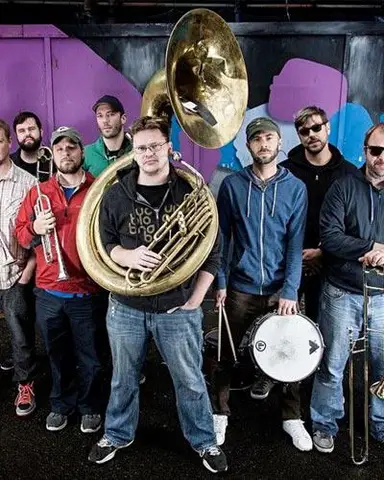
Youngblood Brass Band verbindet kompromisslose New-Orleans-Bläser mit der Energie und Lyrik des Hip-Hop. Das zehnköpfige Ensemble aus Madison, Brooklyn, Minneapolis und Chicago tourt seit 2000 um die Welt und hat mit Größen wie Questlove und Talib Kweli zusammengearbeitet. Es fühlt sich gleichermaßen wohl dabei, mit eigenen Kompositionen eine Marching Band anzuführen wie ein Punk-Festival als Headliner zu spielen. Auf MusicGurus zerlegen sie ihren Sound aus New Orleans und Hip-Hop: wie sie für Bläser komponieren und arrangieren, das rhythmische und harmonische Vokabular, das alles zusammenhält, und wie man eine Bläserlinie als Teil einer eng verzahnten Section spielt, inklusive der kompletten Stimmen zu ihrem Stück 'Brooklyn'. read more