



Bisheriger Rückblick - Vorzeichen und Akkorde
Lesson time: (4min 13sec)
Darius fasst die bisher gelernten Kernkonzepte zusammen und nutzt dafür eine Reihe herunterladbarer Übersichten: Quart-/Quintenzirkel, Akkorde - Dreiklänge und Septakkorde sowie eine Anleitung zu Akkordsymbolen
Course preview
This lesson is part of the course Harmony 101 - schnell zum 'guten Stoff'
Watch a preview of the full course below.
Lesson transcript:
Understanding the Cycle of Fourths and Fifths
Okay, here's the diagram we've provided for you. It shows the cycle of fourths and fifths.
The Cycle of Fourths
As you move around the cycle of fourths, that is, to the right, you get:
- C
- F
- B flat
- E flat
- A flat
- D flat
- G flat
You're moving in fourths, and with each new key, you add another flat. We will see that in a moment.
The Cycle of Fifths
Going around this diagram in the opposite direction, we have the cycle of fifths where you add sharps. The sequence is:
- C
- G
- D
- A
- E
- B
- F sharp
At each point, for instance, G has one sharp, then D has two sharps, and so on.
The Same Pitch
When we get to F sharp (or G flat), those are actually just two words for the same key on the piano, meaning the same pitch.
Key Signatures
This chart shows you the actual key signatures. You can see that every key maintains a constant relationship between its tonic note and all of the intervals in the key by adding flats and sharps.
Triads and Roman Numeral Notation
Here is a chart in three keys of triads. Underneath each triad is a Roman numeral. This notation describes chords in relation to the scale degree on which they are built:
- Small letters indicate minor
- Capital letters indicate major
Key of C Triads
The first line in the key of C goes:
- I (1)
- ii (2)
- iii (3)
- IV (4)
- V (5)
- vi (6)
- vii° (7)
And then it circles back to I again, allowing you to see which ones are major and minor.
To reinforce the concept of transposition, I've also provided it in F with one flat, and G with one sharp.
Triadic Intervals
Here's the same thing again, but with an added seventh:
- The triadic intervals are: 1, 3, 5.
- By skipping to the next odd number, we include 7.
Once again, this is presented in three keys, and you would really do well to practice this in every key. If you have a keyboard, this will really increase your facility faster than almost anything I can think of concerning being able to grab chords.
Chord Symbol Guide
Here is the chord symbol guide. There are even more ways of representing chords, but you can see:
- Simple abbreviations like major and minor
- Graphic signs like the circle, the circle with a line through it, and the plus triangle
These are all attempts to represent chords in the most compact way possible, so that it's easy to put them onto lead sheets.
Practical Advice
This material is pretty self-explanatory; however, it might be a good idea for you to print it out. Keep it to one side in case you're reading through some music that contains some of these symbols. This way, you'll become familiar with them and be able to refer to this guide easily.
About the instructor
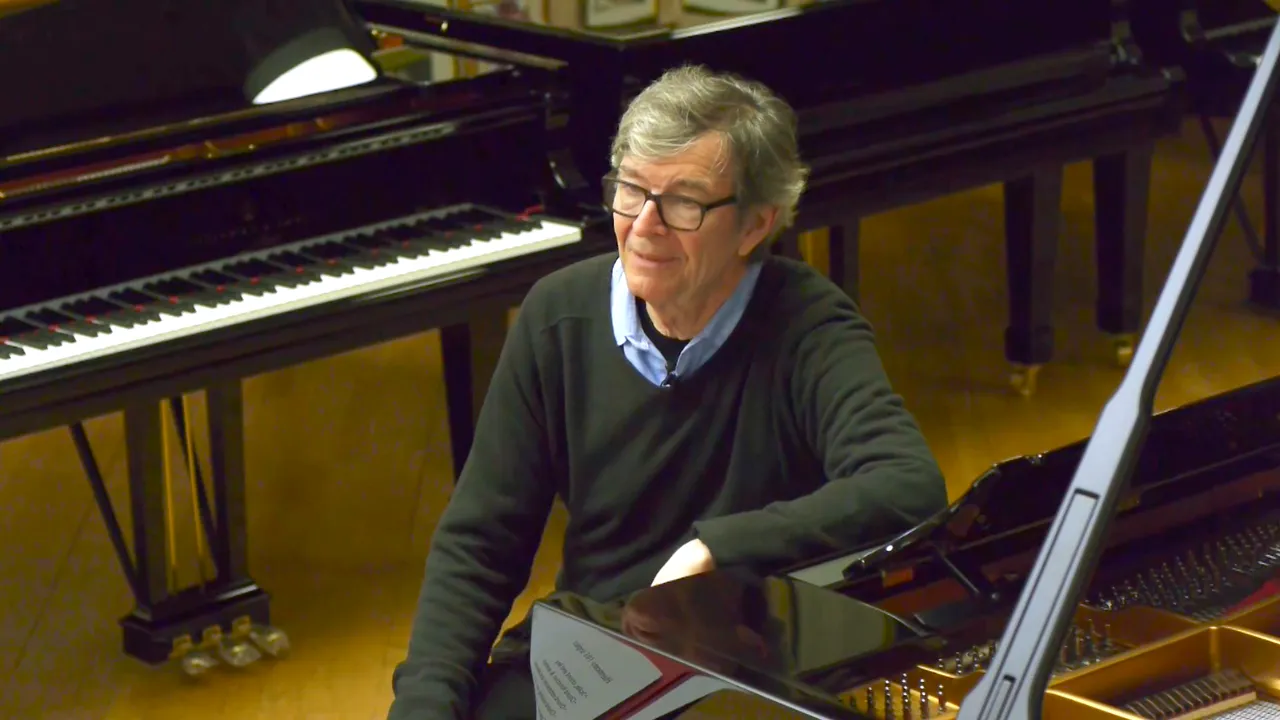
Darius Brubeck ist ein renommierter Jazzpianist und Musikpädagoge. Er hat zahlreiche Alben als Bandleader veröffentlicht, ist international mit seinen eigenen Gruppen getourt und hat mit seinen Brüdern an Brubecks Play Brubeck zusammengearbeitet. Darius war als Fulbright-Gastprofessor in Rumänien und der Türkei tätig. Er rief den ersten Jazz-Studiengang an einer afrikanischen Universität ins Leben, an der University of KwaZulu-Natal in Südafrika, wo er bis 2005 unterrichtete. Darius arbeitet häufig mit Mike Rossi zusammen, Saxofonist und Musikprofessor an der University of Cape Town. Zu Mikes Verdiensten zählen zahlreiche Aufnahmen und internationale Bühnenauftritte als Leader, Solist und Sideman unter anderem mit Tony Bennett, Dave Liebman, Winston Mankunku Ngozi, George Russell, Clark Terry und Alessio Menconi. Mit Darius als Mentor kommst du direkt zum Wesentlichen. In Harmony 101 entmystifiziert er die Jazzharmonik, damit du sie schnell anwenden kannst, und in Mastering Odd Times zeigt er dir, wie du in ungewöhnlichen Taktarten souverän spielst und improvisierst. read more