



Bonus: offene Voicings
"Open Voicing" ist die Art, wie die Töne von Akkorden über einen Bereich verteilt werden, der breiter als eine Oktave ist. Darius erklärt, wie du Voicing nutzt, damit sich deine Stimme als etwas Eigenes abhebt, als eine eigenständige Stimme, die der Melodie etwas hinzufügt, also nicht dasselbe wie die Melodie oder die zugrunde liegende Harmonie.
Das steckt im Kurs
11 Lektionen (1h 48m) · 1 gratis
Transkript der Lektion
Open Voicings and Chord Extensions
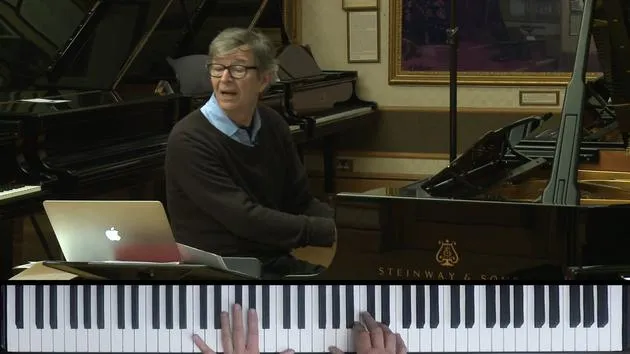
Open voicings involve a simple yet effective technique. Here's how it works:
- Take a close position chord.
- Move the first note above the root up to the top.
As a result, you create an interval larger than an octave, in fact, it's a tenth. This produces a nice, sonorous sound, with the tenth enclosing both the fifth and the seventh.
Chord Extensions
I've written it out for you in two keys. When chords have numbers in them, they indicate extensions. While these extensions are not always stylistically appropriate, they offer significant opportunities for enhancing the harmonic context of any melody.
Consider this: Melody notes may not always coincide with the notes in the chord. Thus, you are inherently hearing extensions.
Harmonizing Melody Notes
- Extensions can provide a means to harmonize melody notes that are present.
- They can also make harmonies more interesting and supportive.
Whether you're playing in a band situation, arranging for a horn section, or creating your own keyboard parts, understanding this concept is crucial. Your part should stand out as something distinct, adding a different voice that doesn't just duplicate the melody or the underlying harmony.
Musical Context
All styles of music effectively utilize this technique. For example, think of artists like Hendrix, James Brown, or Earth, Wind and Fire, each excels in this area. Any music with a strong blues foundation will inherently use a lot of chord extensions.
Thus, chord extensions are not merely an esoteric corner of the harmonic world reserved for jazz musicians; they are an everyday element of a musician's vocabulary.
11 Lektionen
1 Std. 48 Min. strukturierte Videolektionen
Erweiterte Videofunktionen
Verlangsamen, Passagen loopen, mitlesen
Handy, Tablet & Desktop
Üben, wo du willst
100 % Zufriedenheitsgarantie
30 Tage Geld-zurück-Garantie
Lern deinen Guru kennen

Lern deinen Guru kennen
Darius Brubeck ist ein renommierter Jazzpianist und Musikpädagoge. Er hat zahlreiche Alben als Bandleader veröffentlicht, ist international mit seinen eigenen Gruppen getourt und hat mit seinen Brüdern an Brubecks Play Brubeck zusammengearbeitet.
Darius war als Fulbright-Gastprofessor in Rumänien und der Türkei tätig. Er rief den ersten Jazz-Studiengang an einer afrikanischen Universität ins Leben, an der University of KwaZulu-Natal in Südafrika, wo er bis 2005 unterrichtete.
Darius arbeitet häufig mit Mike Rossi zusammen, Saxofonist und Musikprofessor an der University of Cape Town. Zu Mikes Verdiensten zählen zahlreiche Aufnahmen und internationale Bühnenauftritte als Leader, Solist und Sideman unter anderem mit Tony Bennett, Dave Liebman, Winston Mankunku Ngozi, George Russell, Clark Terry und Alessio Menconi.
Mit Darius als Mentor kommst du direkt zum Wesentlichen. In Harmony 101 entmystifiziert er die Jazzharmonik, damit du sie schnell anwenden kannst, und in Mastering Odd Times zeigt er dir, wie du in ungewöhnlichen Taktarten souverän spielst und improvisierst.







