



Tonleiter und Tonart
Darius Brubeck erklärt Intervalle und die Durtonleiter und wie die Tonika einem Stück seine Tonart gibt – wobei die Tonartvorzeichnung anzeigt, wie viele Kreuze oder Bes beteiligt sind.
Das steckt im Kurs
11 Lektionen (1h 48m) · 1 gratis
Transkript der Lektion
Harmony 101: Lesson 1
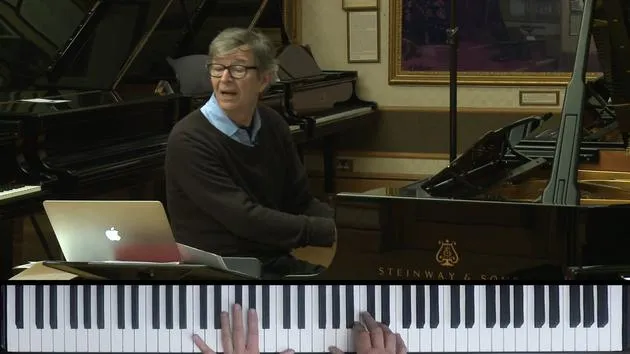
Welcome to the first lesson of Harmony 101 on Music Gurus. Here we are in Steinway Hall, surrounded by magnificent keyboards, and I'm going to use the piano to explain some basic concepts.
Overview of Key Concepts
Now, here are the most basic ideas you can get in studying music:
- Scale
- Chord
- Key
Just be patient because it will get complicated very soon. But to start with, I'll just talk about the scale.
Understanding Scales
We're surrounded by pianos, and we're going to use the piano as a reference to explain all of these concepts. However, it is not necessary to be a pianist at all. It would be useful, though, to have a keyboard for reference.
Suggested Instruments
It would be a good idea for you to get a cheap electric keyboard or a melodica, something where the notes are spelled out as they are at the piano keyboard. This way, you can see how these relationships work.
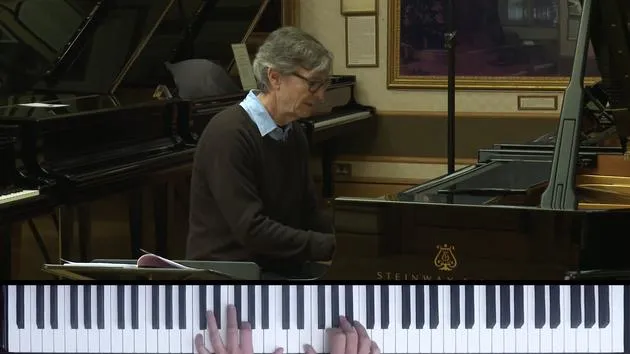
To start with a scale: from here to here, we have a scale.
The Major Scale
There are different possible scales, but right now we're talking about the major scale. This is a series of intervals you get just using the white keys between C and C.
The intervals of this scale are:
- Second
- Major Third (I'll explain why that term is used in a moment)
- Fourth (sometimes called a perfect fourth)
- Fifth (sometimes called a perfect fifth)
- Major Sixth
- Major Seventh
- Octave
When we refer to intervals of the scale (1, 2, 3, 4, 5, 6, 7), it's always just taking them in order from the root, or what's technically called the tonic note of the scale.
Altered Intervals
But these intervals can be altered. For instance:
- There's still a third, sixth, seventh.
- If you have a minor scale, you have a minor third.
This was called a major third because there's a little more distance between the root (the tonic note) and the third.
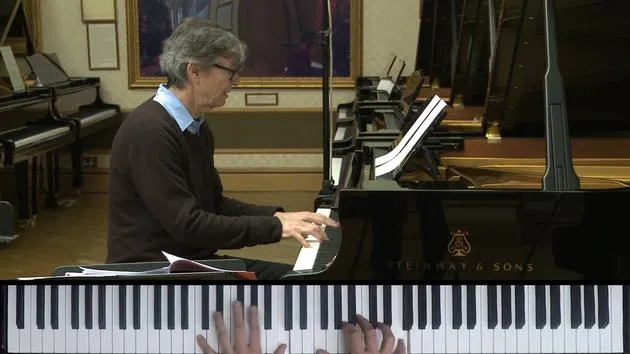
- Here is the minor sixth
- That's the major sixth
- That's the minor seventh
- That's the raised seventh
So you have a different scale, but the key is still C.
Consistency in Scales
The important thing is to understand that the scale may change, but the root of the scale can be the same. You could have:
- A minor pentatonic scale
- A major pentatonic scale
- A blues scale
The crucial point is to maintain the same relationship between the tonic and the other intervals in the scale.
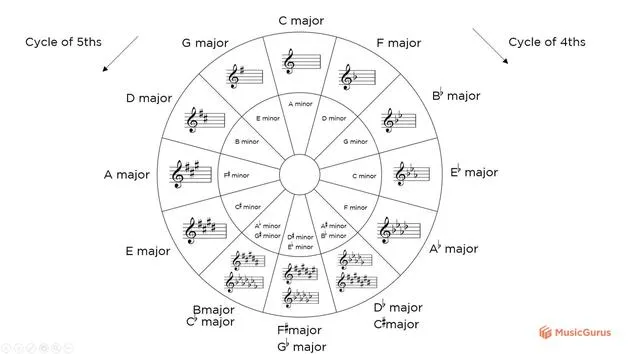
Key Signatures
And that's why we have key signatures.
- For example, if I start on F, there's the B flat in the key signature right there.
- If it weren't there, it would be quite a distinctly different sound.
To maintain the major scale, we need one flat in the case of F.
Further Example
Let's do one more example: there's one sharp in the key of G. All of this is just to keep that relationship constant.
11 Lektionen
1 Std. 48 Min. strukturierte Videolektionen
Erweiterte Videofunktionen
Verlangsamen, Passagen loopen, mitlesen
Handy, Tablet & Desktop
Üben, wo du willst
100 % Zufriedenheitsgarantie
30 Tage Geld-zurück-Garantie
Lern deinen Guru kennen

Lern deinen Guru kennen
Darius Brubeck ist ein renommierter Jazzpianist und Musikpädagoge. Er hat zahlreiche Alben als Bandleader veröffentlicht, ist international mit seinen eigenen Gruppen getourt und hat mit seinen Brüdern an Brubecks Play Brubeck zusammengearbeitet.
Darius war als Fulbright-Gastprofessor in Rumänien und der Türkei tätig. Er rief den ersten Jazz-Studiengang an einer afrikanischen Universität ins Leben, an der University of KwaZulu-Natal in Südafrika, wo er bis 2005 unterrichtete.
Darius arbeitet häufig mit Mike Rossi zusammen, Saxofonist und Musikprofessor an der University of Cape Town. Zu Mikes Verdiensten zählen zahlreiche Aufnahmen und internationale Bühnenauftritte als Leader, Solist und Sideman unter anderem mit Tony Bennett, Dave Liebman, Winston Mankunku Ngozi, George Russell, Clark Terry und Alessio Menconi.
Mit Darius als Mentor kommst du direkt zum Wesentlichen. In Harmony 101 entmystifiziert er die Jazzharmonik, damit du sie schnell anwenden kannst, und in Mastering Odd Times zeigt er dir, wie du in ungewöhnlichen Taktarten souverän spielst und improvisierst.







