



Beispiel für Akkordumkehrungen - My Funny Valentine

Lesson time: (4min 28sec)
Die wichtigste Erkenntnis aus der Lektion über Akkordumkehrungen ist, dass der tiefste Ton, den du hörst, nicht zwangsläufig der Grundton des Akkords ist. Darius veranschaulicht das mit dem Klassiker My Funny Valentine.
Course preview
This lesson is part of the course Harmony 101 - schnell zum 'guten Stoff'
Watch a preview of the full course below.
Lesson transcript:
Understanding Inversions in Chord Progression
Perhaps the single most important piece of information you can take away from just this brief look at inversions is that the lowest note you play or hear may not, in fact, be the root of the chord.
Next Lesson Overview
That's why in the next lesson, we're going to talk about chord progression and understand a little more about how it works.
Illustrating Inversions
To illustrate this point further, besides the B section of Summer Song, which you can see written out, I've thought of a couple of other examples where the commonly applied descending line underneath implies inversions.
- My Funny Valentine
- This song has received scant attention to minor, something that we'll pick up in the next lesson.
- It's a familiar ballad.
- Usually, you hear it with a descending bass line.
- This means that even though it can be over a pedal C the whole time (since we're in C minor in passing), you can make some nice voicings that don't disturb the overall C minor quality.
- However, that's really an inversion of a G triad: E flat, A minor, half diminished.
- And then to the subdominant.
- Finally, you're at a root position chord, and so on.
Movement Within Chords
You can see how this works: you can have chord changes within chords that come just from using the lowest note to build another chord, which might be an inversion that adds more richness to the progression.
- An Example in Major
- An example in major would be going from C minor to E flat major, like the song Someone in Love.
- "So what?" you may ask, this could imply that the lowest note is not the root of the chord (3, 6).
Conclusion
So, even though the important aspect is the root progression, inversions give you a way to build up movement even within that. We'll talk about that a lot more in the context of chord progression, but I just thought I might stick that in before discussing voicings that omit the root altogether.
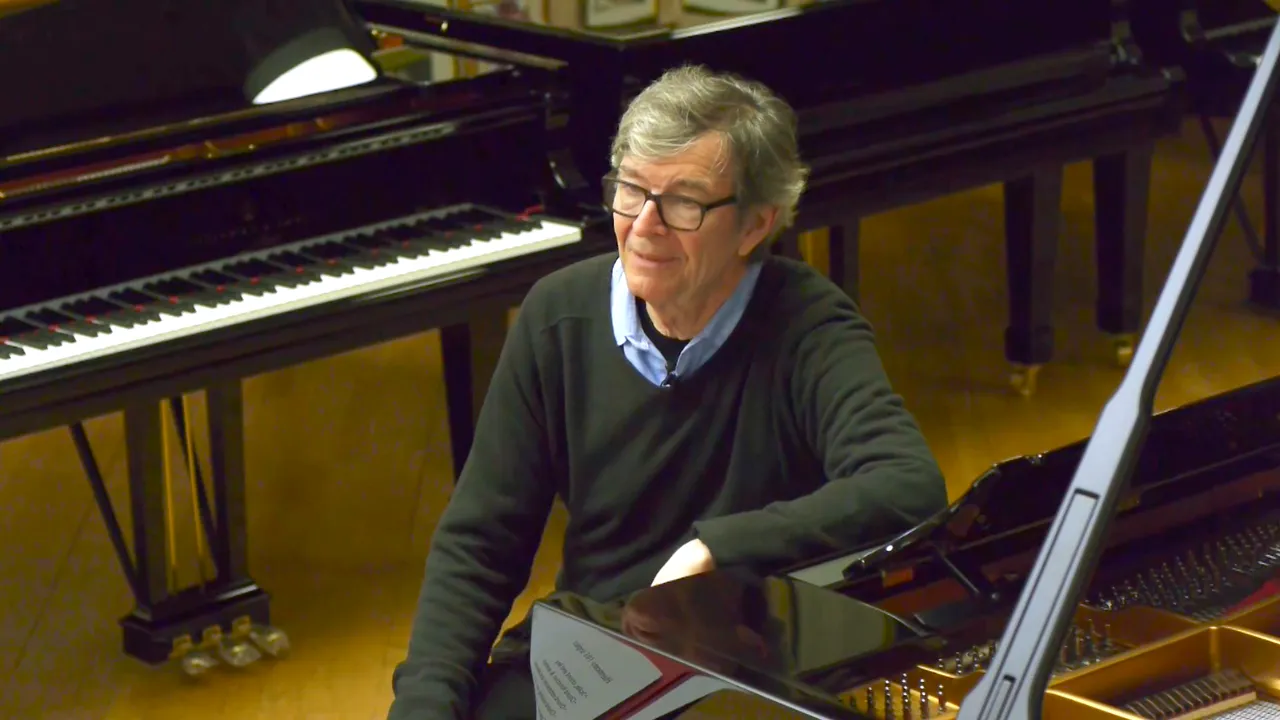
About the instructor
Darius Brubeck ist ein renommierter Jazzpianist und Musikpädagoge. Er hat zahlreiche Alben als Bandleader veröffentlicht, ist international mit seinen eigenen Gruppen getourt und hat mit seinen Brüdern an Brubecks Play Brubeck zusammengearbeitet. Darius war als Fulbright-Gastprofessor in Rumänien und der Türkei tätig. Er rief den ersten Jazz-Studiengang an einer afrikanischen Universität ins Leben, an der University of KwaZulu-Natal in Südafrika, wo er bis 2005 unterrichtete. Darius arbeitet häufig mit Mike Rossi zusammen, Saxofonist und Musikprofessor an der University of Cape Town. Zu Mikes Verdiensten zählen zahlreiche Aufnahmen und internationale Bühnenauftritte als Leader, Solist und Sideman unter anderem mit Tony Bennett, Dave Liebman, Winston Mankunku Ngozi, George Russell, Clark Terry und Alessio Menconi. Mit Darius als Mentor kommst du direkt zum Wesentlichen. In Harmony 101 entmystifiziert er die Jazzharmonik, damit du sie schnell anwenden kannst, und in Mastering Odd Times zeigt er dir, wie du in ungewöhnlichen Taktarten souverän spielst und improvisierst. read more