



Riff für die rechte Hand Nr. 1 – weitere Variationen
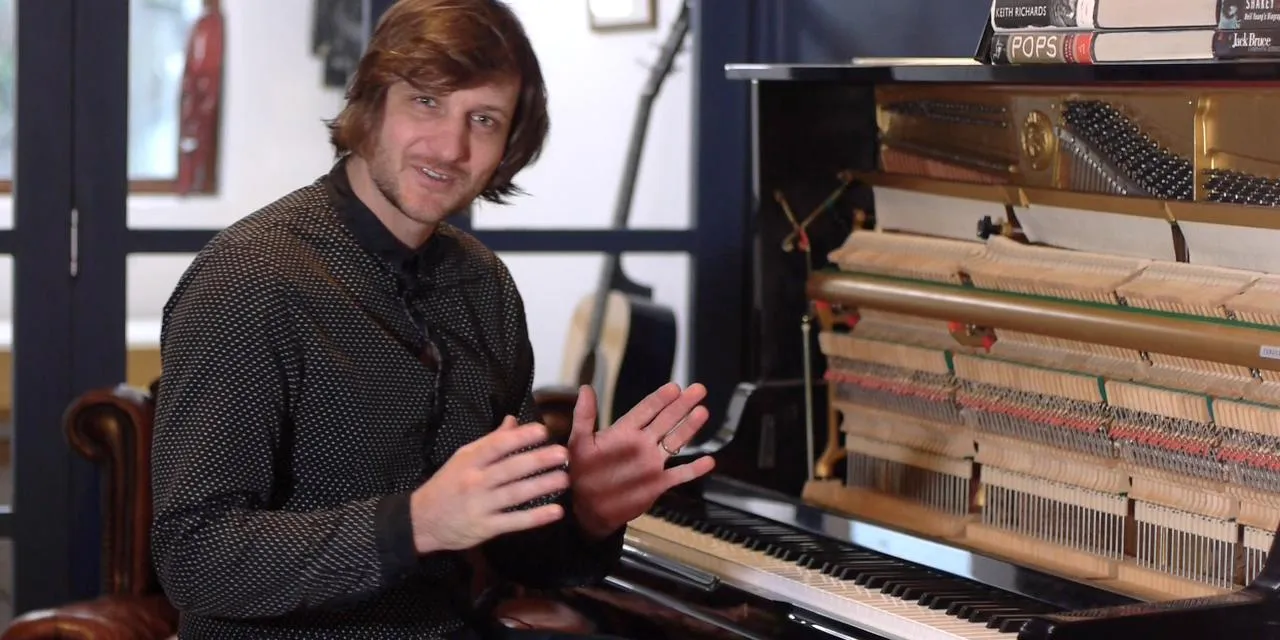
In dieser Lektion gibt dir Paddy weitere Ideen, um Riff Nr. 1 zu erweitern, etwa gerollte Noten, das Phrasieren nach dem Prinzip 'Frage & Antwort' und die Erweiterung auf die Septimen.
Das steckt im Kurs
10 Lektionen (1h 49m) · 1 gratis
01. Für den Anfang: der 12-Bar-Blues
12:20
02. Der Maschinenraum: Bass mit der linken Hand
9:31
03. Die rechte Hand/das Comping hinzufügen
Gratis-Lektion11:47

04. Harmonie entwickeln: Septakkorde & Umkehrungen
15:27
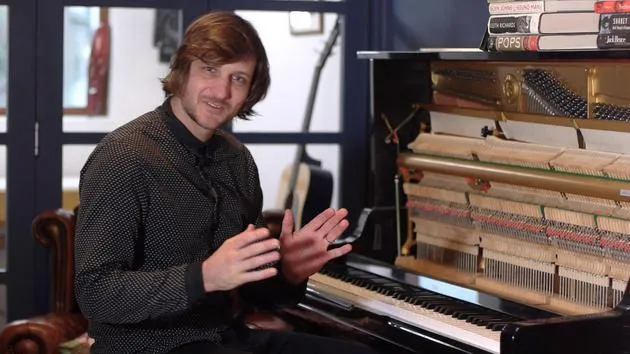
05. Rechte-Hand-Riff Nr. 1 und Variationen
13:20

06. Riff für die rechte Hand Nr. 1 – weitere Variationen
Du bist hier14:39
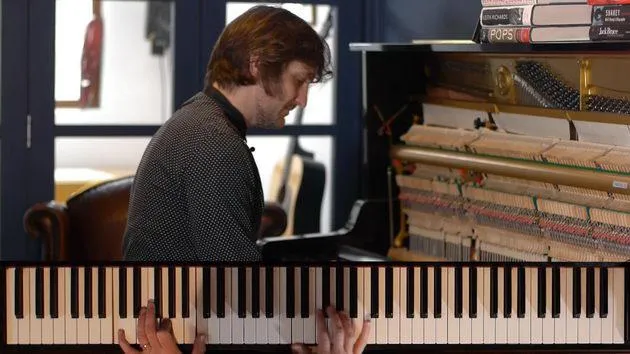
07. Die „Blues-Tonleiter“ & ihre Anwendungen
10:41
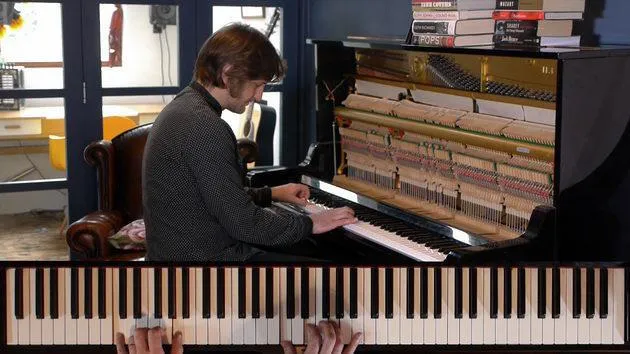
08. Schluss #1 & Variationen
9:26
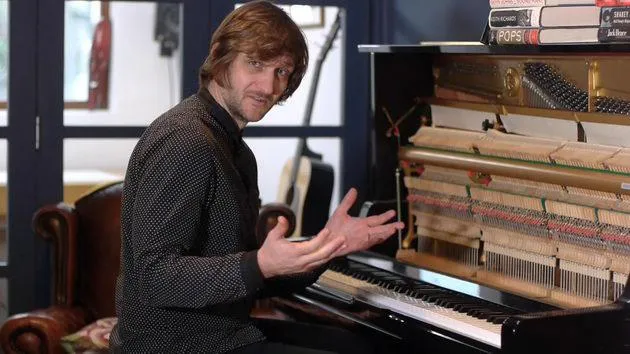
09. Alles zusammenfügen
10:34

10. Das dreckige Dutzend - Die Twelve-Bar-Blues-Challenge
1:59
Transkript der Lektion
Expanding the Riff: A Music Lesson
Introduction to the Riff So, yeah, in the previous lesson, we looked at this riff which is just based on literally going between those two chords. Let's explore some more fun things we can do with that and how we can extend it.
Rocking and Variations
- We looked at rocking, breaking it up, and rocking between the C and the other two parts of that riff.
- We added the crush note.
- We could kind of roll the notes.
This is another cool variation. All I'm doing there is using all the same notes. I'm playing them like this:
[Insert musical notation or sound example]
Fingering Options
You could either use Option A or Option B for fingering.
Contextual Practice: The 12 Bar
Let's look at that in context. How would that sound over a 12-bar sequence?
I'll add a few crush notes in there as well. It sounds something like this:
1, 2, 3, 4.
I'm going to stop there because it already sounds a bit repetitive. Right? It's just too much of the same thing going on.
Mixing it Up
I think it would be cool to mix it up. Let's break it up into phrases so we get more of a question and answer thing going on rather than just repeating the same thing over and over again.
Let's have a go:
1, 2, 3, 4.
Just vary them and put them side by side. Notice the one on the F I played there? I started predominantly with the C, then just added that little broken-up chord at the end, which on the C is that.
Instantly, just through those two or three different variations of that basic riff, it's already sounding much more bluesy, spontaneous, and free.
Experiment and Explore
And of course, I know that you'll have all kinds of ideas to try out on it. So, do anything you want. Try things! Sometimes they work; sometimes they don't. The only way of finding out is by really trying again.
"Try and get all those things going freely between the chords."
However repetitive that might sound from a practice point of view, it might be a good idea to try going around a whole 12-bar of that to get it under your fingers, really working on that muscle memory.
Get your fingers feeling those different hand patterns and shapes more intuitively and naturally.
A Full 12-Bar Practice
So, over that 12-bar, I'm going to play it to you just so you can see. This would be a good practice exercise:
Play a whole 12-bar with that kind of rolling riff.
1, 2, 3, 4.
As I said, this does sound a bit repetitive, but as a practice thing, it would be really useful to do. Play it loudly and softly over the whole 12-bar practice between the chords.
In my previous PDF, which you can download, there will be more practice tips and exercises that you can do with that.
Extending to the Seventh
Now, let's look at one more thing on this riff before we move on to something else. In the next video, we're going to extend this riff to the seventh.
Remember when we looked at the dominant seventh chords, we added the B flat and the different inversions?
With this, we'll extend this riff up to the seventh. Essentially, we're going between three different variations, and we can do exactly the same things as we've done with the basic riff, now with the extension to the seventh.
For example:
- We can add the crush note on the F, which would be from the F7.
- On the G, it will be from the G7 chord.
Additional Variations
Get that under your fingers, maybe play that over the 12-bar sequence, and get the chord changes as fluently as possible. Again, use the same practice techniques:
- Go between the chords.
- Play loudly and softly, all the usual stuff.
Why not?
Also, we can add a funky little crush note on the fifth.
- On the F, the fifth note is C, so the crush note would be the one, the semitone below it, which is B.
- And on the G, it will be the D.
If we play that over a 12-bar sequence, it will sound a bit like this:
[Insert musical example]
Building Comfort and Complexity
It's already sounding bigger, fuller, and fatter. This might be quite demanding to start with. If it is, then perhaps go back to the riff without the seventh in it, without both crush notes, and just do what's comfortable for you.
"Don't stretch yourself so hard that your hands hurt."
It's important that it's comfortable for you. Start off at a slow tempo where it is comfortable and gradually work up.
Exploring More Variations
Applying the other variations we discussed, we could also do the rocking motion with the C. It would sound like this:
[Insert musical example]
And on the G, it sounds a bit like that:
[Insert musical example]
Of course, you can add the crush notes on the F and the G as well! We could even implement the rolling technique discussed in the previous lesson.
Now suddenly, we're getting into more complex and involved material.
Demonstration of Variations
I'm going to play around a couple of 12 bars now to demonstrate the kinds of things you could do with variations on that riff, both using that and going up to the seventh.
Here we go:
1, 2, 3, 4.
Then we go up the octave.
So, suddenly it's getting more interesting. You may have noticed a couple of extra things I was doing. I was adding a triplet as well.
If you've got the other stuff down, then feel free to experiment with the triplets too!
Conclusion
There's so much more we can explore with this. That's what I love about blues music, and music in general , it's a whole world of things to explore.
For this course, that's perhaps as far as we'll go, but there will be all sorts of materials we can carry on exploring in the more advanced courses I'm teaching.
10 Lektionen
1 Std. 49 Min. strukturierte Videolektionen
Erweiterte Videofunktionen
Verlangsamen, Passagen loopen, mitlesen
Handy, Tablet & Desktop
Üben, wo du willst
100 % Zufriedenheitsgarantie
30 Tage Geld-zurück-Garantie
Lern deinen Guru kennen

Lern deinen Guru kennen
Paddy Milner gilt als einer der besten Blues-Pianisten der Welt – derzeit ist er der Stammkeyboarder von Sir Tom Jones, nach mehreren Jahren an der Seite des großartigen, verstorbenen Jack Bruce –, aber er ist auch ein hervorragender eigenständiger Songwriter und ein unverwechselbarer Sänger. Lies einfach das Lob von Größen wie Dave Brubeck weiter unten! Sein Spiel war auf dem Soundtrack des Kinohits 'Rocketman' von 2019 zu hören.
Zweimal wurde er bei den British Blues Awards als bester Keyboarder ausgezeichnet, und als Gründungsmitglied der Ronnie Scott's Blues Explosion hat er eine langjährige Residency im weltberühmten Club Ronnie Scott's.
Seine aktuelle Band LONDONOLA spielt selbst geschriebene britische Musik mit einer kräftigen Portion New-Orleans-Geist, und sein gemeinsames Projekt JAWBONE geht seit der Veröffentlichung des gleichnamigen Debütalbums von Stärke zu Stärke.
- „Ich liebe es... da ist einer, der wirklich Klavier spielen kann" - Dave Brubeck
- „Ich kann es nur wärmstens empfehlen. Irgendwie fängt alles an, sich viel besser anzufühlen!" - Jack Bruce
- „Der beste Blues-Pianist Europas..." - Blues Access, USA
- „Beeindruckend und originell" - The Times
- „Blendend" - The Independent
In seinen Kursen zerlegt Paddy den authentischen Blues-Shuffle, Slow Blues, Boogie-Woogie, Rock 'n' Roll und das New-Orleans-Piano – bis hin zu drei klassischen Boogie-Woogie-Songs –, damit du diese Stile bei einem der Allerbesten des Fachs lernst.







