



Die rechte Hand/das Comping hinzufügen
In dieser Lektion führst du die beiden Hände zusammen. Paddy stellt außerdem einfache Rhythmus-Ideen für die rechte Hand vor, die für mehr Interesse sorgen.
Das steckt im Kurs
10 Lektionen (1h 49m) · 1 gratis
01. Für den Anfang: der 12-Bar-Blues
12:20
02. Der Maschinenraum: Bass mit der linken Hand
9:31
03. Die rechte Hand/das Comping hinzufügen
Du bist hier11:47

04. Harmonie entwickeln: Septakkorde & Umkehrungen
15:27
05. Rechte-Hand-Riff Nr. 1 und Variationen
13:20

06. Riff für die rechte Hand Nr. 1 – weitere Variationen
14:39
07. Die „Blues-Tonleiter“ & ihre Anwendungen
10:41
08. Schluss #1 & Variationen
9:26
09. Alles zusammenfügen
10:34

10. Das dreckige Dutzend - Die Twelve-Bar-Blues-Challenge
1:59
Transkript der Lektion
12-Bar Blues: Bringing It All Together
Welcome back! In this lesson, we will:
- Bring the two hands together
- Elevate the 12-bar blues
- Make it more interesting
Getting Started
First, I'm assuming that you've got the left hand down pretty fluently and you can play this pattern throughout the whole 12-bar blues. You really need to master that before we can explore the more fun stuff in the right hand.
Putting It All Together
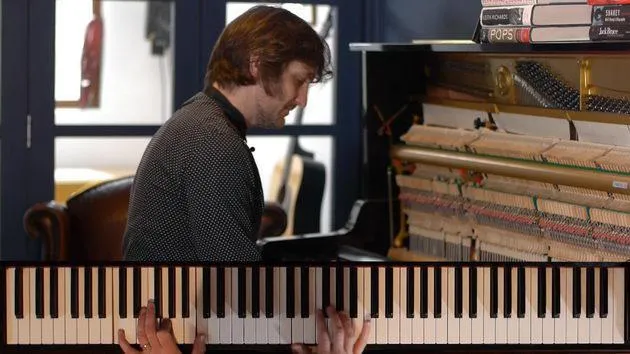
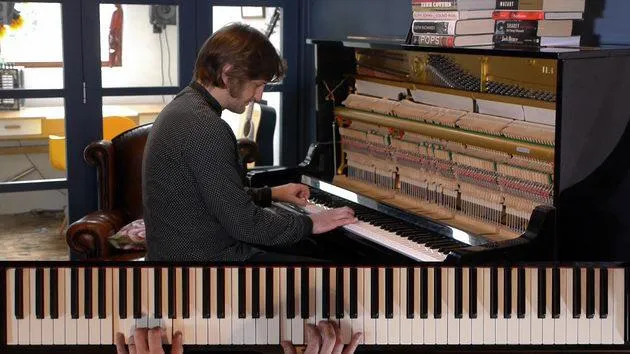
When we first looked at the 12-bar blues, we played it like this. Now, let's try combining the right hand with the left hand. It should sound something like this:
- Chord of C
- Right hand playing crotchet (quarter note) beats
- Left hand playing the bass pattern
The right hand will play on every other note that the left hand plays. If we play this over the whole 12-bar, it will sound like this:
- Bars 2-5:
Moving from C up to F (with a little variation in the left hand), then to G, back to F, and finishing on G before returning to C to start the whole sequence again.
Practice Tips
The aim is to get this as fluent and automatic as possible. Here are some tips:
-
Start Slow:
Begin at the slowest tempo that feels comfortable. -
Coordinate the Hands:
Ensure you are playing the right hand on every other note of the left hand. -
Smooth Transitions:
Practice changing between chords without breaks.
Specific Chord Changes
You can practice transitions between chords like we did in the previous lesson. For instance:
- C to F
- C to G
- G to F
Break it down to two beats each to improve your flow:
- One measure per chord: e.g., C to F, then back to C.
Feel free to develop your own practice routines.
Creative Practice Techniques
I encourage you not just to learn what I'm teaching, but to come up with your own creative ways to make music. Here are some additional practice tips:
-
Vary Volume:
Play at different volumes. This helps develop muscle memory and a deeper understanding of the music.- Practice quietly and then as loudly as you can.
-
Hands Independence:
Practice each hand at different volumes.- For example, play the left hand loudly and the right hand softly.
Exploring Rhythmic Variations
Once you've got the rhythm down fluently, let's explore playing the right hand on the offbeat. This creates a more authentic blues sound.
- Offbeat Playing:
Rather than playing on the beat, target the second and fourth notes of the left hand.
As you practice the 12-bar progression, it will instantly sound more blues-like. You can hear this style in many songs, especially in jump swing blues records by artists like Louis Prima and Louis Jordan.
Final Rhythmic Variation
Before we finish this lesson, let's look at one more rhythmic variation in the right hand.
- Two-Bar Cycle:
It starts off and smoothly continues with the corresponding chords.
Try to master this rhythm over the 12-bar blues. Remember, you can always rewind and watch it again; feel free to play along with me!
Get Creative
Experiment with your own rhythms. Keep these tips in mind:
-
Driving Forward:
Ensure the music maintains momentum. -
Improvise:
Reverse elements, double them up, or mix them.
This is all about improvisation and bringing your unique style to the music.
Looking Ahead
In the next lesson, we will explore some simple right-hand riffs to show you various techniques for developing and varying them. This will be a great addition to your left-hand patterns!
10 Lektionen
1 Std. 49 Min. strukturierte Videolektionen
Erweiterte Videofunktionen
Verlangsamen, Passagen loopen, mitlesen
Handy, Tablet & Desktop
Üben, wo du willst
100 % Zufriedenheitsgarantie
30 Tage Geld-zurück-Garantie
Lern deinen Guru kennen

Lern deinen Guru kennen
Paddy Milner gilt als einer der besten Blues-Pianisten der Welt – derzeit ist er der Stammkeyboarder von Sir Tom Jones, nach mehreren Jahren an der Seite des großartigen, verstorbenen Jack Bruce –, aber er ist auch ein hervorragender eigenständiger Songwriter und ein unverwechselbarer Sänger. Lies einfach das Lob von Größen wie Dave Brubeck weiter unten! Sein Spiel war auf dem Soundtrack des Kinohits 'Rocketman' von 2019 zu hören.
Zweimal wurde er bei den British Blues Awards als bester Keyboarder ausgezeichnet, und als Gründungsmitglied der Ronnie Scott's Blues Explosion hat er eine langjährige Residency im weltberühmten Club Ronnie Scott's.
Seine aktuelle Band LONDONOLA spielt selbst geschriebene britische Musik mit einer kräftigen Portion New-Orleans-Geist, und sein gemeinsames Projekt JAWBONE geht seit der Veröffentlichung des gleichnamigen Debütalbums von Stärke zu Stärke.
- „Ich liebe es... da ist einer, der wirklich Klavier spielen kann" - Dave Brubeck
- „Ich kann es nur wärmstens empfehlen. Irgendwie fängt alles an, sich viel besser anzufühlen!" - Jack Bruce
- „Der beste Blues-Pianist Europas..." - Blues Access, USA
- „Beeindruckend und originell" - The Times
- „Blendend" - The Independent
In seinen Kursen zerlegt Paddy den authentischen Blues-Shuffle, Slow Blues, Boogie-Woogie, Rock 'n' Roll und das New-Orleans-Piano – bis hin zu drei klassischen Boogie-Woogie-Songs –, damit du diese Stile bei einem der Allerbesten des Fachs lernst.







