



Harmonie entwickeln: Septakkorde & Umkehrungen
In dieser Lektion erweitert Paddy die Idee der Dreiklänge auf Septakkorde und Umkehrungen.
Das steckt im Kurs
10 Lektionen (1h 49m) · 1 gratis
01. Für den Anfang: der 12-Bar-Blues
12:20
02. Der Maschinenraum: Bass mit der linken Hand
9:31
03. Die rechte Hand/das Comping hinzufügen
Gratis-Lektion11:47
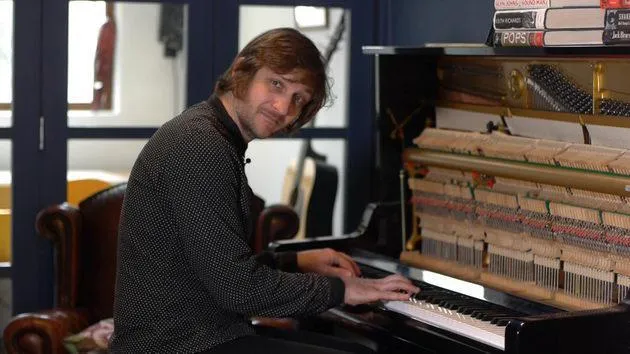
04. Harmonie entwickeln: Septakkorde & Umkehrungen
Du bist hier15:27
05. Rechte-Hand-Riff Nr. 1 und Variationen
13:20
06. Riff für die rechte Hand Nr. 1 – weitere Variationen
14:39
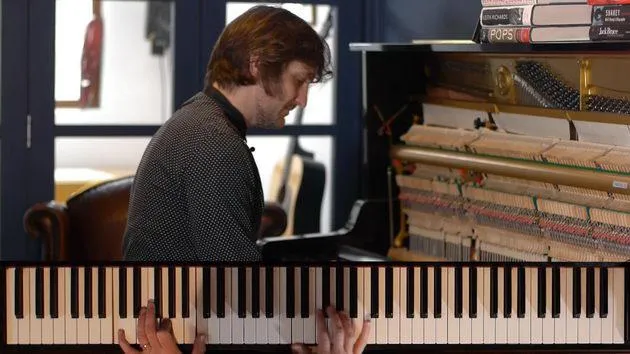
07. Die „Blues-Tonleiter“ & ihre Anwendungen
10:41
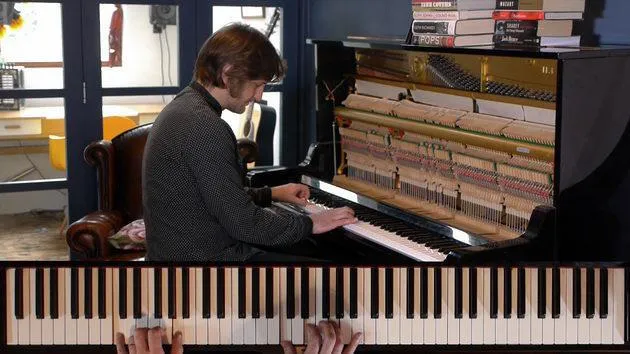
08. Schluss #1 & Variationen
9:26
09. Alles zusammenfügen
10:34
10. Das dreckige Dutzend - Die Twelve-Bar-Blues-Challenge
1:59
Transkript der Lektion
Extending the Harmonic Language of the 12 Bar Blues
Welcome back! In this lesson, we're going to look at extending the harmonic language of the 12-bar blues. Instead of just playing triads, we'll explore:
- Sevenths
- Inversions
This approach will help you add more blues flavor and make the 12-bar sequence harmonically interesting.
Recap of Previous Lesson
In the previous lesson, we looked at adding some rhythms to the right hand. Let's do something similar but use some seventh chords.
Understanding Seventh Chords
A seventh chord consists of the triad plus the flattened seventh.
- For example, in the C major scale, the notes are C, D, E, F, G, A, B.
- The B is the seventh; however, when we flatten it, it becomes a Bb, which gives it a more bluesy sound.
Forming Dominant Seventh Chords
-
F Major Scale:
- The seventh note is E; flattening it gives us F7.
-
G Major Scale:
- The seventh note is F#; flattening it leads to G7.
In classical and jazz terminology, these are known as dominant seventh chords, often referred to simply as seventh chords.
Playing the 12 Bar Blues with Dominant Sevenths
Let's try playing some rhythms over the 12-bar sequence using these dominant seventh chords. It sounds something like this:
1, 2, 3, 4... [Back round again]
This instantly gives it a more authentic blues sound.
You may have noticed I added some crushed notes (normally on the third), which is a very bluesy technique. I'll cover that in future lessons, so for now, if you've got the dominant sevenths down, feel free to add those crush notes.
I'm literally using one finger to move between notes, and the same applies to the F7 and G7.
Practice Tips
- Focus on making transitions between chords as smooth as possible with no breaks.
- Start at a comfortable slow tempo before speeding up.
- Experiment with volume variations: play very loud, softly, with the left hand louder than the right, and vice versa.
Practice the chord changes in the 12-bar blues sequence:
- C to F
- F to C
- C to G
- G to C
- G to F
The goal is to become fluent in these transitions.
Experiment with Rhythms
Don't be afraid to experiment! Use the rhythms I showed you in the previous lesson or create your own.
Introducing Inversions
Now, let's look at inversions and how we can use them in the 12-bar blues.
What is an Inversion?
An inversion involves taking one of the notes of the chord and moving it an octave higher.
- Starting with C7, the root note is C.
- Move C up an octave, and you still have C7 but in first inversion.
- If you take the E from C7 and move it to the top, that becomes second inversion.
- Moving G to the top gives us third inversion.
Summary of Inversion Types:
- Root Position
- First Inversion
- Second Inversion
- Third Inversion
The Benefits of Using Inversions
Inversions are particularly helpful when comping or playing riffs. They allow you to minimize hand movement.
Example: To change from C7 to F7:
- The notes of F7 are F, C, and Eb.
- The closest notes to a C7 chord already include C.
- You can find F and A nearby, ensuring a smooth transition.
Demonstration in a 12-Bar Sequence
Let's demonstrate this in the context of a 12-bar sequence:
C7 to F7: You can move smoothly by simply adjusting a few notes without changing hand position.
For instance, moving from C7 to G7 involves finding the nearest notes in G7 without jumping all the way up.
Practicing Inversions
- Start in a first inversion on C7.
- Change to the nearest version of F7.
- Experiment by starting in different inversions, like second inversion on C7.
Feel free to play around with different configurations to create a bluesy feel, especially when transitioning between major and minor thirds.
Final Demonstration
To showcase the use of inversions, I'll play around with the 12-bar sequence a couple of times, switching between different inversions.
Here we go: 1, 2, 3, 4...
Conclusion
You've seen how to switch between different inversions and incorporate a few cheeky crush notes.
Don't forget to download the PDF which contains all the information from this lesson along with additional practice tips. Happy practicing!
10 Lektionen
1 Std. 49 Min. strukturierte Videolektionen
Erweiterte Videofunktionen
Verlangsamen, Passagen loopen, mitlesen
Handy, Tablet & Desktop
Üben, wo du willst
100 % Zufriedenheitsgarantie
30 Tage Geld-zurück-Garantie
Lern deinen Guru kennen

Lern deinen Guru kennen
Paddy Milner gilt als einer der besten Blues-Pianisten der Welt – derzeit ist er der Stammkeyboarder von Sir Tom Jones, nach mehreren Jahren an der Seite des großartigen, verstorbenen Jack Bruce –, aber er ist auch ein hervorragender eigenständiger Songwriter und ein unverwechselbarer Sänger. Lies einfach das Lob von Größen wie Dave Brubeck weiter unten! Sein Spiel war auf dem Soundtrack des Kinohits 'Rocketman' von 2019 zu hören.
Zweimal wurde er bei den British Blues Awards als bester Keyboarder ausgezeichnet, und als Gründungsmitglied der Ronnie Scott's Blues Explosion hat er eine langjährige Residency im weltberühmten Club Ronnie Scott's.
Seine aktuelle Band LONDONOLA spielt selbst geschriebene britische Musik mit einer kräftigen Portion New-Orleans-Geist, und sein gemeinsames Projekt JAWBONE geht seit der Veröffentlichung des gleichnamigen Debütalbums von Stärke zu Stärke.
- „Ich liebe es... da ist einer, der wirklich Klavier spielen kann" - Dave Brubeck
- „Ich kann es nur wärmstens empfehlen. Irgendwie fängt alles an, sich viel besser anzufühlen!" - Jack Bruce
- „Der beste Blues-Pianist Europas..." - Blues Access, USA
- „Beeindruckend und originell" - The Times
- „Blendend" - The Independent
In seinen Kursen zerlegt Paddy den authentischen Blues-Shuffle, Slow Blues, Boogie-Woogie, Rock 'n' Roll und das New-Orleans-Piano – bis hin zu drei klassischen Boogie-Woogie-Songs –, damit du diese Stile bei einem der Allerbesten des Fachs lernst.







