



Solieren mit dem Grundton der Akkorde einer Blues-Progression

Mit
Mat Walklate
Das steckt im Kurs
11 Lektionen (1h 4m) · 2 gratis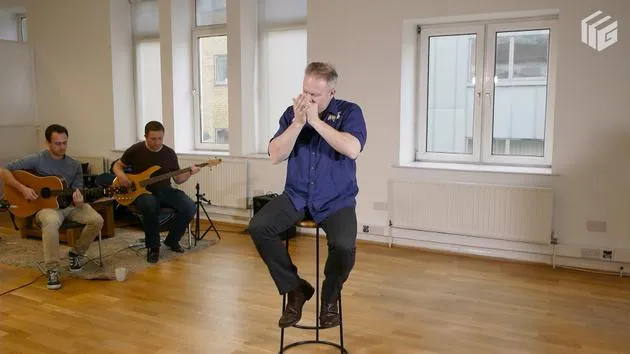
01. Blues spielen, eine Demonstration
Gratis-Lektion2:14
02. Wiederholung der G-Blues-Tonleiter
2:31
03. Noten-Bending für zusätzliche Töne
9:12
04. Einfaches 12-bar Solo
3:50
05. Solieren mit dem Grundton der Akkorde einer Blues-Progression
Du bist hier5:57
06. Vibrato
6:37
07. Interessantere Soli entwickeln
7:43
08. Fortgeschrittenes Tongue Blocking
10:22
09. Blues-Tonleitern in der ersten Lage
5:48
10. Blues-Tonleitern in dritter Position
6:22
11. BONUS: Lerne, Ian Durys "Sex & Drugs & Rock & Roll" auf der Blues-Mundharmonika zu spielen
Gratis-Lektion3:36
Transkript der Lektion
Constructing a Solo on the Diatonic Harmonica
Hello, my name is Matt. In this lesson, we're going to be looking at constructing a solo on the diatonic harmonica using the root notes of the chords that the accompaniment is playing.
Overview
- Instruments: Guitars, bass, piano, etc.
- Chords Involved: Only three chords
- Root Notes on Harmonica:
- 2 draw: G (most common)
- 4 blow: C
- 4 draw: D
The 12 Bar Blues
For the first four bars of a simple 12-bar blues, we have:
- Bars 1-4: G (2 draw)
- Bars 5-6: C (4 blow)
- Bars 7-8: G (2 draw)
- Bar 9: D (4 draw)
- Bar 10: C (4 blow)
- Bars 11-12: G (2 draw)
If you just play the root notes, it can be extremely dull. However, you can start to embroider it, adding one or two extra notes to add character.
Adding Additional Notes
- If you play just the root notes, it's pretty dull.
- By incorporating adjacent notes (notes next door), you can create something more interesting.
Remember, it's all based around the root notes of the chords.
The Importance of Listening
- It's not strictly necessary to count; the more you listen to 12-bar blues, the more you'll anticipate chord changes.
- Most blues follows the 12-bar pattern. Keep listening to what other harmonica players are doing.
By doing this, you'll develop a better understanding of when to change and how to make your playing sound more interesting.
Practical Application
Now, let's put this into practice!
- I will go back to the pub and drag the band out again.
- We'll play two 12-bar progressions, and I will construct two solos based on the root notes of the chords, keeping it straightforward.
After a count of four...
1, 2, 3, 4!
Adding Bends
As you learn to make successful bends on the harmonica, you can add these to your playing as well. Bends provide more options and directions to explore, allowing you to create interesting riffs.
Examples of bends included with root notes:
- 2 draw
- 4 blow
- 4 draw
Once you master those note bends, you can incorporate them into any other formula used to construct a solo.
For instance, in the previous lesson using the blues scale, you can add bends to enhance its lyrical quality.
Final Thoughts
Bends can be difficult, but they are worth persevering with as they open up many more possibilities in your playing. Happy practicing!
11 Lektionen
1 Std. 4 Min. strukturierte Videolektionen
Erweiterte Videofunktionen
Verlangsamen, Passagen loopen, mitlesen
Handy, Tablet & Desktop
Üben, wo du willst
100 % Zufriedenheitsgarantie
30 Tage Geld-zurück-Garantie
Lern deinen Guru kennen
Lern deinen Guru kennen
Mat Walklate ist ein in Manchester ansässiger Mundharmonikaspieler und Lehrer, der im Blues und Folk zu Hause ist und außerdem Flöte, Whistle und Uilleann Pipes spielt und singt. Er gewann 1992 die British Blues Harmonica Championship und 1993 das All-Britain Fleadh Cheoil an der Mundharmonika und ist ein von Seydel unterstützter Künstler.
In einer dreißigjährigen Laufbahn ist er mit Bands wie The Moochers und der Irish-Music-Gruppe The House Devils durch Europa getourt, hat zwischen 2001 und 2021 rund vierzehn Alben aufgenommen und gemischt – darunter Sea of Blues und Traditional Harmonica – und tritt heute im Duo mit dem Sänger und Gitarristen Alex Haynes sowie an der Seite des Blues-Gelehrten Dr Tom Attah auf. Er unterrichtet Mundharmonika am Leeds Conservatoire und privat.
Auf MusicGurus führen dich seine Kurse von deinen ersten Tönen auf einer C-Mundharmonika – Ansatz, die Cross-Harp-Position, Bending und deine erste Improvisation – bis hin zu flüssigem Blues-Spiel, mit Vibrato, alternativen Positionen und der Phrasierung, die ein Solo zum Singen bringt.







