



Wiederholung der G-Blues-Tonleiter

Lesson time: (2min 31sec)
Wiederholung, wie du die G-Blues-Tonleiter auf der C-Mundharmonika spielst
Course preview
This lesson is part of the course Flüssig werden auf der Blues-Harmonika
Watch a preview of the full course below.
Lesson transcript:
Tips and Tricks for Playing Blues on the Diatonic Harmonica
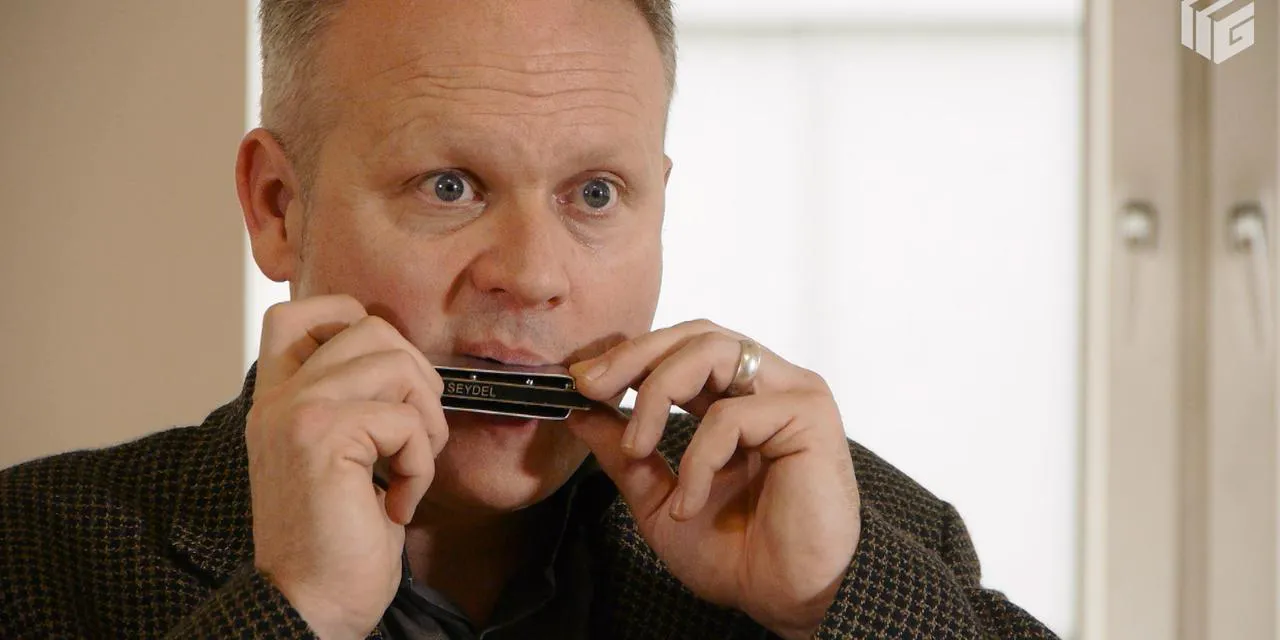
Hello, my name's Matt, and I'm going to be showing you a few tips and tricks on the diatonic harmonica to improve your blues playing.
Understanding Key Positions
This harmonica is in the key of C. Interestingly, the easiest way to play blues on a C harmonica isn't in the key of C, it's actually in the key of G.
The Blues Scale
Every diatonic harmonica has a blues scale hidden in there purely by accident. This scale typically goes from:
- 2 Draw
- 3 Draw
- 4 Blow
- 4 Draw
- 5 Draw
- 6 Blow
You would play it like this to embody the essence of blues harmonica solos. Playing in this way is known as second position or cross harp.
Recap of the Blues Scale
To recap, on the scale that spans from 2 to 6, all the notes on the harmonica are at your disposal, and we can use those to construct solos.
Strong and Weak Notes
- Strong Draw Notes: The draw notes in the first six holes are typically stronger when playing blues in second position.
- Weak Blow Notes: Some of the blow notes are not quite as strong.
Rule of Thumb
As a basic rule of thumb:
- If you can't think of what to play and your mind goes completely blank, breathe in.
- Breathing in while using the first six holes is usually a safer option than breathing out.
Expanding the Blues Scale
The blues scale continues all the way up to the top. For instance, you can go from number nine to number six, like so.
Two Octaves
This gives you access to two octaves and a bit of the blues scale. You can further enhance your playing by adding bent notes.
- Bent Notes: You can bend many of the notes down in pitch, which provides additional notes to expand your palate.
Ultimately, the basic skeleton or framework to focus on is that foundational blues scale, as discussed.
About the instructor
Mat Walklate ist ein in Manchester ansässiger Mundharmonikaspieler und Lehrer, der im Blues und Folk zu Hause ist und außerdem Flöte, Whistle und Uilleann Pipes spielt und singt. Er gewann 1992 die British Blues Harmonica Championship und 1993 das All-Britain Fleadh Cheoil an der Mundharmonika und ist ein von Seydel unterstützter Künstler.In einer dreißigjährigen Laufbahn ist er mit Bands wie The Moochers und der Irish-Music-Gruppe The House Devils durch Europa getourt, hat zwischen 2001 und 2021 rund vierzehn Alben aufgenommen und gemischt – darunter Sea of Blues und Traditional Harmonica – und tritt heute im Duo mit dem Sänger und Gitarristen Alex Haynes sowie an der Seite des Blues-Gelehrten Dr Tom Attah auf. Er unterrichtet Mundharmonika am Leeds Conservatoire und privat.Auf MusicGurus führen dich seine Kurse von deinen ersten Tönen auf einer C-Mundharmonika – Ansatz, die Cross-Harp-Position, Bending und deine erste Improvisation – bis hin zu flüssigem Blues-Spiel, mit Vibrato, alternativen Positionen und der Phrasierung, die ein Solo zum Singen bringt. read more