



Blues-Tonleitern in dritter Position

Mit
Mat Walklate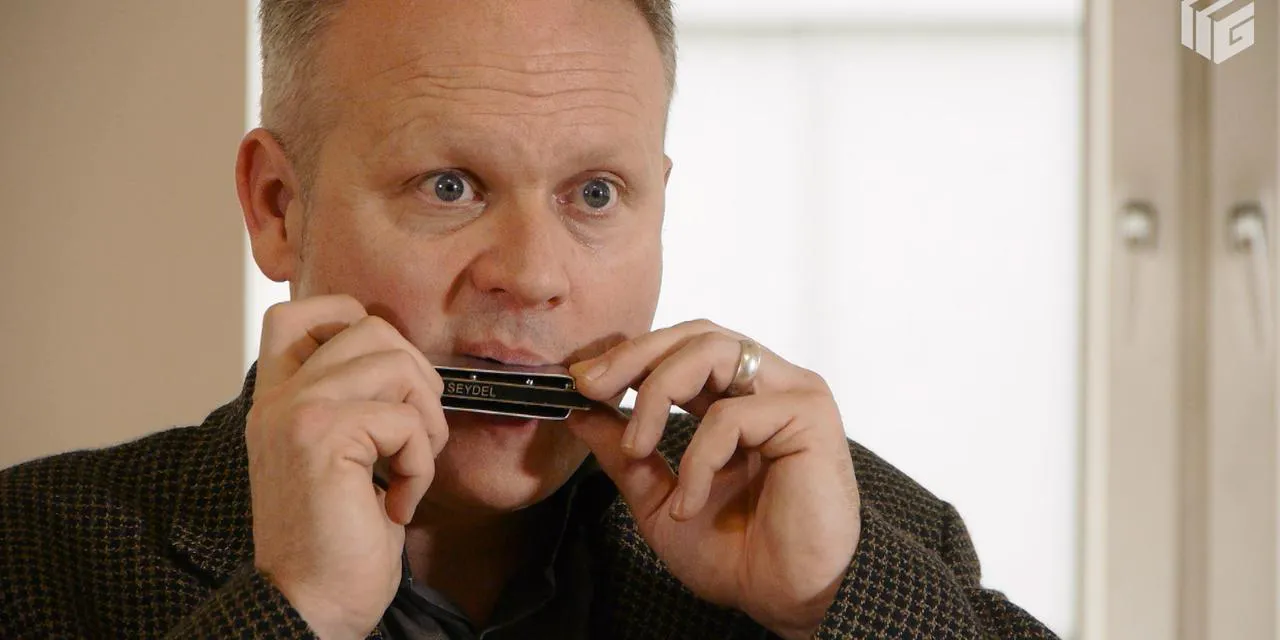
Das steckt im Kurs
11 Lektionen (1h 4m) · 2 gratis
01. Blues spielen, eine Demonstration
Gratis-Lektion2:14
02. Wiederholung der G-Blues-Tonleiter
2:31
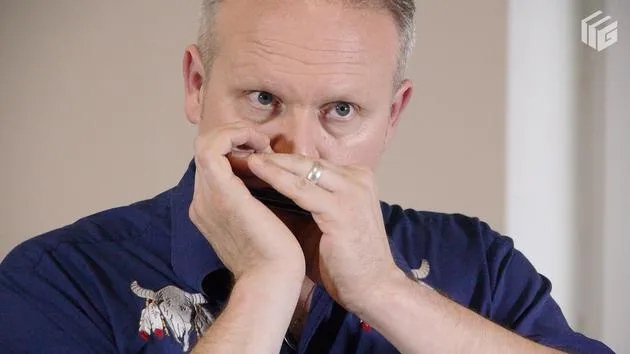
03. Noten-Bending für zusätzliche Töne
9:12
04. Einfaches 12-bar Solo
3:50
05. Solieren mit dem Grundton der Akkorde einer Blues-Progression
5:57
06. Vibrato
6:37
07. Interessantere Soli entwickeln
7:43
08. Fortgeschrittenes Tongue Blocking
10:22
09. Blues-Tonleitern in der ersten Lage
5:48
10. Blues-Tonleitern in dritter Position
Du bist hier6:22
11. BONUS: Lerne, Ian Durys "Sex & Drugs & Rock & Roll" auf der Blues-Mundharmonika zu spielen
Gratis-Lektion3:36
Transkript der Lektion
Understanding Third Position on the Harmonica
So now we'll look at the other position that's widely used, which is third position. This involves using a minor scale that exists in the harmonica without having to bend or do any difficult techniques.
The Basics
- Starting Hole: It starts on hole number four draw, allowing you to play a minor pentatonic scale.
- Comparison with Second Position: When we play in second position, we're using a major pentatonic scale. In this case, it's a minor one.
"If you check out the site, there'll be a PDF with this scale written out for your reference."
Easy Entry into Third Position
If you want an easy way into third position:
- Stay away from the first three holes.
- Play from hole four upwards.
Key Compatibility
Play over:
- D minor
- D major
This is one of the key aspects of third position: it works over both the minor and the major key. It sounds best, if I'm honest, over the minor key, but it will still work over the major.
"The scale that we're using there is a scale in the key of D."
Hole Number Three Considerations
- The reason for staying away from the first three holes is primarily to avoid hole number three.
- This hole cannot be played in its normal state in third position; you have to bend it.
"If you're going to venture down to the first three holes, or if you're going to venture down to hole number three, you have to be able to bend it. Otherwise, it sounds off."
Freedom Beyond Hole Four
Above hole number four, you can:
- Play great big draw chords.
- Experiment with glissando (glissandi) to your heart's content.
- If you can play octaves, you can make great use of them in third position.
"It's what people who play blues on the chromatic harmonica tend to use, the one with the push button. Because if you play those in third position, you don't have to use the button, which makes life a lot easier."
Hole Number Three Demonstration
The problem with hole number three is that you always have to bend it:
- You can jump over it if you want to use one and two, that kind of thing.
- If you've never done third position before, then obviously stay away from holes one, two, and three. Focus on hole four upwards.
Characteristics of Third Position
- It allows for a looser, freer playing style.
- It sounds quite bluesy due to the use of a minor scale.
Bending in Third Position
You can use the bend in hole number six quite freely. The bend in six draw is a powerful tool if we're using it in second position.
"If we use it too much, it's a bit like putting too much chili in food. It's a little overpowering and becomes a little bit irritating if you use it too much."
However, in third position, you can use it as often as you like because it serves a different role.
Recording Session
In a moment, we'll record a couple of 12 bars in D minor and possibly also a couple in D major to show you how you can use third position effectively over these keys.
Let's Play!
-
D Minor (third position): Here we go!
1, 2, 3, 4. -
Blues in D Major (still third position for the C harmonica):
Oh.
1, 2, 3, 4.
11 Lektionen
1 Std. 4 Min. strukturierte Videolektionen
Erweiterte Videofunktionen
Verlangsamen, Passagen loopen, mitlesen
Handy, Tablet & Desktop
Üben, wo du willst
100 % Zufriedenheitsgarantie
30 Tage Geld-zurück-Garantie
Lern deinen Guru kennen
Lern deinen Guru kennen
Mat Walklate ist ein in Manchester ansässiger Mundharmonikaspieler und Lehrer, der im Blues und Folk zu Hause ist und außerdem Flöte, Whistle und Uilleann Pipes spielt und singt. Er gewann 1992 die British Blues Harmonica Championship und 1993 das All-Britain Fleadh Cheoil an der Mundharmonika und ist ein von Seydel unterstützter Künstler.
In einer dreißigjährigen Laufbahn ist er mit Bands wie The Moochers und der Irish-Music-Gruppe The House Devils durch Europa getourt, hat zwischen 2001 und 2021 rund vierzehn Alben aufgenommen und gemischt – darunter Sea of Blues und Traditional Harmonica – und tritt heute im Duo mit dem Sänger und Gitarristen Alex Haynes sowie an der Seite des Blues-Gelehrten Dr Tom Attah auf. Er unterrichtet Mundharmonika am Leeds Conservatoire und privat.
Auf MusicGurus führen dich seine Kurse von deinen ersten Tönen auf einer C-Mundharmonika – Ansatz, die Cross-Harp-Position, Bending und deine erste Improvisation – bis hin zu flüssigem Blues-Spiel, mit Vibrato, alternativen Positionen und der Phrasierung, die ein Solo zum Singen bringt.







