



Interessantere Soli entwickeln

Mit
Mat WalklateMat Walklate zeigt, wie du einem Blues-Solo Dramatik und einen erzählerischen Bogen verleihst, indem du ein wiederholtes Riff zu einem feurigen Höhepunkt aufbaust.
Das steckt im Kurs
11 Lektionen (1h 4m) · 2 gratis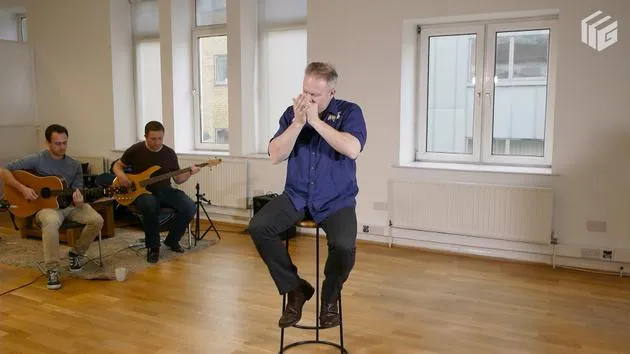
01. Blues spielen, eine Demonstration
Gratis-Lektion2:14
02. Wiederholung der G-Blues-Tonleiter
2:31
03. Noten-Bending für zusätzliche Töne
9:12
04. Einfaches 12-bar Solo
3:50
05. Solieren mit dem Grundton der Akkorde einer Blues-Progression
5:57
06. Vibrato
6:37
07. Interessantere Soli entwickeln
Du bist hier7:43
08. Fortgeschrittenes Tongue Blocking
10:22
09. Blues-Tonleitern in der ersten Lage
5:48
10. Blues-Tonleitern in dritter Position
6:22
11. BONUS: Lerne, Ian Durys "Sex & Drugs & Rock & Roll" auf der Blues-Mundharmonika zu spielen
Gratis-Lektion3:36
Transkript der Lektion
Developing Interesting Solos: A Lesson with Matt
Hello, I'm Matt, and this lesson is hopefully going to help you:
- Develop interesting solos
- Add some drama to your solos
- Give your solos a narrative arc
Riff Repetition
So, what can we do? One effective approach to constructing a solo that adds a bit of spice and drama is to find a little riff and repeat it.
- Sometimes, you can repeat it to the point where people think you're going to overdo it.
- Then, transition into a big fiery note; this can create a strong apex for your solo.
Most good riffs involve draw notes and possibly bends as well. For instance, you might start fairly simply, something like this, and then begin to develop a riff. It's not the only way to create a solo, but it does work.
Structuring Your Solos
You're not going to use this method for every solo, hopefully, as you want to experiment with different approaches. However, this is one rewarding method of playing.
Often, the apex of the solo comes around bar number nine, where you have the big lift. Not always, but it's one way of doing things.
Exploring Different Riffs
- There are lots of different riffs out there.
- You can be as simple or as busy as you like.
Consider starting from the bottom of the harmonic scale. This could be tricky in a jam situation, but if you know how many solos you're expected to play, you can structure them based on that length of time:
- If you're playing only one 12-bar solo, then you'll want to showcase as much as possible.
- If you're getting two or three, think about structuring your solos to avoid using all your best stuff in the first 12 bars.
This can involve keeping some ideas in reserve if you have multiple solos in a row.
Playing Through the Turnaround
If you're playing two 12-bar solos (or maybe three), you can:
- Stop and start the next solo, or
- Play through the turnaround, which can be quite effective.
As I said, there's not just one approach to constructing a solo; there are many, and you can adjust based on your preferences.
The Importance of Simplicity
Being fast and busy doesn't necessarily make a solo better. You can say a lot with very few notes. Things like tone and vibrato can help to enhance your sound significantly.
Many blues harp solos from the 40s, 50s, and 60s often didn't stray above hole number four. They managed to create diverse-sounding solos using just those four holes.
Quick Demonstration
As a quick demonstration, I'll illustrate what you can do with the first four holes. Let me think...
And that's just two possibilities out of thousands of permutations you can create using those holes!
Exercise Recommendation
To practice after this lesson, you might consider restricting yourself to the first four holes on your harmonica. You could even physically tape over holes five through ten! Try to create something using just:
- 1, 2, 3, 4 draw notes
- Blow notes: 3 blow (same as 2 draw) and 4 blow for variety
- Be cautious with 1 blow (don't linger) and stay away from 2 blow, as it's the weakest of the bunch.
With bends in 1, 2, 3, and 4 draw, you have quite a few notes to work with. By limiting yourself to these four holes, you may discover new ideas and sounds that emerge from this exercise.
Happy playing!
11 Lektionen
1 Std. 4 Min. strukturierte Videolektionen
Erweiterte Videofunktionen
Verlangsamen, Passagen loopen, mitlesen
Handy, Tablet & Desktop
Üben, wo du willst
100 % Zufriedenheitsgarantie
30 Tage Geld-zurück-Garantie
Lern deinen Guru kennen
Lern deinen Guru kennen
Mat Walklate ist ein in Manchester ansässiger Mundharmonikaspieler und Lehrer, der im Blues und Folk zu Hause ist und außerdem Flöte, Whistle und Uilleann Pipes spielt und singt. Er gewann 1992 die British Blues Harmonica Championship und 1993 das All-Britain Fleadh Cheoil an der Mundharmonika und ist ein von Seydel unterstützter Künstler.
In einer dreißigjährigen Laufbahn ist er mit Bands wie The Moochers und der Irish-Music-Gruppe The House Devils durch Europa getourt, hat zwischen 2001 und 2021 rund vierzehn Alben aufgenommen und gemischt – darunter Sea of Blues und Traditional Harmonica – und tritt heute im Duo mit dem Sänger und Gitarristen Alex Haynes sowie an der Seite des Blues-Gelehrten Dr Tom Attah auf. Er unterrichtet Mundharmonika am Leeds Conservatoire und privat.
Auf MusicGurus führen dich seine Kurse von deinen ersten Tönen auf einer C-Mundharmonika – Ansatz, die Cross-Harp-Position, Bending und deine erste Improvisation – bis hin zu flüssigem Blues-Spiel, mit Vibrato, alternativen Positionen und der Phrasierung, die ein Solo zum Singen bringt.







