



Quartal Harmony Blues Scale

With
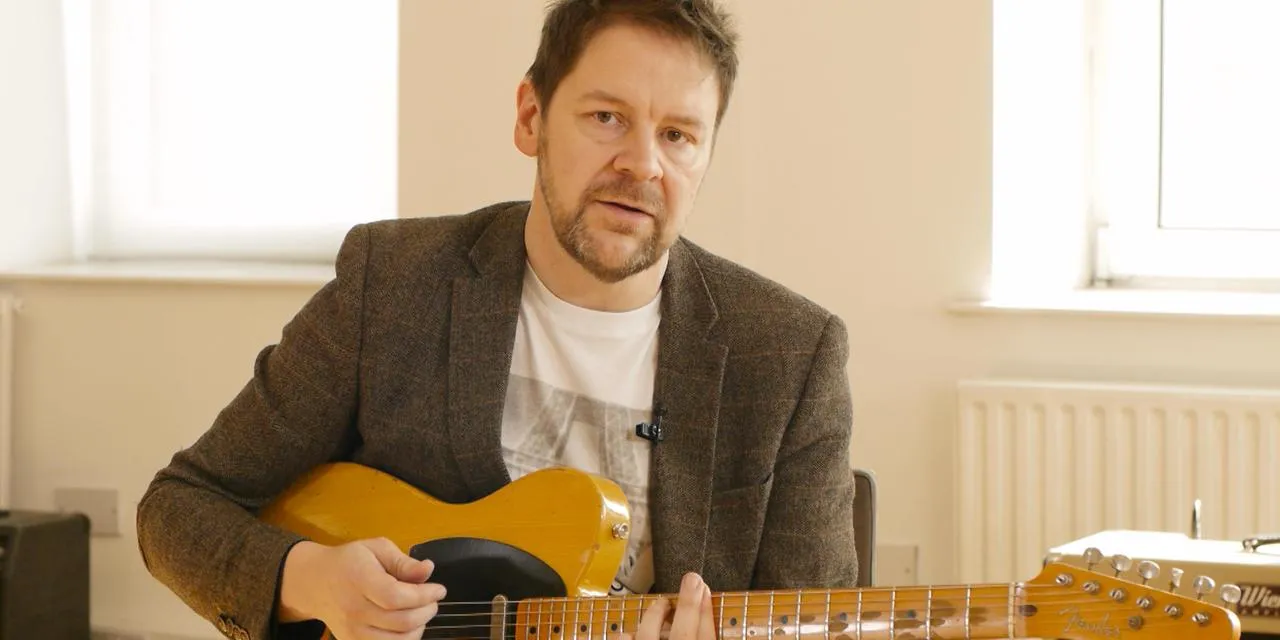
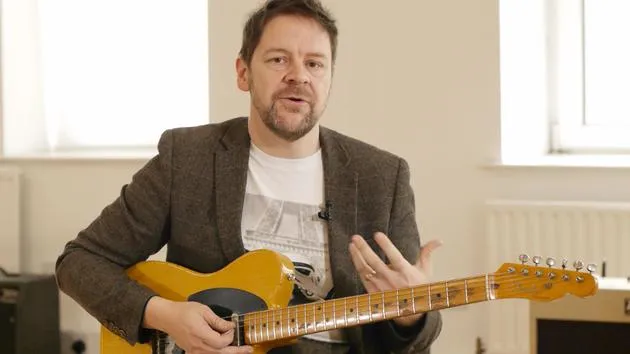
Ron SayerRon Sayer shows how to stack fourths into quartal chords for a fusion-flavoured sound you can drop into a slow blues or funk groove.
What's in the course
12 lessons (1h 27m) · 2 free
01. ‘Welcome To The Course’ Jam
Free lesson2:21

02. Using Arpeggios In Your Blues
Free lesson8:23

03. Half Tone/Whole Scales In Your Blues
8:49
04. Diminished 7th Arpeggios In Your Blues
10:14

05. More Diminished 7th Arpeggios
10:32

06. Sliding 9th To 6th Chords In Your Blues
8:16

07. Quartal Harmony Blues Scale
You are here4:46

08. 9th Chord Blues Scale
3:24

09. Minor 7th & Quartal Chords In Your Blues
4:36

10. Major 7th Arpeggios in your Minor Blues
12:48

11. Altered Scales In Your Minor Blues
9:56

12. BONUS LESSON: Santana - Black Magic Woman
3:16
Lesson transcript
Understanding Chordal Harmony
Okay, we're going to look at something called chordal harmony. This posh name essentially refers to a chord that's created by stacking lots of fourths in a row. So, fourth, fourth, fourth, fourth creates our chordal harmony chord.
Why Use Chordal Harmony?
I really like this idea. It's nice to throw in to something like a slow blues or something funky, just to give things a bit of a fusion-esque sound. It's quite reminiscent of Robin Ford's style.
However, it was a guitarist named Greg Cork who actually showed me this nice little lick, so thanks Greg for that!
The Chord Structure
Finding the Chord
We're going to start with the following notes:
- F#
- B
- E
- A
This forms our chord, using A as the root note.
Concentration on Root Notes
What you need to concentrate on is that these notes move from the root note, allowing you to monitor where you're at.
- D ? 4th fret
- G ? 4th fret
- B ? 5th fret
- A ? 5th fret
This forms a nice chord, but take that top note, A. That's the note you need to keep an eye on.
Blending with the Blues Scale
Now, what you're going to do is play a pentatonic scale or a blues scale on your E string. It's up to you. I'm going to play a blues scale because I think it sounds much nicer.
Incorporating the Chord
You're going to include all the other parts of that chord while you play it. So, you're going to play your blues scale and then combine it with the chord:
- Play up to the top of the blues scale.
- Use the chord alongside it.
Once more, here's our pentatonic scale up the E string, combined with our chordal harmony style chord, played over the blues scale.
Extending the Scale
Obviously, you can carry on if you can reach. That's as far as I'm going to go, but you can also go back down.
Practical Application
So, the entire blues scale is using that chord over it. Now, I'm going to give you an example of the sort of things you can do.
What you're trying to achieve is to play over a blues scale while incorporating an entire chord.
Let's Play
I'm going to get the guys to play me a vamp, and I'll show you what we can do over it.
A 1, 2, 3, 4.
12 lessons
1h 27m of structured video lessons
Advanced video features
Slow down, loop a passage, follow along
Mobile, tablet & desktop
Practise wherever you are
100% satisfaction guarantee
30-day money-back guarantee
Meet your guru
Meet your guru
Ron Sayer is a guitarist's guitarist on the UK blues circuit and a mentor to players including Oli Brown and Sol Philcox. He has been nominated four times at the British Blues Awards - for the album 'Better Side', the single 'Don't Make Me Stay', and his co-writing on Oli Brown's 'Here I Am' - and has won Guitarist of the Year. In his courses he breaks down the phrasing, tone and feel behind electric blues lead playing.







