



Minor 7th & Quartal Chords In Your Blues

With
Ron SayerRon Sayer applies minor 7th and quartal chord voicings over a blues scale for a Robben Ford-flavoured sound that edges toward fusion.
What's in the course
12 lessons (1h 27m) · 2 free
01. ‘Welcome To The Course’ Jam
Free lesson2:21
02. Using Arpeggios In Your Blues
Free lesson8:23

03. Half Tone/Whole Scales In Your Blues
8:49
04. Diminished 7th Arpeggios In Your Blues
10:14
05. More Diminished 7th Arpeggios
10:32
06. Sliding 9th To 6th Chords In Your Blues
8:16

07. Quartal Harmony Blues Scale
4:46
08. 9th Chord Blues Scale
3:24

09. Minor 7th & Quartal Chords In Your Blues
You are here4:36
10. Major 7th Arpeggios in your Minor Blues
12:48

11. Altered Scales In Your Minor Blues
9:56

12. BONUS LESSON: Santana - Black Magic Woman
3:16
Lesson transcript
Lesson: Exploring Quartal Harmony in a Blues Scale
Okay, this next lesson is a follow-on from our quartal harmony chords over a blues scale.
Recap
You may well remember that we played a scale with chord harmony in a blues scale. So what I'm going to do here is just show you something different you can do with that chordal harmony idea.
A Robin Ford Sounding Idea
This concept is very reminiscent of Robin Ford's style. Here's what you will do:
-
Use a Minor Seventh Chord
Move down to the chordal chord and translate that every place you play that particular chord. -
Example
- There's our first place to play it.
- Move up to the next note in the blues scale.
- Go up to the minor seventh, such as a C minor seven chord.
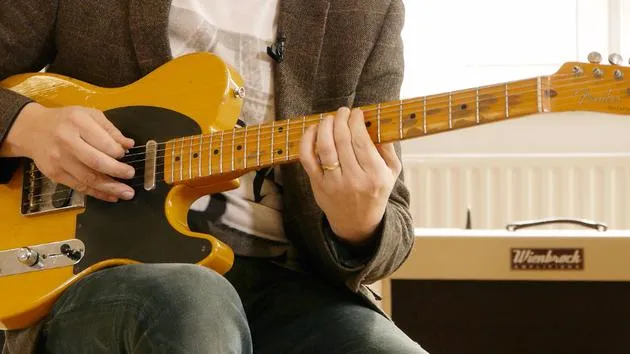
Fingering Technique
Every other place you play it, you can do that by laying your finger across where it's supposed to be in your pentatonic scale. In other words:
- Start on the Fifth Fret
- Move down so your first finger is over the D and G on the fourth fret.
- Use your third finger on the fifth fret for the B and E.
Movement Pattern
- Move it to the 8th fret, then down:
- 7th and 8th fret
- Up to the 10th
- Down to the 9th and 10th
- Up to the Blue Note (11th fret)
- Down to the 10th and 11th
- Up to the 12th
- Then to the 11th and 12th
- Up to the 15th
- And finally, the 14th and 15th
Returning to the Octave
You'll return to where you started, moving down to the third fret, then to the second and third frets.
Combining Techniques
This is something you can throw in along with those chordal chords, and obviously, with your ninth chords as well.
Conclusion
To round it off, have a listen to what you can do and how it sounds over a verma.
Ready, guys?
1, 2, 3, 4, SA.
12 lessons
1h 27m of structured video lessons
Advanced video features
Slow down, loop a passage, follow along
Mobile, tablet & desktop
Practise wherever you are
100% satisfaction guarantee
30-day money-back guarantee
Meet your guru
Meet your guru
Ron Sayer is a guitarist's guitarist on the UK blues circuit and a mentor to players including Oli Brown and Sol Philcox. He has been nominated four times at the British Blues Awards - for the album 'Better Side', the single 'Don't Make Me Stay', and his co-writing on Oli Brown's 'Here I Am' - and has won Guitarist of the Year. In his courses he breaks down the phrasing, tone and feel behind electric blues lead playing.







