



Cool chords

With
Ron SayerRon Sayer shows how to make a standard 12-bar blues more interesting, moving beyond plain G7, D7 and E7 to richer chord choices.
What's in the course
12 lessons (1h 8m) · 1 free
01. Pentatonic And Blues Scale Shapes: A Review
Free lesson6:59
02. A Different Pentatonic Shape!
5:10
03. Adding Flat 5th, Major 6th To The Pentatonic Scale
3:45
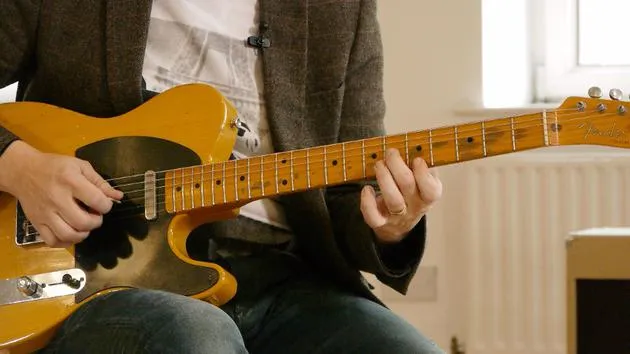
04. Mixing Major & Minor Pentatonics.
4:41
05. The Hybrid Blues Scale
4:26

06. Using double stops
6:35
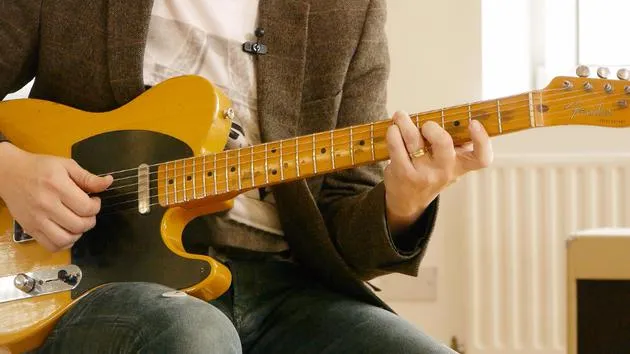
07. Double Stops with passing notes
4:18
08. Ways To Play: 7th Chords
6:26
09. Ways To Play: 9th Chords
4:49
10. Cool chords
You are here10:42
11. Turnaround Variations
5:25
12. BONUS RIFF: Learn how to play Pride & Joy by Stevie Ray Vaughan
5:30
Lesson transcript
Exploring the Twelve-Bar Chord Progression
Hello again! This time, we're going to be looking at the twelve-bar chord progression. We've done a lot of work on:
- Pentatonic scales
- Adding notes to pentatonic scales
- Double stops
- Seventh and ninth chords
Now, I'd like to turn our focus to making your twelve-bar chords more interesting. This will lead into future lessons where you'll be soloing over these chords, helping you understand what you aim to achieve when soloing over the underlying chords.
The Alternate Twelve-Bar Progression
Let's start with an alternate twelve-bar progression. I'll play through what I would call an "interesting" twelve-bar progression, rather than sticking to just G7, D7, and E7.
Listen and Explore
- I'll play through the whole progression to give you a sense of it:
- Count-in: 1, 2, 3, 4.
Here's the full twelve-bar with some cool chords tucked away:
Now, let's break it down, bar by bar.
Chord Breakdown
Bar 1: A9
- Start with an A9 chord (from our previous lesson on ninth chords).
Bar 2: D9 to D13
- Move to a D9 chord.
- Halfway through, switch to a D13 chord by placing your little finger on the seventh fret of the E string.
Bar 3: A9
- Return to A9 for the entire bar.
Bar 4: E minor 9 to A7 augmented
- Transition to an E minor 9 chord.
- Halfway through, change to an A augmented seventh chord (an A7 with a sharp five).
Bar 5: D9 to D13
- Play a D9 chord, transitioning to D13 halfway through.
Bar 6: D# diminished 7
- Then shift to a D# diminished seventh chord.
Bars 7-9: Bm7 to C#min7 to Cmin7
- Proceed with A7,
- Followed by B minor 7,
- C# minor 7,
- C minor 7,
- B minor 7.
Bar 10: F9
- Play F9 with a C in the bass.
Bar 11: E7#9(b13)
- Move to an E7 sharp 9 flat 13 chord.
- This is similar to the classic Hendrix chord.
Turnaround: Bars 12-13
- Wrap up with:
- A7
- C9
- B minor 11
- B flat 7 flat 5.
All of these chords may sound complex, but they're documented in the accompanying PDF for reference.
Playthrough with Explanation
Here's the recap of the chords:
- Bars: A9, D9 (change to D13), A9, E minor 9, A7 augmented, D9, D13, D# diminished 7, A7, B minor 7, C# minor 7, C minor 7, B minor 7, F9 (C in the bass), E7#9(b13), A7, C9, B minor 11, B flat 7 flat 5.
This makes the twelve-bar progression definitely more interesting to play and hopefully to listen to as well.
Additional Techniques
Experimenting in Bar 6
- When you reach the D# diminished seventh:
- You can move your diminished seventh chord up and down the diminished seventh arpeggio, which consists of minor thirds.
- For example:
- Starting on the A string 6th fret, you can move:
- Down to the third fret,
- Up to the ninth fret,
- And then up to the twelfth fret.
- Starting on the A string 6th fret, you can move:
Minor Seventh Chord Run
- After the D# diminished seventh, notice the run from:
- B minor 7 to C# minor 7 to C minor 7.
- You can enhance these chords by adding sevenths:
- For example, add your little finger on B for the minor 13th chord or change to the ninth on the E string for a minor 9th chord.
F9 Variations
- With the F9 chord:
- You can switch between the root note (F) and C in the bass.
Conclusion
Hopefully, this gives you plenty to work with in terms of chord changes. Practice the progression with these variations in mind! In the next lesson, we'll focus on the last two bars of the turnaround and explore more interesting ideas to enhance your play.
12 lessons
1h 8m of structured video lessons
Advanced video features
Slow down, loop a passage, follow along
Mobile, tablet & desktop
Practise wherever you are
100% satisfaction guarantee
30-day money-back guarantee
Meet your guru
Meet your guru
Ron Sayer is a guitarist's guitarist on the UK blues circuit and a mentor to players including Oli Brown and Sol Philcox. He has been nominated four times at the British Blues Awards - for the album 'Better Side', the single 'Don't Make Me Stay', and his co-writing on Oli Brown's 'Here I Am' - and has won Guitarist of the Year. In his courses he breaks down the phrasing, tone and feel behind electric blues lead playing.







