



Mixing Major & Minor Pentatonics.

With
Ron SayerRon Sayer shows how to blend major and minor pentatonics over a 12-bar blues by switching to the relative minor shape, like F# minor over an A chord.
What's in the course
12 lessons (1h 8m) · 1 free
01. Pentatonic And Blues Scale Shapes: A Review
Free lesson6:59

02. A Different Pentatonic Shape!
5:10
03. Adding Flat 5th, Major 6th To The Pentatonic Scale
3:45
04. Mixing Major & Minor Pentatonics.
You are here4:41
05. The Hybrid Blues Scale
4:26

06. Using double stops
6:35
07. Double Stops with passing notes
4:18

08. Ways To Play: 7th Chords
6:26

09. Ways To Play: 9th Chords
4:49

10. Cool chords
10:42

11. Turnaround Variations
5:25

12. BONUS RIFF: Learn how to play Pride & Joy by Stevie Ray Vaughan
5:30
Lesson transcript
Major Pentatonics Over a Blues Scale
Hello again! Hopefully, you got on okay with that last little section.
Introduction to Major Pentatonics
What I want to look at now is something that sounds quite nice: using major pentatonics over a blues scale.
The Approach
So, how do I approach this? The easiest way to think about it is:
- Instead of using your major pentatonic scale, I think it's a good idea to drop down and use the minor pentatonic in the relative minor scale.
Practical Exercise
Here's what I want you to do:
- Over the A in your 12-bar progression, drop down to F# and use A minor pentatonic.
Trust me, it works!
Essentially, when you have the I chord (A chord) in the progression, you can use F# minor pentatonic. Let your ears guide you with this because:
- Some notes won't work as well.
- If you try to center around F#, it's not going to work; it needs to be centered around A.
Minor Pentatonic Overview
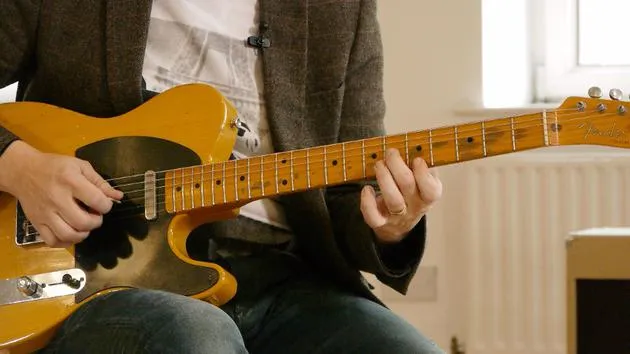
I'll just run through the minor pentatonic scale anyway, in case you're not quite sure of it. It starts on the second fret.
Example:
Tom, could you just play me an A? Strum an A chord for me and I'll just play that over so you can hear how this scale sounds over the top of an A.
Exercise with F# Minor Pentatonic
So here's how it sounds with a major pentatonic.
When you do your 12-bar this time, I want you to concentrate on using that F# minor pentatonic, experimenting with it over chord I (the A chord). However, when you get to:
- Chord IV (D chord)
- Chord V (E chord)
As we've discussed, I want you to drop back to using minor pentatonics again.
Jumping Between Scales
Now, it may feel like you're just jumping up and down from the second fret to the fifth fret, but that's fine. Initially, you want it to feel like you're jumping back and forth, as this helps you to develop your ear.
Note: Your ears are incredibly important in playing over changes, so make sure you're aware. You'll know quickly if you're playing over the wrong chord.
Demonstration
I just want to demonstrate that. We're going to do a little shuffle to show you what it's like to move backwards and forwards between major pentatonic (A) and minor pentatonic.
Ready? Here we go:
- A, 1, 2, 3...
And again.
- First position: F# minor → A minor
- Back to F# minor → A minor
- Again: back to F#...
Yeah, lovely!
Conclusion
So, that's the concept of playing: shifting between major pentatonic and minor pentatonic scales.
Just remember:
- Major pentatonic over the I chord
- Minor pentatonic over the IV and V chords.
12 lessons
1h 8m of structured video lessons
Advanced video features
Slow down, loop a passage, follow along
Mobile, tablet & desktop
Practise wherever you are
100% satisfaction guarantee
30-day money-back guarantee
Meet your guru
Meet your guru
Ron Sayer is a guitarist's guitarist on the UK blues circuit and a mentor to players including Oli Brown and Sol Philcox. He has been nominated four times at the British Blues Awards - for the album 'Better Side', the single 'Don't Make Me Stay', and his co-writing on Oli Brown's 'Here I Am' - and has won Guitarist of the Year. In his courses he breaks down the phrasing, tone and feel behind electric blues lead playing.







