



Recap so far - Key signatures & Chords
With
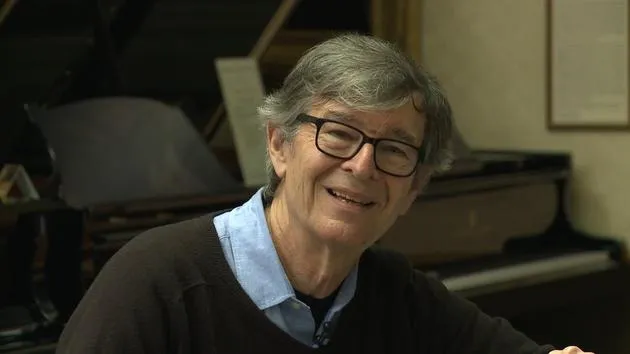
Darius BrubeckDarius summarizes the key concepts learned so far, using a set of downloadable charts for your reference: Cycle of 4ths / 5ths, Chords - Triads & 7ths, and a Chord symbol guide
What's in the course
11 lessons (1h 48m) · 1 free
Lesson transcript
Understanding the Cycle of Fourths and Fifths
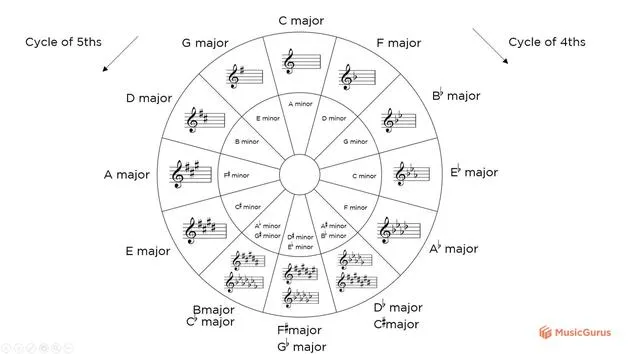
Okay, here's the diagram we've provided for you. It shows the cycle of fourths and fifths.
The Cycle of Fourths
As you move around the cycle of fourths, that is, to the right, you get:
- C
- F
- B flat
- E flat
- A flat
- D flat
- G flat
You're moving in fourths, and with each new key, you add another flat. We will see that in a moment.
The Cycle of Fifths
Going around this diagram in the opposite direction, we have the cycle of fifths where you add sharps. The sequence is:
- C
- G
- D
- A
- E
- B
- F sharp
At each point, for instance, G has one sharp, then D has two sharps, and so on.
The Same Pitch
When we get to F sharp (or G flat), those are actually just two words for the same key on the piano, meaning the same pitch.
Key Signatures
This chart shows you the actual key signatures. You can see that every key maintains a constant relationship between its tonic note and all of the intervals in the key by adding flats and sharps.
Triads and Roman Numeral Notation
Here is a chart in three keys of triads. Underneath each triad is a Roman numeral. This notation describes chords in relation to the scale degree on which they are built:
- Small letters indicate minor
- Capital letters indicate major
Key of C Triads
The first line in the key of C goes:
- I (1)
- ii (2)
- iii (3)
- IV (4)
- V (5)
- vi (6)
- vii° (7)
And then it circles back to I again, allowing you to see which ones are major and minor.
To reinforce the concept of transposition, I've also provided it in F with one flat, and G with one sharp.
Triadic Intervals
Here's the same thing again, but with an added seventh:
- The triadic intervals are: 1, 3, 5.
- By skipping to the next odd number, we include 7.
Once again, this is presented in three keys, and you would really do well to practice this in every key. If you have a keyboard, this will really increase your facility faster than almost anything I can think of concerning being able to grab chords.
Chord Symbol Guide
Here is the chord symbol guide. There are even more ways of representing chords, but you can see:
- Simple abbreviations like major and minor
- Graphic signs like the circle, the circle with a line through it, and the plus triangle
These are all attempts to represent chords in the most compact way possible, so that it's easy to put them onto lead sheets.
Practical Advice
This material is pretty self-explanatory; however, it might be a good idea for you to print it out. Keep it to one side in case you're reading through some music that contains some of these symbols. This way, you'll become familiar with them and be able to refer to this guide easily.
11 lessons
1h 48m of structured video lessons
Advanced video features
Slow down, loop a passage, follow along
Mobile, tablet & desktop
Practise wherever you are
100% satisfaction guarantee
30-day money-back guarantee
Meet your guru
Meet your guru
Darius Brubeck is a noted jazz pianist and educator. He has released numerous albums as a leader, toured internationally with his own groups, and collaborated with his brothers on Brubecks Play Brubeck.
Darius has served as a Fulbright visiting professor in Romania and Turkey. He initiated the first degree course in jazz offered by an African university, at the University of KwaZulu-Natal in South Africa, where he taught until 2005.
Darius often collaborates with Mike Rossi, saxophonist and Professor of Music at the University of Cape Town. Mike's achievements include numerous recordings and international stage appearances as leader, soloist, and sideman with Tony Bennett, Dave Liebman, Winston Mankunku Ngozi, George Russell, Clark Terry and Alessio Menconi, among others.
With Darius as your guide, you'll get straight to the "good stuff". In Harmony 101 he demystifies jazz harmony so you can start putting it to use fast, and in Mastering Odd Times he breaks down how to play and improvise confidently in unusual time signatures.







