



Chords - Triads and 7ths

With
Darius BrubeckDarius Brubeck explains how triads and 7th chords are built, using his parents' tune 'Summer Song' in F major to bring it to life.
What's in the course
11 lessons (1h 48m) · 1 free
Lesson transcript
Music Lesson: Understanding Chords in F Major
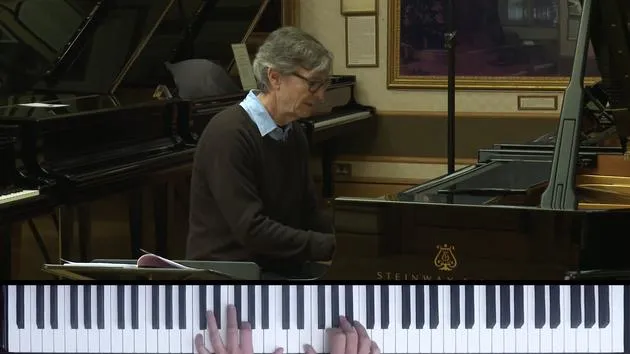
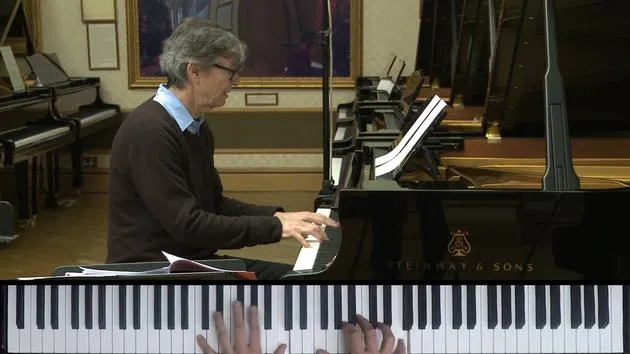
In this lesson, I'll be using a song that my parents, Dave and Iola Brubeck, wrote together called Summer Song. This song will illustrate some of the concepts we'll be discussing throughout the course.
Key Signature
- Key: F major (1 flat)
I chose this particular song not only because I like it, but also because it is very diatonic. It primarily uses notes from the F major scale.
Harmony and Melody
As we move through this piece, you may find it surprising how many ways the melody can be harmonized while maintaining the integrity of the scale.
Chords Built on Scale Degrees
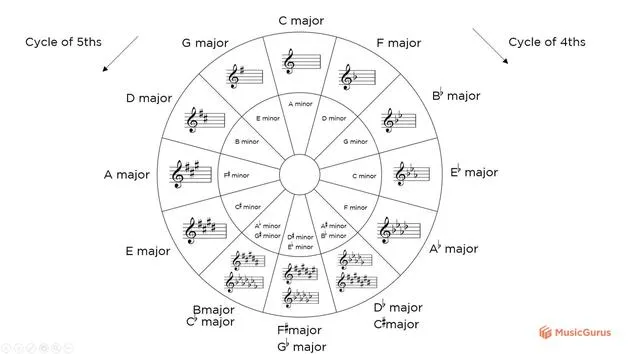
Starting from scales, we can derive chords built on each degree of the scale. For visual clarity, I will switch back to the key of C to demonstrate all of the triads.
- Notation: These chords will be denoted as Roman numerals, which refer to scale degrees and, later on, chord functions.
Triads:
- 1: Tonic chord (I) - 1, 3, 5
- When I say 1, 3, 5, I'm referring to intervals.
For example:
- If my thumb's on F:
- F is 1
- A is 3
- C is 5
This describes the distance between the root and the top note of the chord.
Four Note Chords
To further enrich our harmony, we can make four-note chords:
- 1, 3, 5, 7
By adding an additional interval, we step into the realm of richer contemporary harmony.
Different Qualities of Chords
- I (1): Major seventh
- II (2): Minor seventh (minor triad + flat seventh)
- III (3): Minor seventh
- IV (4): Major seventh
You'll notice that the sounds of these chords are quite similar.
The V Chord
The V chord is distinct:
- It has an interval that is referred to as an augmented fourth or diminished fifth.
The important thing about the V chord is its strong tendency to resolve. Historically, it was referred to in medieval times as the diabolus in musica, or the devil's interval, due to its inherent instability.
Additional Chords
- VI (6): Minor seventh
- VII (7): Diminished fifth and sometimes called a half-diminished chord (minor 7 flat 5).
Lastly, the augmented chord is the only one I've left out. In the major scale, the fifth is extended by a half step.
Summary of Chords in Major Scale
- Primary Triads (I, IV, V):
- I and IV are major.
- V has a flat seventh, referred to as a dominant seventh. This chord has a unique function.
Final Thoughts
This concludes our discussion on chords, scales, and keys. Don't be fooled; we will soon delve into much more advanced harmony. However, mastering these foundational concepts is essential.
Challenge
I encourage you to challenge yourself by playing all of the seventh chords based on scale tones across 12 keys on a keyboard. You may find it quite difficult, but it's a worthwhile exercise that will help you gain mastery over how chords function in every key.
11 lessons
1h 48m of structured video lessons
Advanced video features
Slow down, loop a passage, follow along
Mobile, tablet & desktop
Practise wherever you are
100% satisfaction guarantee
30-day money-back guarantee
Meet your guru
Meet your guru
Darius Brubeck is a noted jazz pianist and educator. He has released numerous albums as a leader, toured internationally with his own groups, and collaborated with his brothers on Brubecks Play Brubeck.
Darius has served as a Fulbright visiting professor in Romania and Turkey. He initiated the first degree course in jazz offered by an African university, at the University of KwaZulu-Natal in South Africa, where he taught until 2005.
Darius often collaborates with Mike Rossi, saxophonist and Professor of Music at the University of Cape Town. Mike's achievements include numerous recordings and international stage appearances as leader, soloist, and sideman with Tony Bennett, Dave Liebman, Winston Mankunku Ngozi, George Russell, Clark Terry and Alessio Menconi, among others.
With Darius as your guide, you'll get straight to the "good stuff". In Harmony 101 he demystifies jazz harmony so you can start putting it to use fast, and in Mastering Odd Times he breaks down how to play and improvise confidently in unusual time signatures.







