



Greensleeves (lesson)
With
Laurence Juber
What's in the course
16 lessons (1h 6m) · 1 free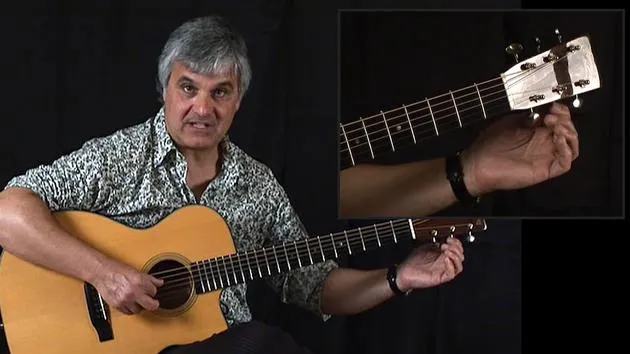
01. A few comments on tuning & theory
Free lesson6:11
02. Amazing Grace (lesson)
10:51
03. Amazing Grace (performance)
1:19
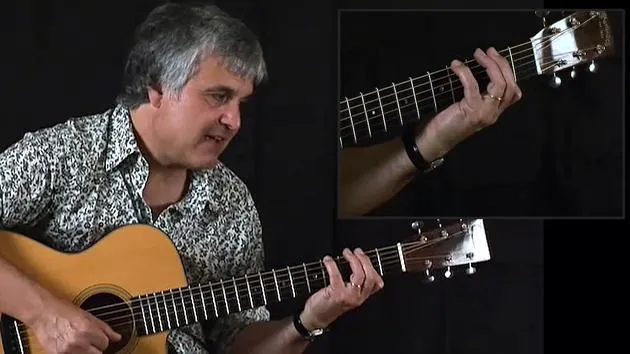
04. Greensleeves (lesson)
You are here8:36
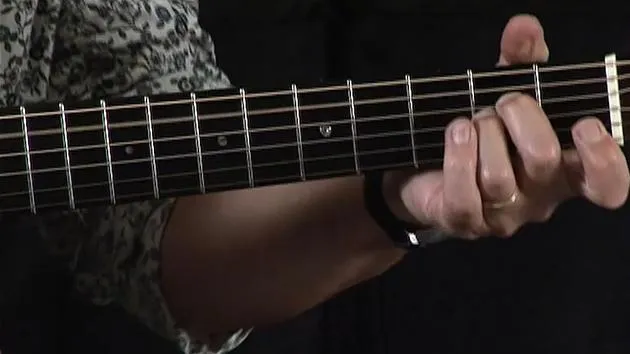
05. Greensleeves (performance)
1:12
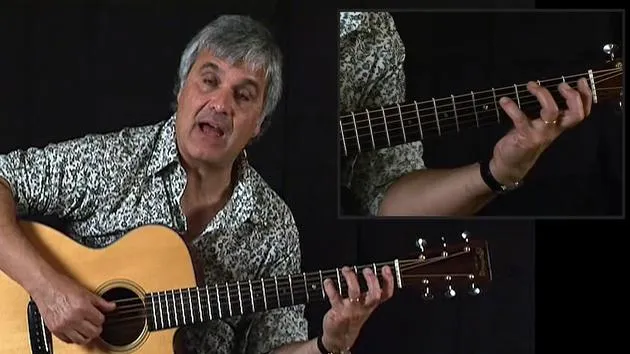
06. Shebeg & Shemore (lesson)
6:53
07. Shebeg & Shemore (performance)
1:54
08. Wayfaring Stranger (lesson)
7:35
09. Wayfaring Stranger (performance)
2:36
10. Shenandoah (lesson)
5:34
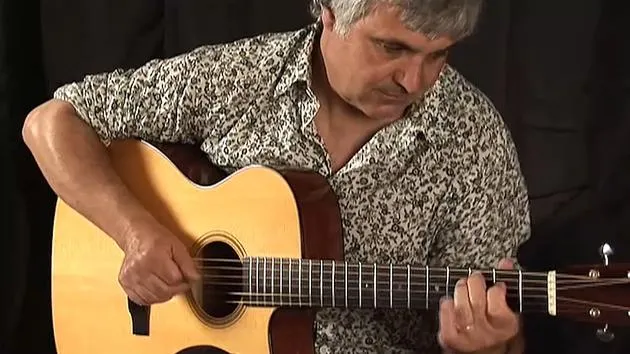
11. Shenandoah (performance)
1:55
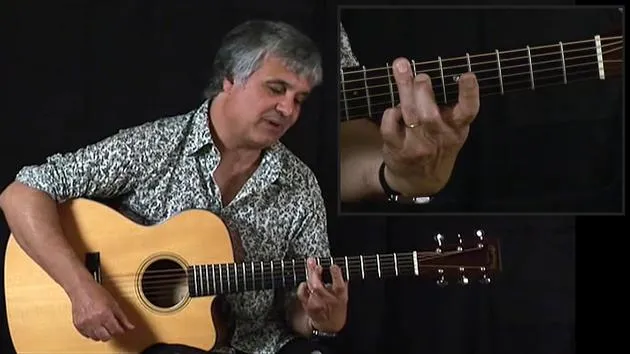
12. When The Saints Go Marching In (lesson)
3:47
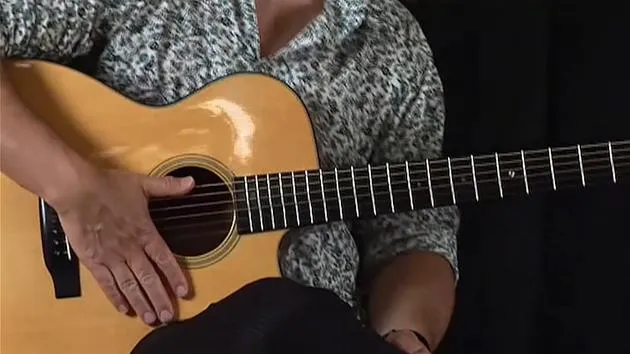
13. When The Saints Go Marching In (performance)
0:43
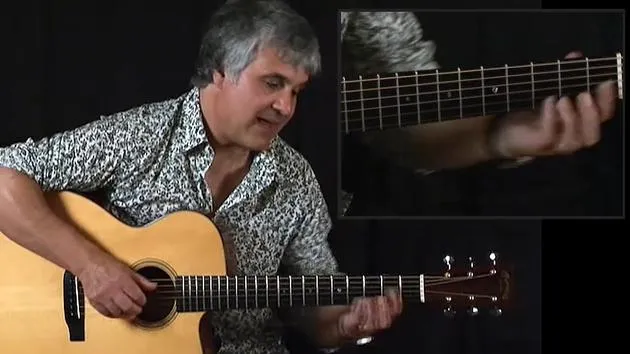
14. Take Me Out To The Ballgame (lesson)
4:14
15. Take Me Out To The Ballgame (performance)
1:26
16. A few notes on the key of D Minor & sign-off
1:40
Lesson transcript
Exploring DADGAD Tuning: Chord Zones and Voicings
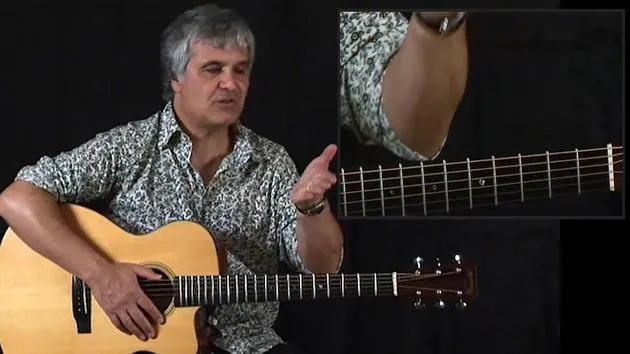
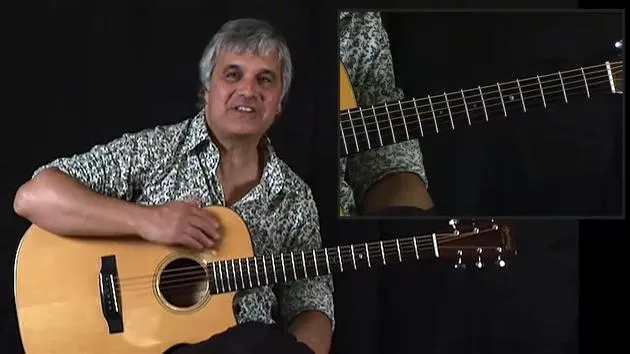
So we've explored the key of D in DADGAD. But DADGAD lends itself really to multiple keys, not just the key of D. What I'd like to do is take us through and just kind of get acquainted with some of the chord zones.
Chord Shapes
I hesitate to refer to just regular chord shapes, although there are movable chord shapes in DADGAD. For example, let's say:
- Let's take F.
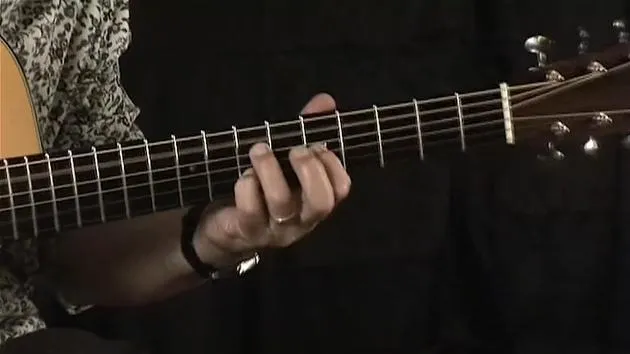
- This F shape is a closed shape.
- You can move it up and down the fingerboard: F sharp, G, G sharp, A, et cetera.
Here's the E of that. If you analyze it, you'll see that the second string and the sixth string are just two frets higher than what in standard tuning would basically be your conventional E shape. But now I have an open D on top, which makes for an E seventh chord.
Voicings
If I move it up to the F shape, I could make that an F6 chord. But the beauty of DADGAD is that because of these adjacent scale tones, which really allow all kinds of relationships to emerge.
Example Voicings:
- I could take that F chord and voice it like this:
- With the open A string, the open second string, and the open third string, creating a very sweet sounding voicing.
- When I take that G shape, I could refinger that and again add an open string.
- In this case the A string, which is the second.
Unique Fingering
I could take the B flat, for example, which is at the eighth fret. Instead of fingering the D on the seventh fret of the third string, I can make the top string open, that D, and then add the G third string open. This gives me a very cool and interesting sound and texture if I do a simple picking pattern with it.
Exploring Chords
Those are just a few examples of the kinds of power that you can find within DADGAD. For instance, I might take a C chord like this with a D on top:
- It's a C with an added two.
- If I lift off that finger, I have an open G string.
This gives me a lot of flexibility with all these chordal tones. If I just do this, I'm back to my D tonality: E, F, G, B flat, C. And that's just one set of fingerings.
A Chord Zone
You go to the A where you would normally play, like the A shapes, the A zone. Now, you have an open A string, which gives you a lot of flexibility, too. Also, be aware in DADGAD that very often in any one position, you can play the same thing but with two different fingerings.
- For example, I could do this, or I could do that kind of thing.
- I have these two adjacent scale tones: a C here, and a C here.
Tonality Differences
I'll show you the difference again.
- There's the C on the second string.
- There's the C on the third string.
Each one has a slightly different tonality to it. An F chord like this could be fingered like this with a very different kind of sonority. Now, I have the third of the chord as an open string, which sounds more like a string section when I play it this way, as opposed to the more traditional guitar-like sound.
Demonstrating with "Greensleeves"
If you're familiar with my Volume 1 DVD, I did an arrangement of "Greensleeves" on there, which was designed to demonstrate some of the interesting things about minor tunings. I'm going to tackle the same tune, but this time in DADGAD.
- In that DVD, it was in standard tuning.
Melody Playing
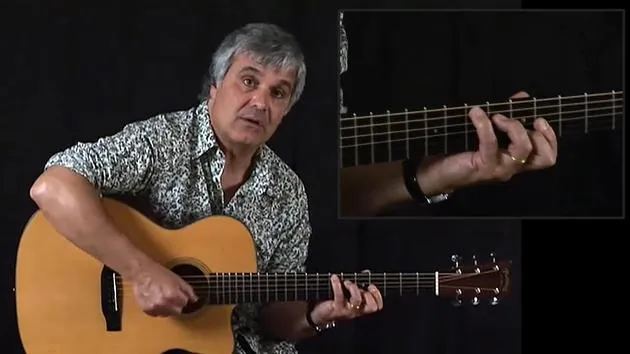
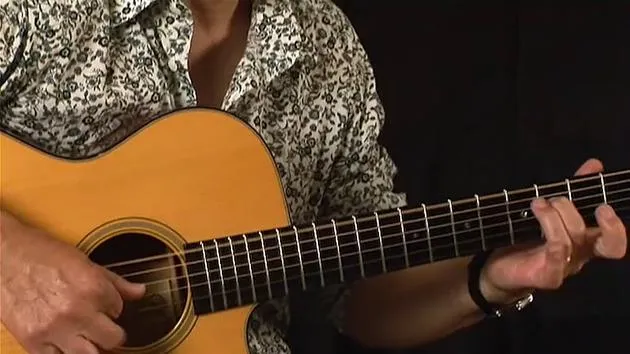
What I'm doing here is using this A minor shape, which is the DADGAD equivalent of the familiar cowboy A minor that you would normally play.
- I'm going to play the melody.
- Now I'm going to go to a G and back to the A minor:
- Now here.
- Now I'm using the open A, no third in the chord, which gives it that Renaissance, medieval sound.
Now I go to the E shape that I showed you. Then to A minor. Now this time, instead of staying on the A minor, I'm going to move to the D.
- Instead of featuring the F natural, I'll make it an F sharp.
- This becomes a D ninth chord.
Progression and Texture
There's a G. There's an E minor.
- Here's an F, and you'll notice that F shape, how nicely that lends itself to a melodic progression:
- C, B, A.
- I've got the F base note, plus I have an F and a G ringing together for a nice color.
Then, moving into the next section, I have a little walk down. Now look at the stretch.
Stretching Techniques
REM: It's easier if you play the top note and then stretch back rather than play the lower note and then stretch up to the top note. That's just the way that your muscles work, and that's how you can more efficiently do those kinds of stretches.
I have a little moving bass line here that kind of pre-echoes the melody.
Final Touches
- I'm also moving a moving bass line on the G chord.
- A minor is also moving.
Here's a little trick: I could do this, but I'm kind of choosing to do something that has an interesting sonority on an F.
Now I'm changing the way I'm approaching the C by doing more of a climax.
- So I have a C,
- Now I have a C over a D, an E, D, and an A.
So it's really like a D 11th chord. But Henry VIII never thought of that one, did he, when he wrote?
Now I'm getting a little jazzy here. I'm going to do a G add 9, an F sharp minor 7th, but with the added 4th to an E minor, A minor, and then E minor D E over B A to finish things up.
You'll see that even there at the ending, I'm playing with the melodic minor, the flattened seventh, the minor seventh versus the major seventh, an E natural versus a G, sorry, a G natural versus a G sharp on the E chord.
Conclusion
So let me play this tune from the top. This is "Greensleeves" in DADGAD tuning.
16 lessons
1h 6m of structured video lessons
Advanced video features
Slow down, loop a passage, follow along
Mobile, tablet & desktop
Practise wherever you are
100% satisfaction guarantee
30-day money-back guarantee
Meet your guru
Meet your guru
Laurence Juber first became known as lead guitarist in Paul McCartney's band Wings. Since then he has built a career as a fingerstyle guitarist, composer and arranger, working largely in the DADGAD tuning that earned him the nickname 'the Duke of DADGAD'.
He has been voted Guitarist of the Year by readers of Fingerstyle Guitar Magazine and named among the top guitarists by Acoustic Guitar magazine, alongside a long list of solo albums and worldwide touring.
In his courses he teaches his fingerstyle technique and the DADGAD tuning he's known for, how to arrange melody, harmony and bass together for solo guitar, and the pieces - like his signature 'Wooden Horses' - that bring it all together.







